

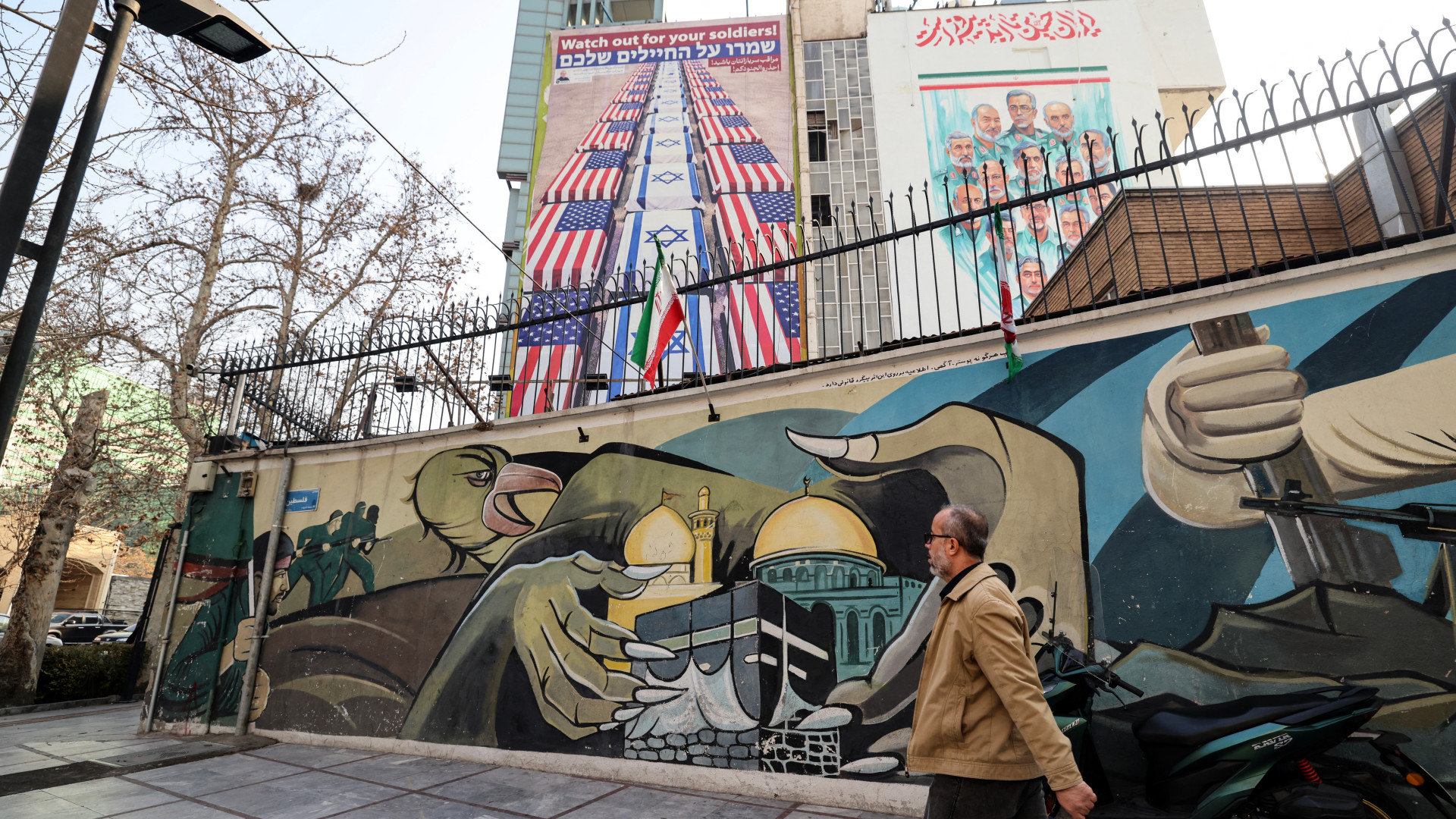
The world has been bracing for a potential US strike on Iran since the Trump administration issued a series of threats and deployed an “armada” consisting of dozens of aircraft, 12 warships and the USS Abraham Lincoln aircraft carrier to the region.
After protests in Iran that began late last year spread across the country, US President Donald Trump urged demonstrators to “keep protesting” and “take over” state institutions, promising that “help is on its way” while warning of US military action.
This escalation followed the brazen abduction of Venezuelan President Nicolas Maduro and his wife over the new year, and declarations that the US would “run” the country and seize control of its oil.
Despite repeated claims of being a “peacemaker”, Trump has pursued an increasingly belligerent US foreign policy, from bombing Iranian nuclear facilities last June to supporting the Zionist regime’s dangerous policy of regime change in Iran, including the killing of more than a dozen Iranian nuclear scientists. He has also declared US ownership of Gaza and vowed to take over Greenland “one way or another”, making an enemy of even western allies.
Accompanying Trump’s threats has been a familiar mobilisation of media outlets and policy think tanks that lay the groundwork for intervention, producing a steady stream of analysis intended to normalise US military violence.
New MEE newsletter: Jerusalem Dispatch
Sign up to get the latest insights and analysis on
Israel-Palestine, alongside Turkey Unpacked and other MEE newsletters
For decades, western powers have presented themselves as neutral observers predicting the imminent collapse of governments in the Global South while actively working to overthrow them.
Whether it was Iran and Guatemala in the 1950s, Chile in 1973 or Iraq in 2003, they used the same predictable language, claiming with certainty that the regime is rotting and on the verge of collapse.
Today, this rhetoric is once again being deployed in the lead-up to potential US and Israeli strikes on Iran, with mainstream outlets following the same playbook. These arguments claim that the government lacks legitimacy and popular support, while denying the documented role of outside forces in fomenting violence and instability.
Media and policy discourse operate as one pillar of a wider regime-change strategy targeting Iran, functioning as a propaganda war alongside economic warfare
They ignore the role of coercive measures such as economic strangulation and covert operations, while advocating military strikes and regime change as responses to a supposedly dying system.
An essay in the January 2026 edition of Foreign Affairs, long regarded as a bellwether of Washington’s foreign policy consensus, continues this strategy. Under the guise of objective analysis, it works to prepare the terrain for the dehumanisation of a society and the eventual dismantling of its government.
It forms part of a broader corpus of political commentary aimed at conditioning western audiences to view regime change as the outcome of internal decay and popular will, rather than the result of sustained external intervention.
Media and policy discourse thus operate as one pillar of a wider regime-change strategy targeting Iran, functioning as a propaganda war alongside economic warfare, internal destabilisation and military escalation.
Even if the US has, for now, refrained from a direct assault, the strategy remains fully in motion – and it cannot be understood in isolation from Iran’s stance on Palestine and its central role within the axis of resistance, which has long brought it into direct confrontation with US and Israeli regional objectives.
A long siege
Since 1979, Washington has pursued a policy of regime change and destabilisation against Iran, including backing Saddam Hussein’s invasion in the 1980s, during which the US provided intelligence and political cover while Iraq used chemical weapons.
The US Navy also shot down Iran Air Flight 655 in 1988, killing 290 civilians. In 1996, Congress passed the Iran-Libya Sanctions Act, deepening Iran’s economic isolation, as many in the West sought to foment ethnic tension and separatism.

Trump’s plan to force Iran to surrender is a fatal error
Read More »
In 2006, Washington escalated multilateral financial warfare, severing Iran from global banking systems. Since 2009, US and Israeli intelligence have deployed cyber sabotage through the Stuxnet virus and the Olympic Games operation, damaging Iran’s Natanz and other nuclear facilities. During the same period, Israel also carried out a campaign of mass assassination targeting Iranian nuclear scientists across the country.
In 2018, the Trump administration withdrew from the Joint Comprehensive Plan of Action (JCPOA), the nuclear deal the US signed with Iran in 2015, despite Iran’s verified compliance, and imposed “maximum pressure” sanctions.
Over the next four years, Iran lost hundreds of billions of dollars in oil revenue and access to global markets. In January 2020, Trump ordered the assassination of General Qassem Soleimani in Baghdad, the architect of Iran’s regional deterrence strategy.
Few states in modern history have endured this level of sustained pressure without collapse. That Iran remains politically intact nearly 50 years after its revolution reflects the strength of its state structures and its resilience in the face of external assault.
It is in this context that the recent unrest in Iran must be understood.
Four pillars
The latest American-Israeli regime-change scheme did not arise spontaneously in response to events on the ground. It was a deliberate strategy formulated in late 2025, following a meeting between Israeli Prime Minister Benjamin Netanyahu and Trump at the latter’s Florida residence.
According to multiple regional and western accounts, the plan rested on four interlocking components: intensified economic warfare aimed at weakening the Iranian currency and exploiting economic grievances; the infiltration of mass demonstrations by trained agitators to provoke violence and security overreaction; a coordinated propaganda drive portraying Iran as ungovernable and regime collapse as inevitable; and a prospective phase of direct foreign intervention by Israel and the US through military strikes against regime and security targets.
The strategy failed before the fourth component was implemented. Iranian authorities arrested thousands of operatives and disrupted external coordination networks, partly by shutting down internet access after reportedly uncovering tens of thousands of Starlink terminals smuggled into the country.
Analysts, including John Mearsheimer, Scott Ritter and Alastair Crooke, noted that Iran’s security institutions had uncovered the scheme, possibly with Russian and Chinese assistance, and neutralised it before it achieved its intended outcome.
The Foreign Affairs essay was one of many interventions advancing a misleading account of the protests in Iran, foregrounding internal dynamics and framing collapse as inevitable while marginalising the role of sustained external pressure.
For weeks, this narrative was used to suggest that any potential US-led intervention would be driven by humanitarian concern for peaceful protesters.
That pretext has now been openly dispensed with.
As the protests have subsided, the US and Israel have moved to articulate their underlying objectives: Iran’s nuclear programme, its ballistic missile capabilities and its support for resistance movements across the region, particularly in Yemen, Lebanon and Palestine.
Follow Middle East Eye’s live coverage of Israel’s genocide in Gaza
Indeed, western engagement with Iran has never been motivated by concern for its people, economic hardship or democracy, especially given that those same governments have imposed sanctions that have decimated the country’s economy and healthcare system.
Iran has long expressed willingness to negotiate limits on nuclear enrichment, maintaining that its programme is for peaceful purposes. For decades, however, Israel has falsely claimed that Iran is on the verge of developing a nuclear weapon. Iran’s ballistic missile programme has meanwhile remained a red line, with Tehran arguing that it has only ever been used defensively, including in response to Israel’s unprovoked attack last June.
The real reason
US and Israeli regime-change efforts are ultimately driven by Iran’s stance on Palestine and its central role within the axis of resistance.
Since the early 1980s, Iran has been the only major state in the region to place Palestinian resistance at the centre of its foreign policy. After Israel’s 1982 invasion of Lebanon, Iran helped form Hezbollah, which forced Israel’s withdrawal from southern Lebanon in May 2000.
US pressure to disarm Hezbollah is pushing Lebanon to the brink
Paul Khalifeh
Read More »
In 2006, Hezbollah defeated Israel in a 33-day war, shattering the myth of Israeli military invincibility. Since the early 1990s, Iran has supported Hamas and Islamic Jihad as the Oslo process sought to marginalise armed resistance. Iran also helped sustain Gaza after Israel imposed a crippling blockade in 2007.
In 2012, Iranian-supplied technology and missiles reached Israeli cities from Gaza for the first time. After October 2023, when Hamas’s attack was followed by a genocidal Israeli war on Gaza, Iran supported a regional deterrence posture through Hezbollah in Lebanon, the Houthis in Yemen and allied militias in Iraq.
Meanwhile, Israel and its principal backer, the US, have sought to reshape the Middle East through attacks on Lebanon, Yemen, Syria and other arenas, targeting both resistance groups and civilian populations.
Iran is not being targeted for the sake of protesters or democracy, but because it obstructs Israel’s regional hegemony. While much of the Arab world has colluded in the marginalisation of the Palestinian struggle, Iran has rejected its permanent erasure.
Misreading Iran
When western observers insist that Iran governs through force and has lost legitimacy, they ignore the political sociology of revolutionary states and their ability to withstand foreign intervention and subversion.
Iran emerged from a mass popular revolution in 1979 that dismantled a monarchy installed through a CIA-backed coup in 1953. It then fought an eight-year war with Iraq, backed by western powers, that killed more than half a million Iranians and targeted civilian infrastructure.
Any genuine change in Iran will come through movements led by its people, not foreign armies or the fantasies of magazine writers
These experiences shaped a political system structured to guard against military coups, infiltration and externally driven regime change.
Predictions of Iran’s collapse surfaced in 1999, 2009, 2017, 2019 and 2022, each time insisting that it was “imminent”. But their miscalculation lies in a persistent failure to grasp how external pressure often backfires and instead brings a nation together in a resolve to maintain its sovereignty.
They further argue that Iran cannot achieve democracy without resorting to coups or external forces. This claim reveals a deeper belief that a democratic Iran that continued to resist Israeli dominance would remain unacceptable to western elites. That is why undemocratic and repressive regimes such as Egypt under Abdel Fattah el-Sisi or Gulf monarchies face no sanctions and no threat of violent regime change.
Any genuine change in Iran will come through movements led by its people, not foreign armies or the fantasies of magazine writers.
The views expressed in this article belong to the author and do not necessarily reflect the editorial policy of Middle East Eye.
