

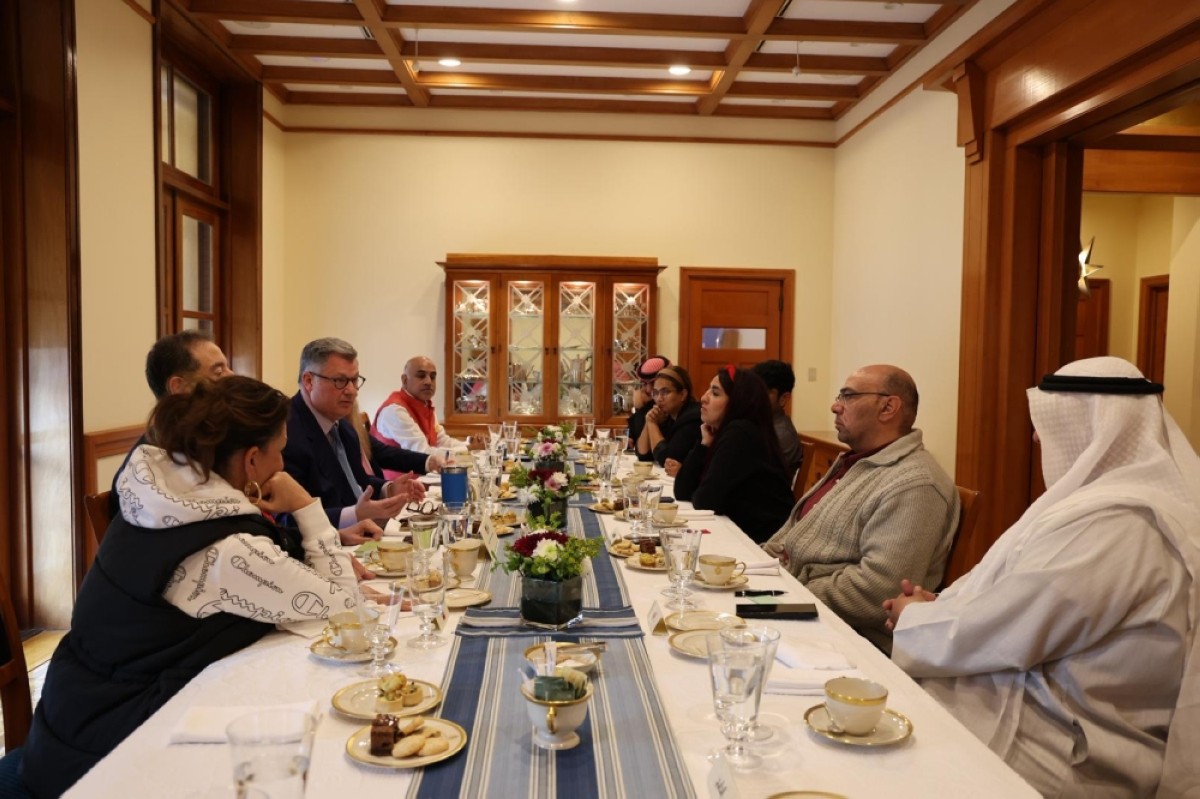
KUWAIT: The Chargé d’Affaires at the US Embassy in Kuwait, Steven Butler, affirmed that the partnership between the United States and Kuwait is not only strong, but also thriving, deep-rooted and durable, forming a cornerstone of security and stability in the region. Speaking at a roundtable held at the embassy on Tuesday, Butler said that relations between the two countries span more than 60 years of friendship and partnership, noting that Kuwait is a trusted ally and that the United States is fully committed to Kuwait’s security and sovereignty.
He praised Kuwait’s role in shaping regional stability, including its recent decision to join the Board of Peace (BoP) as a founding member, an initiative aimed at turning diplomatic breakthroughs into lasting peace and prosperity in Gaza and across the region. Marking the upcoming 35th anniversary of Kuwait’s liberation, Butler recalled how the defense partnership was forged during Operation Desert Storm, when US and Kuwaiti forces fought side by side to liberate Kuwait and restore its sovereignty.
Regarding new arms deals between the United States and Kuwait, including the Patriot missile deal recently announced by the Kuwaiti Ministry of Foreign Affairs, Butler said that the Kuwaiti government has already announced part of the agreement. He added that his country has already delivered tens of billions of dollars worth in advanced defense systems to Kuwait, emphasizing that Kuwait is an exceptional partner in the region, playing a leading role in promoting peace and stability, and serving as a model for military integration and interoperability.


He added that military professional from both countries train together on a daily basis, and that US and Kuwaiti forces have conducted joint exercises under unified command. He also highlighted the growing economic partnership, noting that bilateral trade between the two countries amounts to approximately $5 billion annually. Butler pointed out that US companies continue to offer their expertise and advanced technologies in Kuwait, while Kuwaiti investments play an important role in the US economy, highlighting the significant future opportunities in the fields of technology, logistics services and energy innovation.
Addressing people-to-people ties, Butler said that thousands of Kuwaiti students study in the United States, contributing to the building of long-term bonds between the two countries. On the Iranian file, Butler said that the US President has called on Iran to return to the negotiating table to reach a fair agreement. He reaffirmed that the US has been affirming clearly for years its rejection of Iran’s attempts to develop nuclear weapon, as this would present a threat to the entire region.
He added that intensive diplomatic efforts are underway, including indirect talks in Muscat, and stressed that the US Embassy in Kuwait remains in constant communication with Kuwaiti and Gulf partners on this issue. When asked about potential attacks on US bases in Kuwait, Butler said the US and Kuwaiti military forces stand shoulder to shoulder and that the United States remains committed to defending Kuwait and regional stability. The response to any future attack would likely mirror previous US responses to similar incidents in the region.
On the recent US maritime advisory regarding navigation in the Gulf, he flagged Iran’s history of harassing and seizing commercial ships in the Gulf and the Strait of Hormuz, describing current advisories as appropriate. Butler explained that US Naval Forces Central Command (NAVCENT), headquartered in Manama, Bahrain, coordinates maritime security across the region under US Central Command (CENTCOM). NAVCENT works continuously with Gulf partners to protect shipping lanes, commerce and free trade.
Regarding the appointment of a new US ambassador to Kuwait, Butler explained that the candidacy of the previous nominee is no longer on the table as the senate returned the nomination to the White House in accordance with Senate procedures. He noted that the nominee has since accepted another position within the Trump Administration and that no new candidate has been nominated yet. He affirmed that Gulf security is a collective responsibility, noting that Kuwait holds the legal status of a Major Non-NATO Ally, reflecting the depth of the defense relationship. He emphasized that joint training and military integration between US and Gulf forces are essential elements in addressing security challenges.
Regarding visas, Butler acknowledged delays in some cases, attributing this to the need to run enhanced security screening procedures. He stressed that the objective has always been to ensure that correct visa adjudication decisions are being made, and noting that mechanisms do exist for expediting visa applications in emergency medical cases. He clarified that the temporary pause recently announced related only to immigrant visas and did not extend to tourist, student, or other categories of non-immigrant visas, which continue to be processed as normal.
Meanwhile, Butler affirmed that US-Kuwait economic relations are strong and well-established, and that American companies continue to play a major role in the oil, energy and technology sectors. He stressed that US companies welcome fair and transparent competition. He also noted Kuwait’s improved ranking on the Department of State’s Annual Report on Trafficking-in-Persons, attributing this to close cooperation between the two sides, with continued constructive dialogue on human rights.
Butler concluded the meeting by emphasizing that the US-Kuwait relationship is characterized by depth and continuity, even if not all details are visible to the public, stressing that coordination is ongoing around the clock to serve the security and stability of the region. Regarding visas related to the upcoming FIFA World Cup, he advised applicants to apply as early as possible, noting that additional consular resources are being allocated globally to meet increased demand. Specific requirements may be clarified through embassy channels and official websites.
