

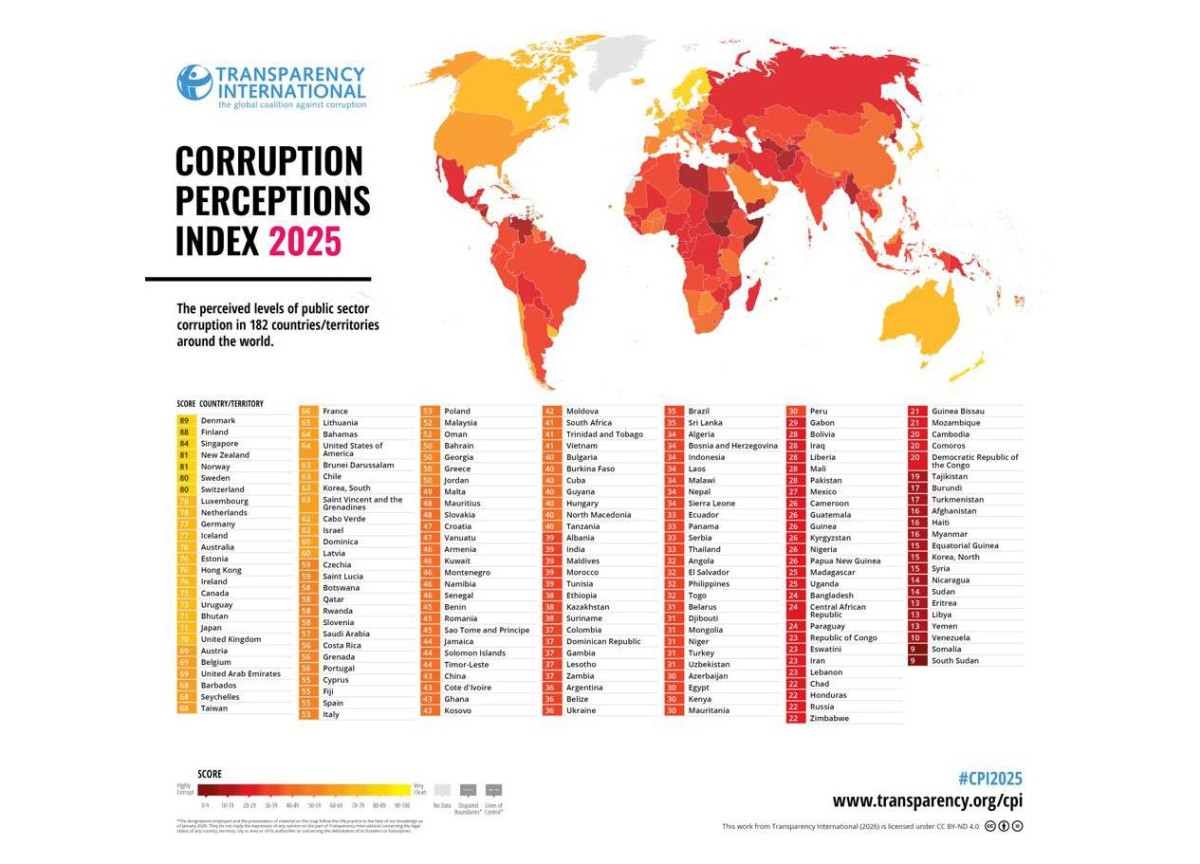
KUWAIT: Kuwait has maintained its score and position on this year’s Transparency International’s Corruption Perceptions Index (CPI), Kuwait Anti-Corruption Authority (Nazaha) said on Tuesday. Like in 2024, Kuwait scored 46 out of 100 and retained its 65th position among 182 countries, Nazaha said in a statement.
Regarding other Gulf states, United Arab Emirates advanced two positions to 21, Qatar retreated three positions to 41 and Saudi Arabia dropped seven places to 45, while Oman was down four
positions to 54 and Bahrain slid to 56th position, a drop of three places, according to the CPI report which was released in Germany on Tuesday.
Nazaha said Kuwait’s score and position “reflect Kuwait’s stable position in the international ranking, despite expanding the scope of the countries covered by the index” from 180 in 2024 to 182 last year. Nazaha cited the report as saying that the 2025 results came amid increasing challenges in the fight against corruption, with the global average on the CPI hitting just 42 out of 100, the lowest in a decade. A majority of the 182 countries and territories scored below this average.
“This reflects a worrying downward trend at the international level, underscoring the importance of Kuwait maintaining its rank, which exceeds the global average,” said Nazaha, adding that Kuwaiti authorities are working to achieve a gradual and sustainable improvement in the near future.
Nazaha said that Kuwait has continued to upgrade its national integrity system in recent years by strengthening legislative and institutional frameworks, issuing and updating legislation related to conflict of interest, whistleblower protection and financial disclosures, in addition to enhancing transparency in government procedures.
It emphasized that improving Kuwait’s position in international indices requires sustained joint national efforts, enhanced coordination among relevant entities, and the consolidation of governance and transparency principles to support sustainable development goals and strengthen institutional trust.
In its report, Transparency International said that corruption across the Middle East and North Africa (MENA) “remains deeply entrenched, with most governments failing to tackle public sector corruption”. “The latest CPI results show that corruption remains embedded in the region, negatively impacting people’s lives,” said Manuel Pirino, Regional Advisor for MENA at Transparency International.
“To tackle this, countries should put in place mechanisms that open civic space and ensure transparency, rather than preventing it. They must ensure anti-corruption and oversight agencies are independent,” Pirino said. “Without the proper accountability mechanisms in place, corruption will only continue to permeate the region” he added.
