

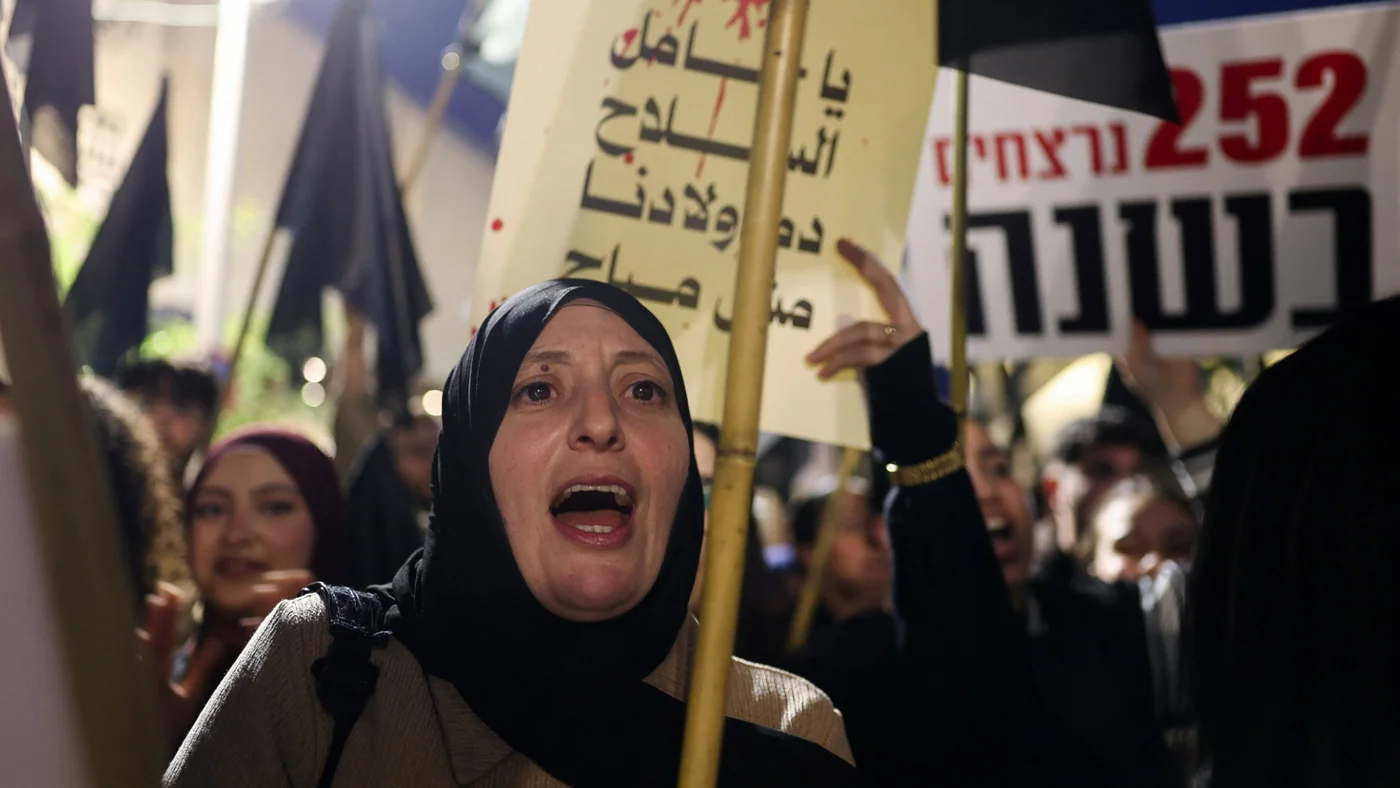
Convoys of cars drove from towns and cities across Israel to government offices in Jerusalem on Sunday to protest rising violent crime affecting Palestinian citizens of Israel.
The demonstration was the latest in a series of protests held in recent weeks, as near-daily homicides continue in predominantly Palestinian towns and villages.
Tens of thousands have taken part in protests and strikes nationwide. The demonstrations began in Sakhnin and Tamra last month before spreading to other areas.
The demonstrations culminated in Tel Aviv last week, where close to 100,000 people gathered in one of the largest mobilisations by Palestinian citizens of Israel in recent years, calling for action against violence and organised crime.
Since the start of the year, at least 36 Palestinian citizens of Israel have been killed in crime-related incidents, an average of nearly one death a day.
New MEE newsletter: Jerusalem Dispatch
Sign up to get the latest insights and analysis on
Israel-Palestine, alongside Turkey Unpacked and other MEE newsletters
The surge follows a record year in 2025, when 252 people were killed in 218 separate incidents, according to the Abraham Initiatives, a non-governmental organisation that monitors violence in Palestinian communities.
‘Violence has been allowed to proliferate’
– Dr Walid Haddad, criminologist and lecturer
The number of deaths has increased roughly fourfold over the past decade.
Palestinians say their demands extend beyond tackling organised crime. They accuse the Israeli government and law enforcement agencies of failing to address the crisis.
They argue that official bodies have neglected Palestinian communities and, in some cases, enabled the conditions allowing violence to spread.
The rise in killings has continued since National Security Minister Itamar Ben Gvir, who has previously been convicted of offences related to incitement to racism against Arabs, took office in 2023.
In 2023, former police commissioner Kobi Shabtai drew criticism after being recorded suggesting there was little that could be done to curb crime in Arab communities because it was “in their nature” to murder.
Record deaths
In recent years, Palestinian communities inside Israel have become increasingly affected by organised crime, which some residents describe as resembling open battlefields.
Killings now occur almost daily, leaving many neighbourhoods under the influence of armed gangs, while illegal weapons are widely available.
Palestinian citizens of Israel have long accused police of failing to respond adequately to the violence, saying law enforcement acts decisively against criminal networks in Jewish communities but remains ineffective when crime affects Palestinian areas.

The year when Israel began treating its Palestinian citizens officially as enemies
Read More »
In 2025, 308 homicides were recorded across Israel, of which 249 involved Palestinian victims, according to a tally by Haaretz – a ratio of roughly five to one Palestinian to Jewish victims.
“This deliberate negligence is a policy aimed at internally dismantling the community and forcing it to prioritise the basic demand of safety,” Ahmed Khalifa, lawyer and human rights advocate, told Middle East Eye.
“The state defines where gangs operate and allows them space to flourish within Palestinian areas,” he said.
Khalifa added that organised crime is a relatively recent phenomenon in the community, which has not historically experienced violence on this scale.
Dr Walid Haddad, a criminologist and university lecturer, said there were about 50 victims of such crimes in 2016. The number rose above 100 in 2020 and exceeded 200 by 2023.
At the current rate, he warned, the figure could surpass 300 this year.
“Violence has been allowed to proliferate,” Haddad told MEE, blaming the government for the deepening crisis.
“Israel has not treated the rise of crime as a strategic threat to the state, and therefore no governmental plan has been proposed,” he added.
“The responsibility lies with the institution itself. In every country where organised crime spreads, it is ultimately the state’s responsibility.”
‘Coerced displacement’
Palestinian citizens of Israel are descendants of Arab residents of historic Palestine who remained in their homeland after the 1948 Nakba, during which Zionist gangs expelled around 750,000 Palestinians before the creation of the state of Israel.
Today, the community numbers about two million people, accounting for roughly 20 percent of Israel’s population of nearly 10 million.
‘Palestinians are confronting not just gangs, but the broader system that normalises fear and coerced displacement’
– Rawyah Handaqlu, founder of Eilaf
Despite holding Israeli citizenship, they have faced discriminatory laws and practices for decades, including a period of military rule from 1948 to 1966.
Many in the community say they continue to feel targeted by the state. This is particularly evident when they express solidarity with Palestinians in the occupied West Bank and the Gaza Strip.
Protests by Palestinian citizens of Israel during the Second Intifada were met with deadly force in 2000 and 2001.
Following the 2021 protests and riots, hundreds of activists and young people were detained and handed long prison sentences.
During Israel’s genocide in Gaza, expressions of solidarity with Palestinians there were heavily restricted, with even small demonstrations swiftly dispersed.
The current crime crisis has pushed many to question whether the government’s failure to curb the violence is contributing to displacement from these communities.
Most Palestinian citizens of Israel live in towns and cities that are predominantly Palestinian, and where the majority of gang-related crime is reported.

Israel’s Ben Gvir proposes prison ‘encircled by crocodiles’ for Palestinians
Read More »
Experts warn that the crisis could push many families to seek safety away from their hometowns, including in Jewish-majority areas, which would have lasting social effects on the community.
Rawyah Handaqlu, founder of Eilaf, the Center for Advancing Security in Arab Society, said the crime crisis could not be separated from this broader political context.
“When fear becomes a permanent part of daily life, young families and the middle class begin to see emigration as the only rational choice,” Handaqlu said.
She argued that the government has shifted responsibility for crime onto the community while dismantling previous anti-crime initiatives and privatising security, deepening inequality.
“Addressing crime as an existential issue forces us to move from reaction to strategy, turning pain and anger into organised power,” she said.
“Palestinians are confronting not just gangs, but the broader system that normalises fear and coerced displacement.”
