

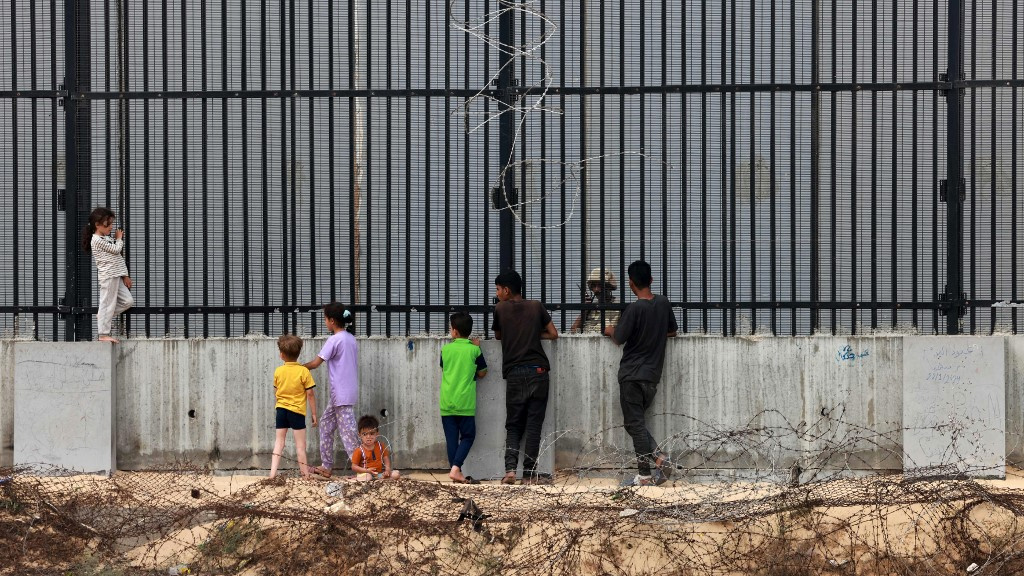
The recently disclosed US-led proposal for a “planned community” in Rafah, Gaza, represents a fundamental paradigm shift in the mechanisms of control Israel exerts over the occupied Palestinian territories, marking an evolution from physical military checkpoints towards a deepening financial occupation.
This new architecture, which would replace the cash-based economy with “electronic shekel wallets”, is designed to embed Palestinians directly within an Israeli-controlled monetary network. Payment systems would thus become a primary instrument for surveillance, dependency and political pacification.
According to leaked documents from the US-led Civil-Military Coordination Center (CMCC), which were obtained by Drop Site News, the “Gaza First Planned Community” is structured around several integrated control mechanisms, including biometric surveillance, checkpoints and financial monitoring through the electronic wallets.
This framework would enable Israeli authorities to monitor purchases and identify economic networks that might divert resources to “Hamas financial channels”. Such structural dependency on the Israeli financial system would effectively remove any remaining Palestinian financial sovereignty.
The integration of electronic wallets as part of Gaza’s reconstruction plan follows a broader pattern of leveraging economic dependencies to advance specific political objectives.
New MEE newsletter: Jerusalem Dispatch
Sign up to get the latest insights and analysis on
Israel-Palestine, alongside Turkey Unpacked and other MEE newsletters
The groundwork for this shift was laid during more than two years of Israel’s brutal war on Gaza, which devastated the vast majority of the territory’s bank branches and ATMs.
Unlike the Bank of Israel’s proposed digital shekel, intended to modernise domestic payments with privacy protections, the electronic wallets in Gaza would likely function explicitly as surveillance tools tied to military vetting and biometric identification.
Irreversible dependencies
The role of the Bank of Palestine in this scheme deserves scrutiny. The proposal notes that “a Bank of Palestine branch in the community would provide secure and transparent commerce”. A Palestinian institution with dozens of branches across the occupied territories – and a lifeline during the war, as the institutional backbone of the PalPay digital wallet system – would thus be transformed into an intermediary for Israeli financial control.
The surveillance apparatus envisioned in the CMCC plan extends beyond individual wallets to encompass the entire supply chain, requiring Israel to monitor merchants and goods to prevent “diversion”. Furthermore, the lack of clarity on where funds are held suggests they could be channelled through Israeli military-linked financial institutions, granting Israeli authorities the discretionary power to freeze accounts or block transactions.
The geopolitical architecture behind this project points to an intersection of Gulf capital and American political strategy, with UAE funding channelled through US President Donald Trump’s “Board of Peace”. The proposed new community is being called “the Emirati compound”.
Every resident would become economically embedded in Israeli financial networks, where the cost of resistance is exclusion from commerce
This strategy is in line with the revival of the India-Middle East-Europe Economic Corridor (IMEC) project. The Gaza proposal aims to integrate the territory into regional trade networks. But Gaza’s participation in the IMEC would require surrendering monetary sovereignty, accepting biometric surveillance, and conducting all commerce through systems overseen by the Israeli military.
It would also position the UAE, which is part of the CMCC, as a financial sponsor of the occupation – a role that aligns with Abu Dhabi’s previous investments in West Bank checkpoints and its broader participation in the Abraham Accords.
The Rafah pilot project extends the economic logic of these accords into Gaza, using reconstruction financing and technology to create irreversible dependencies designed to preclude future resistance. This mirrors the weaponised interdependence seen in other states that have normalised relations with Israel, such as the restriction of water exports to Jordan, and gas supplies to Egypt, in an effort to mute criticism of Israel’s military actions.
At the micro level in Gaza, every resident would become economically embedded in Israeli financial networks, where the cost of resistance is exclusion from commerce.
Profound implications
Indeed, the shift from cash to electronic payments would carry profound implications for the capacity of Palestinians to resist Israeli occupation. Cash economies provide anonymity and allow informal networks to operate independently of state surveillance. During the war, Gaza’s economy relied on informal cash brokers who charged commissions of around 40 percent, but provided essential liquidity.
The electronic wallet system would eliminate this informal sector, exposing all economic networks to Israeli monitoring – an architecture further reinforced by the captive labour market in the Rafah community, where income would be contingent on cooperation with Israeli-vetted authorities.
At the same time, educational curricula would follow “Culture of Peace” principles modelled after the UAE, while a so-called international stabilisation force would provide “security”, layering external control over every aspect of Palestinian life.

It’s time to decolonise the Palestinian economic system
Read More »
Meaningful Palestinian monetary sovereignty is explicitly foreclosed by the Rafah model. Alternative financial systems, such as the Brics architecture or Chinese or Russian payment mechanisms, could offer a way around this – but without political recognition and state sovereignty, individual Palestinian institutions cannot access these systems.
Israel’s project echoes the deradicalisation camps in Xinjiang, where China combined biometric surveillance and economic coercion to produce compliant subjects. The Rafah pilot project is seen as a test case for a governance model that can be scaled across Gaza, the occupied West Bank and beyond – allowing Israel to claim military withdrawal, while retaining real-time monitoring and the power to punish non-compliance.
This project’s success or failure will shape broader dynamics across the Mena region. For the UAE, it represents a test case for the role of Gulf capital in managing post-conflict environments aligned with Israeli strategic interests. If the electronic wallet infrastructure proves viable, it could become a blueprint for similar systems in southern Lebanon or Syria, further expanding the economic logic of the Abraham Accords.
Despite the technical sophistication of these systems, however, history suggests that Palestinians may adapt by seeking alternative transfer mechanisms or bartering arrangements, moving financial activity further underground.
Ultimately, control over payment infrastructure and monetary life cannot be a substitute for political legitimacy. What is being constructed in Rafah is a model where survival is exchanged for submission to surveillance. But the strategic question remains: will Palestinians accept a reconstruction model that requires the permanent surrender of their monetary sovereignty?
The views expressed in this article belong to the author and do not necessarily reflect the editorial policy of Middle East Eye.
