

It’s February – and Sunderland are four points away from reaching 40 points. Premier League safety would be secured with a few months to spare – in a sensational case of rewriting history.
The last two seasons saw all three newly-promoted teams sent back down and it’s not been a completely different story this time around.
Second-bottom Burnley look doomed after 16 games without a win, while Leeds are above the drop zone – but worryingly looking over their shoulders.
Sunderland are nowhere to be seen in that relegation fight – sitting in the top half of the table and are dreaming about Europe. This is a side that needed three late goals to get themselves through the Championship play-offs, let alone the best league in the world.
So how has Regis Le Bris – now a high-flying contender for Manager of the Season – done it? The Sunderland boss speaks exclusively to Sky Sports about how he constructed a team to stay in the Premier League…
‘The Roefs is on fire’ – why Sunderland defend so well
Part of Sunderland’s success this season has been at the back. At the start of the season, Sky Sports data revealed that conceding 60 goals or fewer gives you an 83 per cent chance of staying up.
Just like their league position, Sunderland are overachieving in that department. They have conceded just 29 goals in 25 games – the joint-sixth-best record in the division. They have let in fewer goals than both Liverpool and Manchester United so far this season.
Le Bris names three key components for his team’s defensive solidity this season: goalkeeper, centre-backs and the No 6s – also known as the defensive midfielders. “I think the connection between our goalkeeper, our centre-backs, our sixes, is now getting really good. This part of the game gives us control.”
And it helps having a top-quality goalkeeper in Robin Roefs – who is statistically in the top two or three No 1s in the division this season.
His shot-stopping ability has helped keep the numbers down – but his ability to consistently find team-mates with his passing record has also stood out.
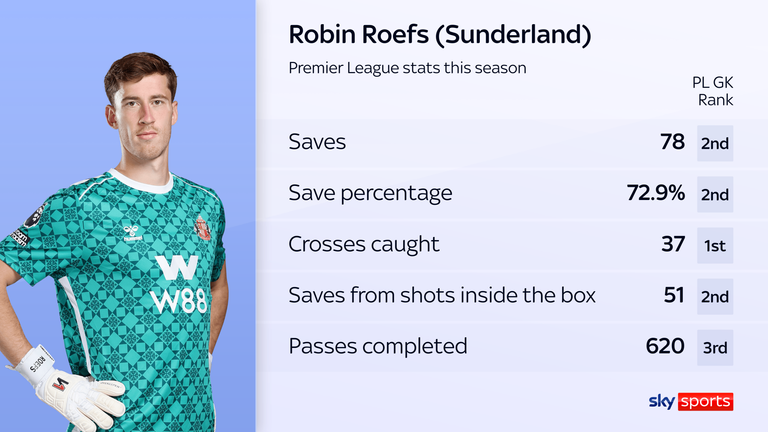
Robin Roefs’ Premier League goalkeeper stats
“He’s key,” says Le Bris about his goalkeeper. “It’s fair to say that in an efficient team, you need strong players on both sides. I think the goalkeeper and the centre-backs are really important to protect the goal.
“He’s young, without a lot of experience. Often you would say you need an experienced goalkeeper, because this role is really demanding, even psychologically.
“So he’s doing really well. When you give opportunities to young players, you can be surprised. I think it’s part of our identity.”
The key defenders showing ‘physicality’
But all goalkeepers need protection – and bringing in defensive solidity at the back was a key part of their summer transfer policy.
Sunderland spent £183.4m in the summer transfer window – the most by any newly-promoted team in the last five seasons. But crucially, they spent it wisely.
“It was really efficient for the recruitment staff,” says Le Bris. “With the standards of the Premier League, you need to have a strong physicality.
“The teamwork is key. The way you defend together is key. Because if you are too exposed, and it’s so tough to score goals in this league, you can’t win games. So our defence was a key point.”
Around £25m of that was summer spending spent on two key defenders – Nordi Mukiele and Omar Alderete, signed in separate £12m deals from Paris Saint-Germain and Getafe – and their additions have been crucial in the team’s success.
“Those two have this mindset and this physicality, which is really important in the league,” says the Sunderland boss.
“When you defend a bit deeper, you have to defend the box really efficiently. So they are good in that part of the pitch. And when we go man for man, they are strong as well.
“So these two parts of the defensive workflow are really important and they are well connected on that side.”
But while Sunderland invested heavily in a new goalkeeper and two new defenders, perhaps their most efficient player at the back is Dan Ballard, who has been an ever-present at the back despite a lot of change around him.
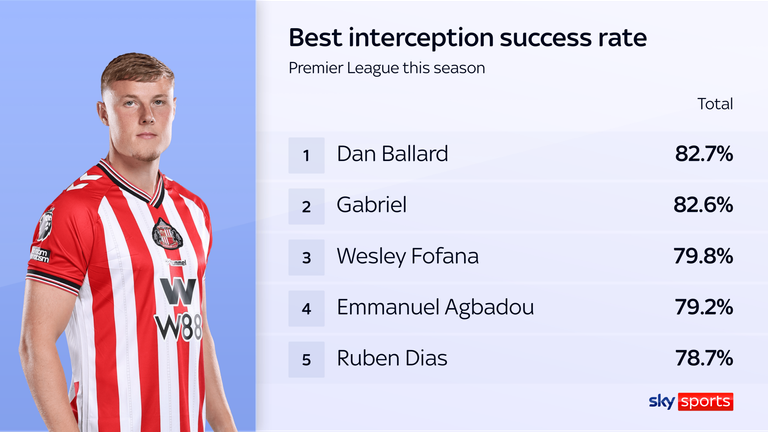
Dan Ballard’s Premier League stats
The centre-back had a slow start to life under Le Bris, picking up a knee issue last season during pre-season, which meant he had to take his time in the Championship promotion season last term.
Now, with a perfect pre-season, Ballard is showing exactly what he can do – and why he was so highly-rated by Arsenal before leaving the club.
“I’m not sure he knows how strong he is,” says Le Bris about Ballard. “Quite often he needs a bit more belief and confidence because he’s doing really well and he’s a key part of our defence.”
Xhaka is a ‘beacon’ – why is it a blow to be without him?
Then come the No 6s in Noah Sadiki and Granit Xhaka, who have helped marshal not only the midfield – but the entire energy of the team.
Both central midfielders rank in the top six players in the Premier League this season for distance covered, connecting an efficient backline to the attacking, dangerous players in this Sunderland team.
“They want to run!” says Le Bris. “They are good footballers, they are versatile, they have so many good qualities. They have a good profile, they work well together – and they are well connected with the squad.
“Everything is connected. If you have a weak point, it will influence the whole dynamic.”
Of course, Xhaka’s experience of the high standards of European football has been an important addition to this Sunderland team. Le Bris has referred to his captain as the ‘second coach’ on the pitch – so what does that mean?
“I think it’s about ambition, understanding and composure,” Le Bris says of Xhaka. “It’s not always something impressive. It’s more about consistency – whatever the event, whatever the opponent.
“So we go away to Chelsea? We can win, if we believe. We are playing at home against a team that struggles at the table? We have to win and stay consistent. It’s about managing emotions, events and consistency.”
So with Xhaka currently missing with an ankle injury, it makes a huge difference. Le Bris highlighted the recent defeat to West Ham, in which Sunderland were 3-0 down at half-time and out of the game, as an example of how useful Xhaka can be.
“I wasn’t happy at West Ham because after the first goal, the energy was really low,” recalls the Black Cats boss.

FREE TO WATCH: Highlights from West Ham’s match against Sunderland in the Premier League.
“When the captain is missing, this support, this drive is a bit different. The reaction after the goal, we didn’t switch. We stayed in the same mood, even a bit lower.
“When you have a more experienced player on the pitch, it helps. Granit’s like a beacon. You want to follow the light. Against West Ham, probably it wasn’t the case.”
How Brobbey needed time and patience after summer move
So Sunderland have an excellent defence but as Le Bris says: “it doesn’t mean you can score goals.”
“When you build your squad, it’s about different layers. So our foundations are strong defensively and we are good. The final third is the most difficult part.”
This is the clear area of improvement for this Sunderland team. They are so efficient in the first two phases of the game – the next part of Le Bris’ masterplan is to improve the efficiency in attack.
In terms of a centre-forward, Sunderland have tried different combinations. Eliezer Maydenda started the season in that role, before Wilson Isidor played himself into form.
But Deadline Day signing Brian Brobbey is now the key focal point up front. And his efficient finishing up front puts him among the best shot converters in the top-flight this season.
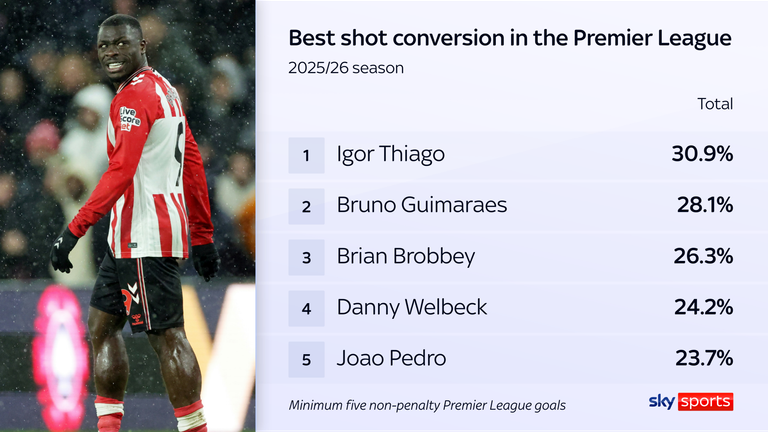
Brian Brobbey’s finishing stats
But like many new centre forwards this season – such as Viktor Gyokeres and Benjamin Sesko – summer signings have had to bide their time to get up to speed with the Premier League.
“He’s a good example of the way of building a new striker,” says Le Bris of Brobbey. “He struggled a bit last season, but he has great potential.
“He started a bit slowly because of different reasons. He’s new in this league as well, so he needs to learn. He’s talented and he works hard, and after opportunities, support, connection with his teammates, he shows his potential and his qualities. I hope that will be the case for a long time.
“It’s about support, consistency and confidence. Riding the wave is really important.
“And then for a striker, even if you don’t do well for one or two games, it’s not just: ‘OK, now we switch player, we’ll go for another one.’ They need consistency, they need support.”
“In our mind, the identity of the club, we want to build. We can’t buy the top six or top eight clubs. They can buy two or three wingers for £60m.
“It’s not possible for us. We believe that we can start with a young potential player. After that, they need opportunities, they need support, they need time.
“Sometimes it’s a bit longer and you have to accept that because it’s not always a quick dynamic.”
Except Sunderland have taken to the Premier League like a duck to water. There are a few issues to iron about – particularly the away form, where they have not won on the road in the Premier League since beating Chelsea in October.
But at home, they are a different animal. They are the only Premier League team yet to be beaten on home soil. The Stadium of Light has already taken points off Arsenal and Manchester City this season – and Liverpool are next.
Follow live coverage of Sunderland vs Liverpool on Sky Sports’ digital platforms on Wednesday night, kick-off at 8.15pm – and watch free match highlights straight after full-time…
