

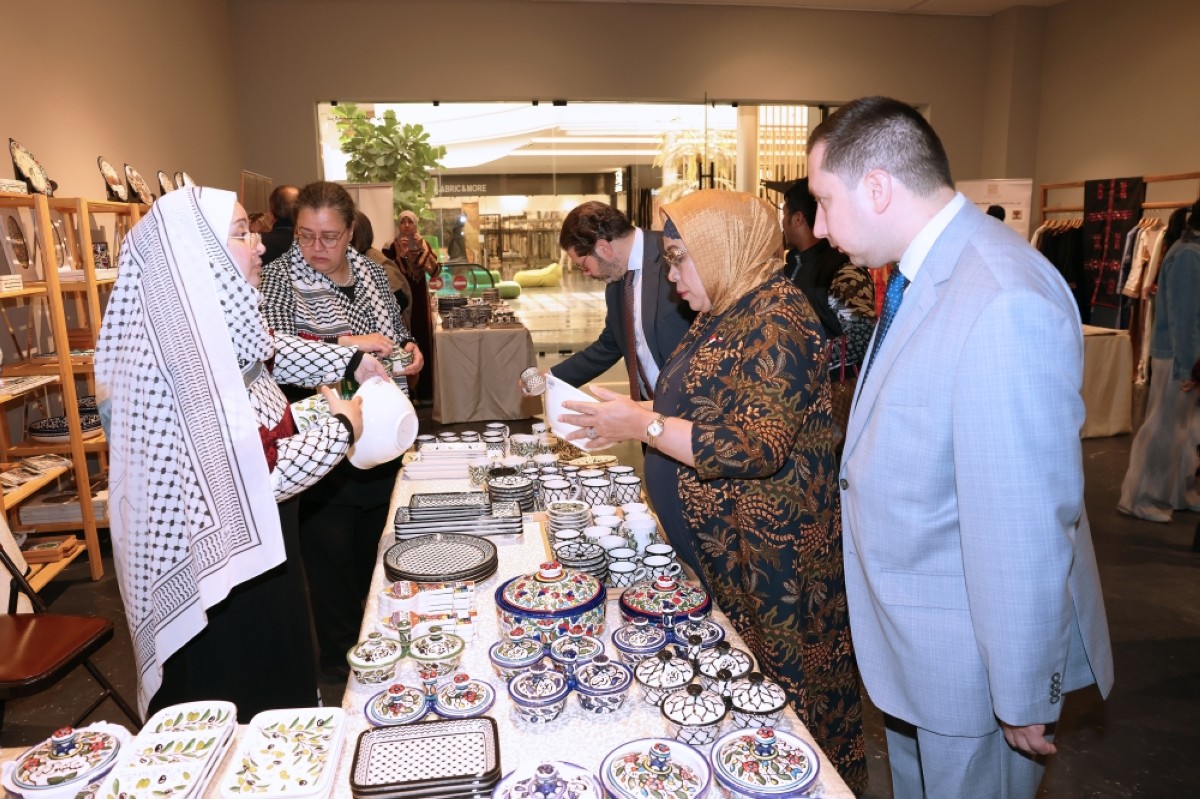
KUWAIT: Following the challenges faced by Palestinian farmers during the olive oil harvesting season, olive oil products were still able to reach the 62nd exhibition of the Palestinian Culture Center in Kuwait, albeit in significantly reduced quantities. Held in collaboration with the Embassy of Palestine, the exhibition aims to support Palestinian families while preserving cultural heritage and reviving traditions at risk of being lost. It runs from Monday to Thursday at the Contemporary Art Platform (CAP) in the Design District, Shuwaikh.
Explaining the conditions faced by contributors from refugee camps in Jordan and Palestine, the Palestinian Ambassador to Kuwait Rami Tahboub said the challenges extend across multiple sectors, affecting not only farmers, but also ceramic artisans, embroidery workers and olive wood craftsmen alike. He noted that despite these obstacles, efforts continue to support producers and help them overcome the hardships through ongoing and future initiatives.
Faten Abu-Ghazaleh, spokesperson and long-time volunteer at the Palestinian Culture Center, attributed the sharp decline in olive oil production to escalating violence during the harvest season. “This year in particular the Zionist entity is enabling, allowing, and encouraging settlers to be as violent as they can toward Palestinians,” she told Kuwait Times.
From 200 tanks to just two
Abu-Ghazaleh explained that during previous olive harvesting seasons, which take place in October and November, international NGOs such as the International Solidarity Movement accompanied Palestinian farmers to help protect them from harassment. “This year, they weren’t able to do that,” she said. “The settlers were extremely violent.” She added that the impact on production has been devastating. “The gentleman we’ve been importing olive oil from for maybe 20 years told me that this year, a man who usually produces around 200 tanks of olive oil, each tank being a large container, was only able to produce two.”
According to Abu-Ghazaleh, settlers often uproot olive trees, burn products, or steal olives, sometimes after they have already been harvested, making olive oil production a real struggle.
The impact of settler violence has also been evident in the limited availability of ceramics. Of the many workshops that once sustained this 500-year-old tradition, only three remain today, all of which continue to operate entirely by hand. “These workshops continue to struggle, largely because settlers often storm in and destroy ceramic pieces just after they are completed, forcing artisans to start again from nothing,” said Abu-Ghazaleh.
Killing art
The Palestinian Ambassador to Kuwait echoed these concerns, noting that many ceramic factories are unable to operate due to restrictions imposed by the Zionist occupation. “Personally, I know of one factory that has been closed for more than a year because of an Israeli checkpoint positioned at its entrance, which has prevented its owners from accessing it,” he said. Beyond production challenges, the Palestinian cultural center itself faces ongoing difficulties that’s limiting growth, largely due to its reliance on volunteer support. “We don’t have a dedicated team in Kuwait; everyone involved is a volunteer,” Abu-Ghazaleh said. “It’s always a challenge to get people to commit their time.” Despite that, the center has managed for the past years to hold two exhibitions a year in Kuwait, and an exhibition once a year in Jordan.
They hope to expand their activities, but even maintaining an online presence has proven difficult due to limited volunteer capacity. Abu-Ghazaleh explained that most volunteers are retirees or housewives, while younger people are often unable to participate because of work commitments. Still, she stressed that the center remains open to anyone willing to contribute their skills.
Cherishing life amid genocide
Despite these constraints, the exhibition stands as an assertion of presence and purpose. The exhibition itself reflected that commitment, featuring a wide range of handmade Palestinian products, including embroidered pieces, traditional ceramics from the city of Hebron, a rich collection of books, and silver items documenting Palestine’s oral history. Coinciding with the Ramadan season, it also included special Ramadan baskets containing olive oil, olives, and other products sourced from Palestine, despite the significant challenges involved in importing them.
“This initiative reflects our core mission to convey the Palestinian narrative to the world,” said Palestinian Ambassador to Kuwait Rami Tahboub. “It affirms that Palestinians are people who cherish life and aspire to live in safety and peace, like all other nations.” He added that the strong turnout of diplomatic missions at the event sends a clear message of solidarity with the Palestinian people and their cause. Echoing that sentiment, Abu-Ghazaleh said Palestinians continue to invest in life, culture, and creation despite the destruction they face. “We plant trees – we do not uproot them. We build museums and cultural centers – we do not destroy them. We believe in building peace, and we hope that one day, we will all be together in Palestine, living in a land of peace.”
