

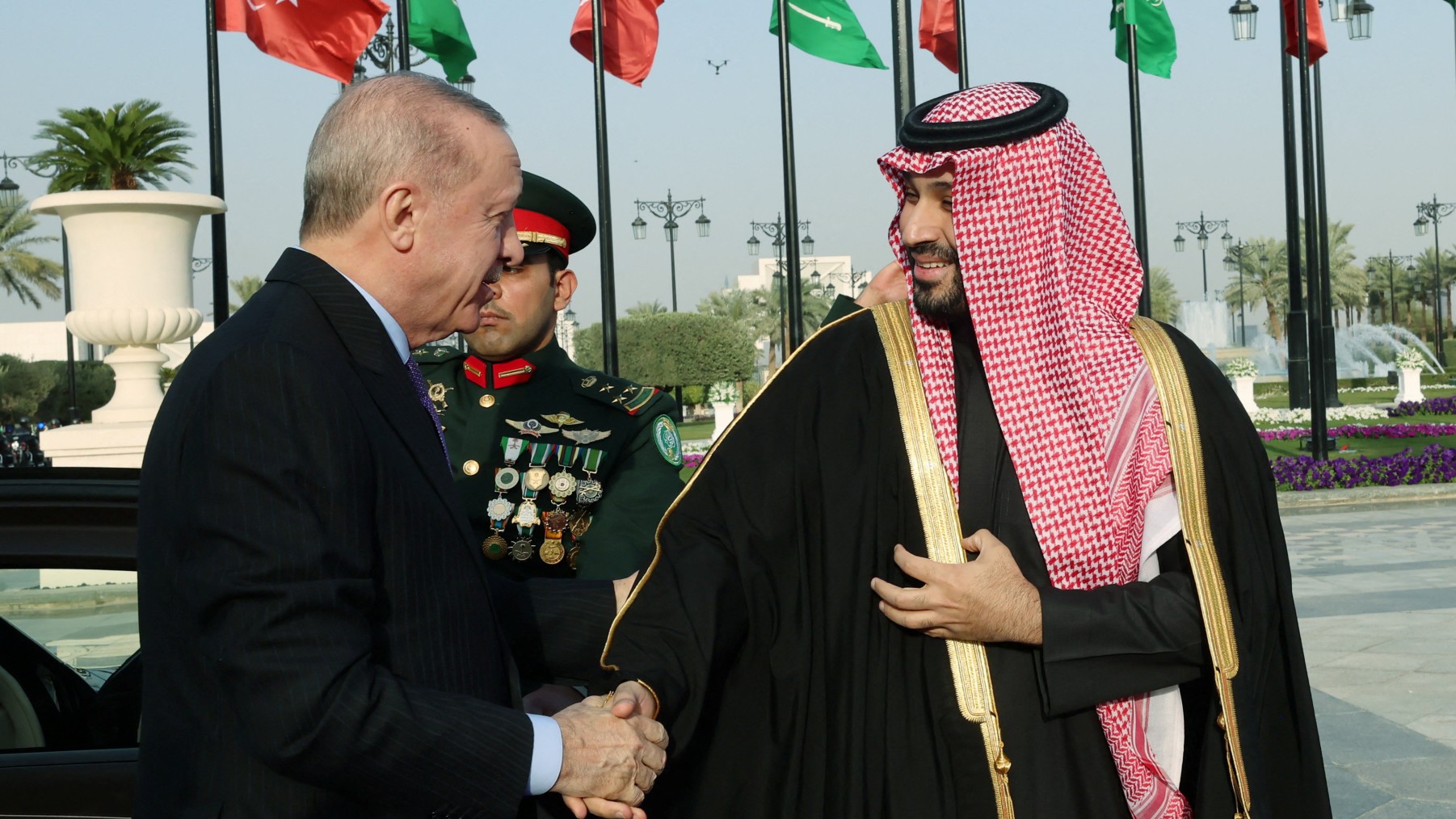
Turkish President Recep Tayyip Erdogan recently paid a visit to Saudi Arabia, amid ongoing strain between Riyadh and Abu Dhabi over their conflicting interests in Yemen and the Horn of Africa, and speculation about Turkey potentially joining a Pakistan-Saudi military pact.
These are all critical regional issues, yet with Riyadh’s return to a proactive regional profile, particularly in Yemen, the primary question now is: where does Turkey fit within Crown Prince Mohammed bin Salman’s “new Saudiness”?
Since the killing of journalist Jamal Khashoggi in 2018, Mohammed bin Salman has sustained a lower regional profile, focusing more on his domestic vision.
This was a conscious strategic choice: the crown prince’s vision of a new “Saudiness” is one that no longer bears the collective burdens of the Arab world, following failed interventions in Yemen and Syria, along with decades of conflict in Palestine.
But since the fall of the Assad regime in Syria in December 2024, Saudi foreign policy has once again become more proactive, aiming to redefine Riyadh’s regional policy.
New MEE newsletter: Jerusalem Dispatch
Sign up to get the latest insights and analysis on
Israel-Palestine, alongside Turkey Unpacked and other MEE newsletters
The distinctly domestic character of the new Saudiness is rooted in Vision 2030, which focuses on new lifestyles, tourism, and a reimagined sense of history. Yet this glossy transformation also narrows who belongs, and on what terms.
Several factors underpin the crown prince’s project, including Saudi Arabia’s demographic transition, with around two-thirds of the population now under 30; the need for economic diversification beyond oil; the institutionalisation of Mohammed bin Salman’s authority, most visibly in his appointment as prime minister in 2022; and the redefinition of Saudiness itself, elevating monarchy and national pride, while displacing Wahhabi influence.
Together, these conditions allow for the creation of a new national imaginary.
At a crossroads
Saudi Arabia is at a crossroads. The new identity aims to project stability and modernity, both to its citizens and to the world – but the kingdom’s identity cannot be fully scripted from above. The success of this project will depend on how Saudis themselves respond, whether by embracing the new narratives of history, heritage and lifestyle, or by seeking to shape alternative versions of belonging.
In this context, the crown prince’s domestic focus is not incidental – it is the cornerstone of his strategy. But from a regional perspective, he needs reliable partners to bolster his diplomatic profile.
In Yemen, the UAE’s prioritisation of its own national interests over the broader goals of the Saudi-led coalition has fuelled tensions. In Palestine, although the kingdom was close to normalising ties with Israel before 7 October 2023, achieving peace in Gaza remains its declared priority.
He may yet seek to associate his reign with a renewed phase of regional activism – but he first needs reliable partners
What distinguishes this new “Saudiness” from the kingdom’s previous foreign policy approach is that Riyadh is no longer willing to fully shoulder the burdens of the Middle East.
But Saudi Arabia is not the only one that has changed; so, too, have its allies and competitors, as the case of Yemen clearly shows. Mohammed bin Salman must now recalibrate his strategy to accommodate the growing leaderships of Qatar and the UAE, and to share, rather than monopolise, regional prominence.
Mohammed bin Salman’s policies may yet seek to associate his reign with a renewed phase of regional activism – but he first needs reliable partners. Only then may we see a more outward-looking Saudi Arabia.
In this context, Turkey’s regional role – which has involved helping to negotiate a deal in Gaza, and supporting status-quo powers in Africa and Yemen, rather than non-state militias – has brought Riyadh and Ankara closer. This offers Mohammed bin Salman room for maneuvering to sustain a level of stability in the region, in contrast to the UAE’s assertive interventionist policies.
Axis of power
The possibility of Turkey’s participation in the Saudi-Pakistan military deal – a development that has thus far not materialised – highlights this emerging axis of power. For Ankara, hedging between the Emirati and Saudi regional policy positions requires a high level of balancing.
At the conclusion of Erdogan’s visit to Riyadh last week, the Saudi and Turkish leaders issued a joint statement rejecting Israel’s recent recognition of Somaliland, and supporting Somalia’s territorial integrity. Erdogan reiterated this position in an interview with Asharq Al-Awsat, calling the Israeli move illegitimate, “null and void”.

Turkey-Gulf rapprochement: Why opposition parties are vexed
Read More »
On Yemen, Ankara supports a unified country, putting it on the same page as Riyadh with regards to eliminating the southern secessionist movement from the long-standing conflict.
Saudi Arabia and Turkey also cited their joint stances on preserving Sudan’s unity, attaining peace in Gaza, and seeking an immediate Israeli withdrawal from Syria. On Syria, Erdogan said Turkey’s benchmark was “a Syria that does not threaten its neighbours, denies safe haven to terrorist organisations, and embraces all segments of society on the basis of equal citizenship”.
Saudi Arabia has emerged as a key supporter of the consolidation of power under Syrian President Ahmed al-Sharaa – but to prevent future tensions, this must involve the reintegration of disparate groups, such as the Kurds, Alawites, Druze and diaspora communities. Riyadh and Ankara are keenly aware that a unified Syria will be key to preventing future tensions and radicalisation.
Defence ties are central to the current cooperation narrative. Saudi and Turkish companies have previously signed defence deals focused on technology transfer, as Riyadh pursues a goal of military self-sufficiency, including drone production. In their latest joint statement, both nations agreed to activate existing defence cooperation agreements to combat crime, extremism and terrorism.
It’s clear that Saudi Arabia is no longer standing still in domestic or regional politics. But as it builds a new image and partnerships, the success or sustainability of this initiative remains to be seen.
The views expressed in this article belong to the author and do not necessarily reflect the editorial policy of Middle East Eye.
