

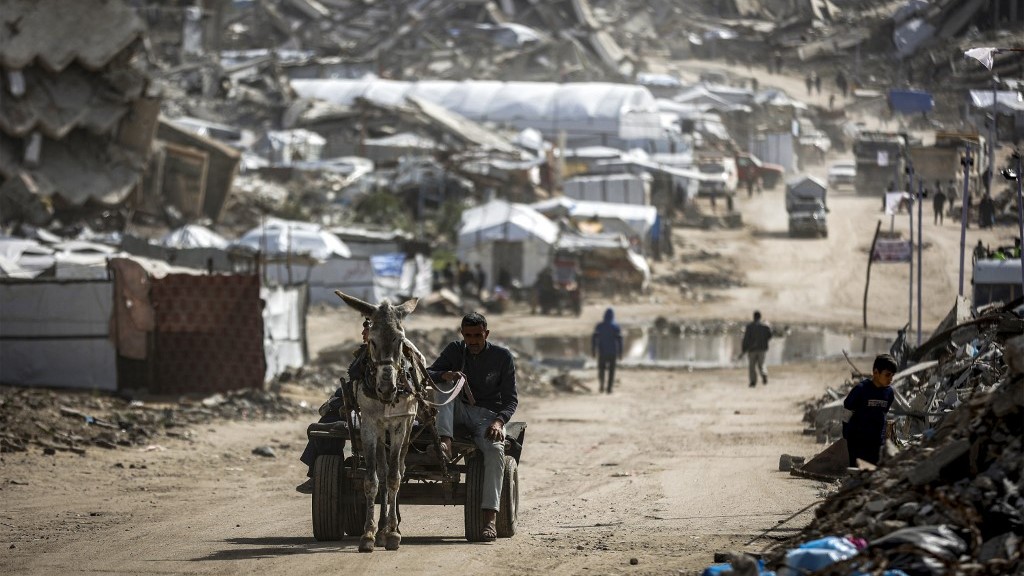
A Palestinian man was killed on Monday after Israeli forces opened fire in Gaza City’s Zaytoun neighbourhood, continuing attacks across the enclave despite the October 2025 ceasefire agreement.
Medical officials told Al Jazeera Arabic that Israeli fire also killed three Palestinians, including a child, in the same area on Sunday.
Since 8 October 2023, Israel has waged a war of genocide on the Gaza Strip, devastating the territory before a ceasefire agreement took effect on 10 October 2025.
Since the agreement entered into force, Israeli forces have carried out hundreds of violations, killing about 580 Palestinians and wounding nearly 1,550 others, according to Palestinian health officials.
At the same time, Israeli political and security decisions in the occupied West Bank have triggered widespread Palestinian condemnation, with officials warning that the measures represent the most dangerous shift in policy since the beginning of the 1967 occupation.
New MEE newsletter: Jerusalem Dispatch
Sign up to get the latest insights and analysis on
Israel-Palestine, alongside Turkey Unpacked and other MEE newsletters
Israel’s security cabinet on Sunday approved expanding occupation authority in Palestinian-administered areas of the West Bank, according to a joint statement issued by Finance Minister Bezalel Smotrich and Defence Minister Israel Katz.
Palestinian officials have said the measures directly undermine the Oslo Accords, which deny Israel authority over civilian administration in Areas A and B under Palestinian Authority control.
The Oslo Accords were a series of agreements signed in the 1990s between Israel and the Palestine Liberation Organization (PLO) that established limited Palestinian self-rule in parts of the occupied West Bank and Gaza Strip.
“We will continue to kill the idea of a Palestinian state”
-Israeli Finance Minister Bezalel Smotrich
They divided the West Bank into Areas A, B, and C, creating a temporary framework intended to lead to a final peace settlement and a Palestinian state, which has never been realised.
Under the new framework, Israeli authorities will impose restrictions that limit Palestinian access to their own water resources and constrain the ability of Palestinians to farm, build homes, and operate businesses.
The measures also ease the illegal sale of Palestinian land to Jews and overturn a Jordanian-era law that prohibited the transfer of land to non-Palestinians.
“We will continue to kill the idea of a Palestinian state,” Smotrich said shortly after the cabinet meeting.
The decisions also transfer planning, licensing, and construction powers in Hebron from the Palestinian municipality to the Israeli army, expanding Israeli control over building permits, development planning, resource management, and security coordination across the West Bank.
An independent local governing body will also be established for the Jewish settlement in Hebron.
The Hebron Municipality condemned the measure on Monday as “illegitimate and dangerous”.
‘Racist and dangerous’
Israeli authorities also removed requirements for Jewish buyers to obtain what Smotrich described as a “complex transaction permit” before purchasing land across the West Bank and lifted confidentiality restrictions on land registry records, allowing potential buyers to identify Palestinian landowners.
Exposing ownership records will make it significantly easier for Jewish settlers to forge ownership claims over Palestinian land, a tactic widely documented that could now be used to further accelerate land seizures reshaping large parts of the occupied territory.

What is the Ibrahimi Mosque and why does it matter?
Read More »
Palestinian National Council Chairman Rawhi Fattouh described the cabinet decisions as “racist and dangerous”, saying they clearly reveal Israeli Prime Minister Benjamin Netanyahu’s intention to move forward with plans to annex the West Bank and impose new colonial realities on the ground.
He said the measures represent a blatant violation of international law and a deliberate dismantling of signed agreements, particularly the 1997 Hebron Agreement, and characterised them as an unprecedented escalation in a policy of “colonial cleansing” targeting Palestinian historical and legal rights.
The Hebron Agreement divided the city into two administrative zones: “Hebron 1,” under Palestinian authority, and “Hebron 2,” under Israeli control, which includes extensive southern and eastern sections of the city.
Muayyad Shaaban, head of the Palestinian Commission Against the Wall and Settlements, said the cabinet decisions represent a dangerous escalation that undermines the international legal order and adds a new layer of crimes against Palestinian geography.
The Palestinian National Initiative movement said the measures drive the final nail into the Oslo Accords and open the door to sweeping land seizures benefiting Israeli settlers.
