

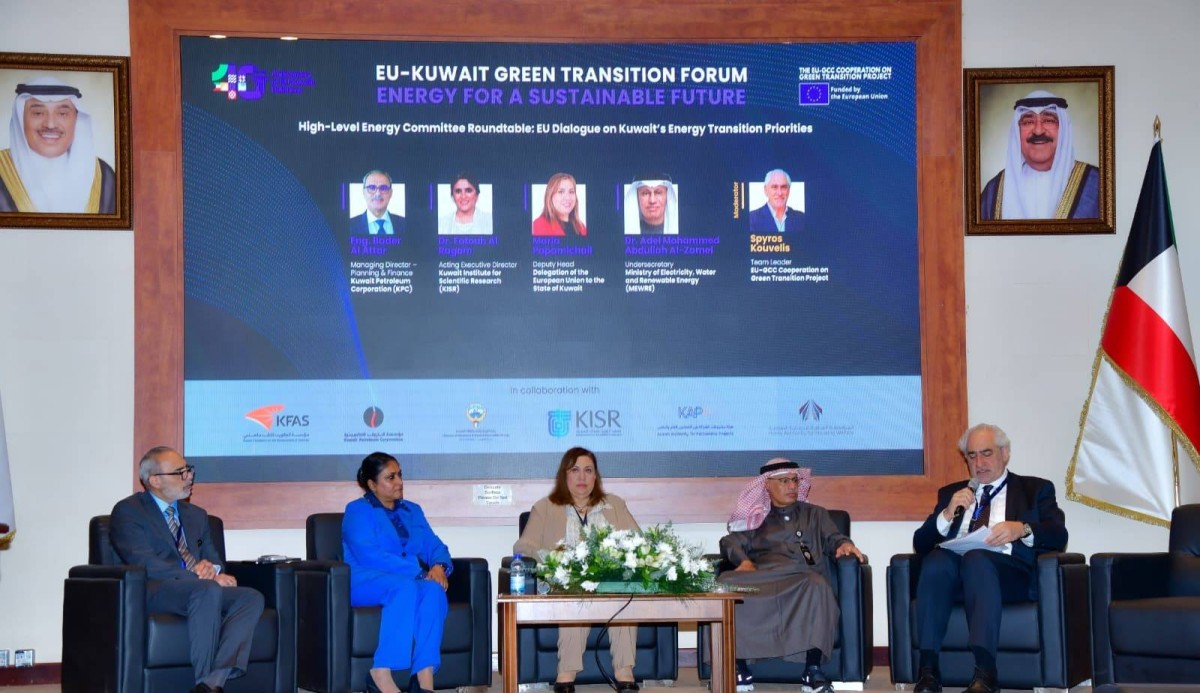
KUWAIT: Minister of Electricity, Water and Renewable Energy Dr Sabeeh Al-Mukhaizeem on Sunday affirmed that Kuwait is making the energy transition a “key national priority,” linking energy policies to economic stability, environmental responsibility and national security. His remarks came at the opening of the Green Transition Forum between the European Union and Kuwait, held in partnership with the EU-GCC Cooperation Project on Green Transition under the auspices of the Supreme Energy Committee.
Dr Al-Mukhaizeem said Kuwait is pursuing the transition with a clear vision that requires strategic management in line with national interests and the long-term development plan. He emphasized that the transition is an “integral part” of Kuwait Vision 2035, the national roadmap for sustainable development and economic diversification.
He explained that the country follows a unified approach under the leadership of the Supreme Energy Committee, ensuring coordination between energy, water, and climate sectors while integrating energy security, sustainable growth, and international commitments. The minister stressed that while Kuwait recognizes the global shift toward cleaner and more efficient energy systems, the transition must be “realistic and gradual,” balancing the nation’s role as a major energy producer with the need to enhance resilience, efficiency, and long-term value.


KUWAIT: Minister of Electricity, Water, and Renewable Energy Dr Subaih Al-Mukhaizeem and senior officials are pictured during the opening of the Green Transition Forum between the European Union and Kuwait, held in partnership with the EU-GCC Cooperation Project on Green Transition under the auspices of the Supreme Energy Committee.- KUNA photos
Dr Al-Mukhaizeem highlighted that the forum offers an important opportunity to deepen cooperation with the European Union, drawing on EU expertise in transition planning, regulatory reforms, and innovation to support Kuwait’s national agenda, while sharing Kuwait’s regional experience and vision for sustainable development. He called for international collaboration to address the complexities of the global energy landscape through practical partnerships in policy, technology, capacity building, and investment, expressing hope that the forum would produce tangible outcomes for a secure and sustainable energy future.
European Union Ambassador to Kuwait Anne Koistinen noted that the forum coincides with the 40th anniversary of diplomatic relations between the EU and Kuwait, reflecting a firm commitment to cooperation. She emphasized the EU’s interest in negotiating a bilateral strategic partnership to enhance ties across sectors, including the green transition, and reaffirmed support for Kuwait through knowledge exchange and technical collaboration.
Koistinen highlighted Kuwait’s vast solar energy potential and its ambition to achieve carbon neutrality by 2060 while sourcing 50 percent of electricity from renewable energy by 2050. She called for adapting successful international strategies to local conditions and highlighted the EU’s achievements, noting that by 2025 wind and solar power are expected to generate more electricity than fossil fuels in EU countries under the European Green Deal. She also underscored the critical role of women in the green transition, pointing out that females comprise around 80 percent of STEM graduates at Kuwait University, representing a rising generation contributing to national development.
Dr Faisal Al-Humaidan, Director General of the Kuwait Institute for Scientific Research (KISR), said Kuwait’s energy sector requires ambitious policies supported by “solid technical credibility” to meet growing electricity demand, complex system requirements, and long-term transition goals. He stressed the need for data-driven decision-making, systems analysis, and understanding of local operational realities, warning that “without these pillars, the goals remain theoretical rather than achievable.”
Dr Al-Humaidan emphasized KISR’s role as the national scientific body providing applied research to support government energy policies, system planning, and risk mitigation in areas including energy efficiency, renewable integration, carbon capture, and sustainable buildings. He noted that KISR operates under the Ministry of Electricity, Water, and Renewable Energy and the Supreme Energy Committee, leading the Energy Efficiency Technical Team, which includes key stakeholders. He described the EU partnership as “extremely strategic,” given its experience in managing complex energy transitions, providing proven models in efficiency, grid integration, and system modernization.
This collaboration, he said, allows Kuwait to leverage shared expertise and advance its energy transformation objectives through technical cooperation and knowledge transfer. Dr Al-Humaidan affirmed KISR’s commitment to supporting the energy sector’s transformation and working closely with national and international partners to translate policy aspirations into practical, technically grounded actions. The forum highlighted the critical intersection of science, policy, and international collaboration as Kuwait moves toward a secure, sustainable, and efficient energy future. — KUNA
