

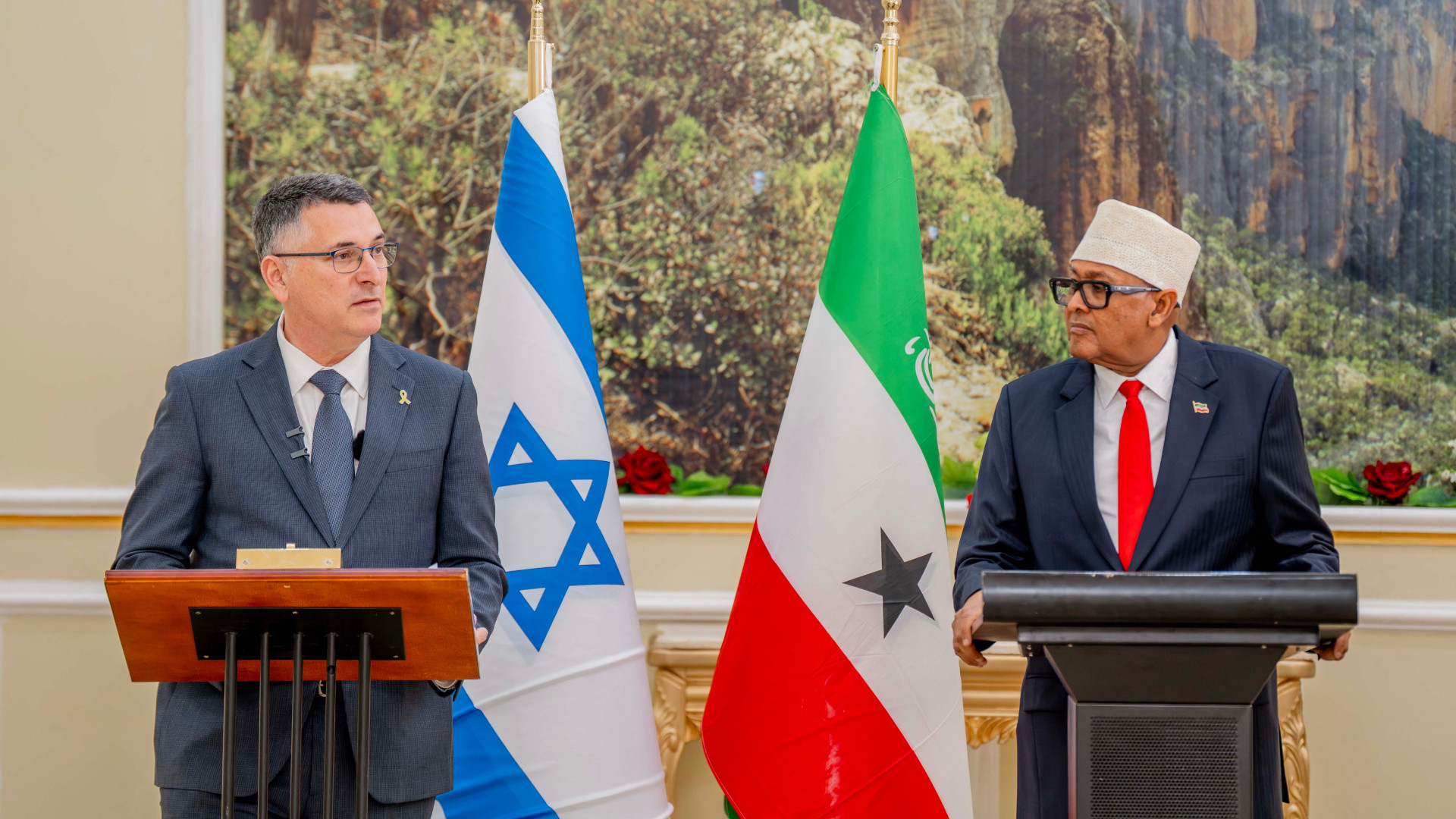
When Israel announced late last month that it would recognise Somaliland, leaders in Hargeisa framed the move as a diplomatic breakthrough.
However, in the Horn of Africa and the wider international community, it was received very differently. It was seen as a warning sign that the Red Sea is becoming the next frontier of militarised fragmentation, where state weakness is exploited to secure strategic footholds with destabilising consequences for an already fragile region.
As the first country to recognise Somaliland, Israel has raised deeper concerns that the move is less about diplomatic normalisation than strategic positioning along one of the world’s most vital maritime corridors.
The reaction by the Federal Government of Somalia was swift. It launched diplomatic countermeasures, public protests erupted in multiple cities, and regional organisations, including the African Union, the Intergovernmental Authority on Development (Igad), the Arab League and the Organisation of Islamic Cooperation (OIC), reaffirmed their support for Somalia’s sovereignty and territorial integrity.
Likewise, more than 30 countries condemned Israel’s recognition and reaffirmed Somalia’s sovereignty.
New MEE newsletter: Jerusalem Dispatch
Sign up to get the latest insights and analysis on
Israel-Palestine, alongside Turkey Unpacked and other MEE newsletters
Given Israel’s broader historical record, this latest announcement is hardly surprising. Since its establishment in 1948, Israel has been widely recognised by human rights organisations and legal scholars as a settler-colonial state.
Recurrent military campaigns against Palestinians have reinforced this perception over time, most recently through its genocidal war on Gaza, which has deepened Israel’s diplomatic isolation amid intensified international outrage.
History of alignment
Israel’s contested position in international politics has repeatedly led it to align with other isolated and outlier states and entities. A defining historical example was its close alliance with apartheid South Africa.
Beginning in the 1970s, the two governments cemented a robust political, ideological and military partnership, forged by their shared status as international pariahs.
South Africa’s defence sector, in particular, became heavily dependent on Israeli expertise and technology, a reality later acknowledged by Alon Liel, a former Israeli ambassador to South Africa, who stated in 2021 that “Israel created the South African arms industry”.
Israel’s alignment with anomalous and isolated entities is part of a deliberate strategy to fragment states it views as strategically hostile
The alliance between Israel and apartheid South Africa rested on more than shared strategic interests. It reflected a deeper ideological affinity, in which state legitimacy in both cases was constructed through narratives that erased the claims and histories of indigenous populations.
Just as Zionist rhetoric once described Palestine as “a land without a people for a people without a land”, so too did Afrikaners construct narratives that denied or diminished the existence of Black populations already living on the land.
This shared ideological framework helped cement their political and military partnership.
Israel’s alignment with anomalous and isolated entities is part of a deliberate strategy to fragment states it views as strategically hostile.
One manifestation of this approach has been Israel’s engagement with separatist movements across the Middle East to erode state cohesion.
This has included outreach to Kurdish independence aspirations in northern Iraq, indirect ties with Kurdish factions in Turkey, and, more recently, providing humanitarian and reported tacit support to Kurdish-led administrations in north-eastern Syria, as well as to Druze communities in southern Syria.
Fragmenting Somalia
The recognition of Somaliland represents the latest manifestation of Israel’s long-standing strategy of division and fragmentation. Israel seeks to exploit the grievances caused by state failure in Somalia.
However, the situation in Somaliland is somewhat different. The administration faces deep internal contradictions, particularly along clan lines, with no consensus on secession.
In early 2023, unionist clans rose up against the Somaliland administration in a violent conflict centred in Las Anod. The confrontation resulted in the collapse of Somaliland’s authority in parts of Sool, Sanaag and Cayn, and the subsequent establishment of a new administration aligned with the Federal Government of Somalia.
This entity, initially known as SSC-Khatumo, was formally recognised by Mogadishu as an interim administration and later evolved into the North Eastern State of Somalia, complete with its own parliament and executive leadership.
Although Somaliland has persistently sought international recognition, no sovereign state has formally responded to this bid. The reluctance is rooted in fundamental principles of international law, particularly the norm of respect for the sovereignty and territorial integrity of existing states.
Israel’s presence in the Horn of Africa and the Red Sea is not new. What has changed, however, is the urgency driving its regional engagement due to the war on Gaza.
Houthi attacks on Israeli-linked shipping have exposed vulnerabilities at this vital maritime chokepoint, inflicting significant economic losses and reinforcing the imperative to secure reliable footholds and influence along the Red Sea corridor.
This also aligns with Netanyahu’s repeated assertion that he intends to fundamentally “restructure” the Middle East.
According to multiple Israeli news outlets and research institutions, in exchange for recognition, Israel will establish military and surveillance facilities along Somaliland’s Red Sea coast to monitor and influence maritime traffic.
While this would enable Israel to tackle the Houthis in any future confrontation with Iran, which is very likely, it would also effectively encircle Egypt, Saudi Arabia and other Gulf states, for whom the Red Sea serves as a critical strategic and economic backyard.
Human and regional consequences
Growing Red Sea fragility is marked by the imminent fragmentation of three critical states: Somalia, Yemen and Sudan.
This broader instability threatens regional security. An Israeli presence in a fragmented Somalia would directly threaten Egypt, much like Sudan’s division has done.
While recent Saudi military intervention has, for now, arrested the total partition of Yemen, its division reshapes Red Sea dynamics, posing a serious national security challenge for Saudi Arabia and the wider region.
Israel’s regional strategy also contends with Turkey, a key competitor and principal strategic ally for Somalia.
Their rivalry is evident in opposing approaches to Syria, where Israel favours division and Turkey supports the new government in Damascus, and in the Eastern Mediterranean, where an Israeli-Greek-Cypriot pact aims to marginalise Ankara.
Months before Israel’s recognition, reports had already surfaced suggesting that Somaliland might accept the resettlement of displaced Palestinians from Gaza
Beyond the regional power rivalries this manoeuvre provokes, it has also fuelled far more disturbing speculation about the human consequences that could follow from such an alignment. The most alarming and widely circulated scenario concerns Somaliland’s alleged willingness to participate in the ethnic cleansing of Palestinians.
Months before Israel’s recognition, reports had already surfaced suggesting that Somaliland might accept the resettlement of displaced Palestinians from Gaza.
Recent developments have lent renewed weight to such claims, particularly as Israel has shown no indication of abandoning its project to forcibly displace Palestinians from their homeland.
It is safe to assume that if Israel’s strategy proceeds unimpeded, the region and its strategic extensions risk being engulfed in prolonged instability. Proxy wars among rival actors would likely intensify, providing fertile ground for extremist groups to expand and reversing years of security investments made by the international community.
Somalia would risk becoming entangled in conflicts among competing regional and international powers, with its territory becoming a legitimate target for actors engaged in hostilities against Israel. In such a scenario, Israel would not deploy its advanced air defence systems, such as the Iron Dome, to protect Somalia.
Consequently, Somalia’s fragile and protracted state-building efforts would suffer severe setbacks, and Somaliland could be thrown into renewed upheaval, with a real risk of civil conflict.
The views expressed in this article belong to the author and do not necessarily reflect the editorial policy of Middle East Eye.
