

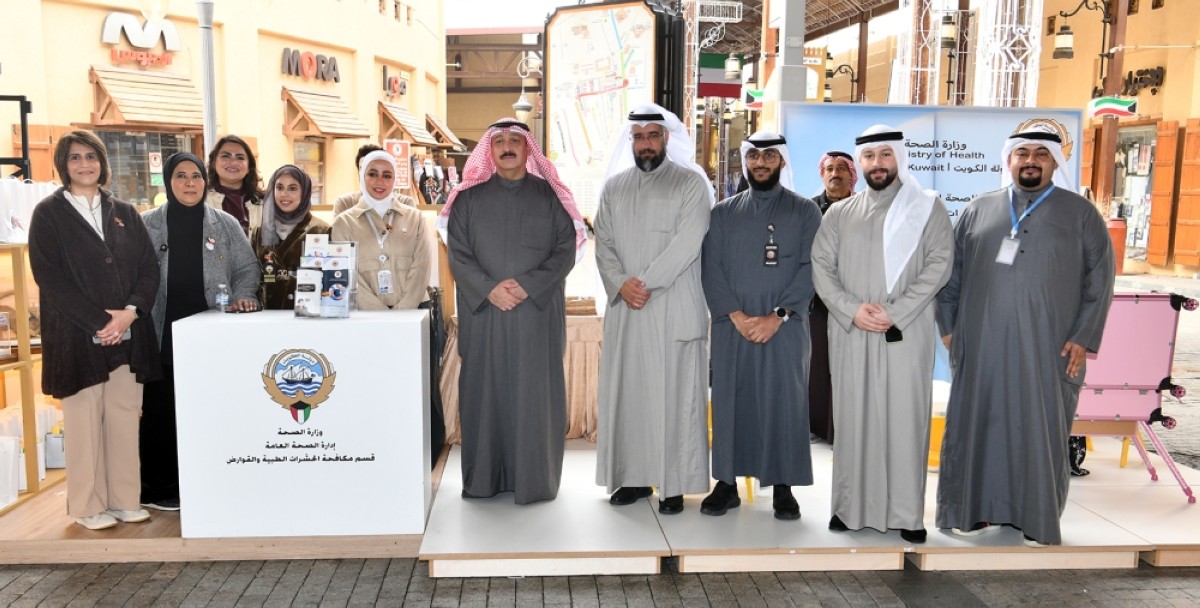
KUWAIT: Minister of Health Dr Ahmad Al-Awadhi said on Saturday that community participation in environmental sanitation plays a vital role in raising awareness, reducing environmental risks and promoting positive behaviors that enhance public health security. The minister made the remarks in a press statement during the opening of an awareness pavilion organized by the Public Health Department at the Ministry of Health in Souq Al-Mubarakiya, held under the slogan “Prevention is Better than Crackdown” as part of the national Environmental Sanitation campaign.
Dr Al-Awadhi highlighted that one of the main challenges facing environmental sanitation is the accumulation of environmental debris and the remnants of buildings and facilities left for long periods, which create breeding grounds for insects and rodents. He stressed that addressing these issues
is essential to ensuring a safe and healthy environment for all. He noted that during 2025, the Public Health Department conducted around 170,000 inspection visits to control rodents in various locations, aiming to reduce the health risks associated with environmental waste. These efforts were carried out through reports submitted via the “Salem” application or the hotline 151.
For her part, Director of the Public Health Department Dr Mona Al-Khabbaz said the pavilion aims to raise public awareness about the importance of environmental sanitation as an integrated system designed to protect community health by minimizing environmental hazards. She explained that a key focus of the campaign is waste management, noting that some individuals dispose of garbage on sidewalks and vacant plots near homes, or leave food scraps to feed animals. Such practices, she warned, create environments conducive to the spread of insects and rodents, leading to health problems within the community.
Meanwhile, Dr Fatima Al-Draiwesh, Head of the Medical Entomology and Rodent Control Section, Director of the Rodent Control Project and Vice Chair of the Environmental Sanitation Committee, stressed that environmental sanitation is a shared responsibility among government bodies, communities and individuals. She described it as a culture based on rationalizing resource consumption, reducing pollution, encouraging recycling and safeguarding public health.
Dr Al-Draiwesh added that the Ministry aims to make 2026 a starting point for a cleaner environment, purer air and more sustainable cities. This includes spreading environmental awareness, promoting positive practices in schools, homes and workplaces, and reinforcing the concept that a healthy environment is the foundation of sustainable development, a strong economy and a healthy society. – KUNA
