

Playing in an open field with his younger brothers near their home in northwest Syria last year, 10-year-old Mohammed spotted what looked to be a half-buried toy and began to dig it out of the dirt.
But he triggered an anti-personnel mine. The blast tore through the group, badly wounding Mohammed, along with Abdul, eight, and Azam, five. A massive crater still marks the spot in Khan Shaykhun, a town in Idlib province.
Arriving on the scene, the Syrian Civil Defence, also known as the White Helmets, scooped up the boys and rushed them 15km to the nearest hospital, where surgeons fought to save their lives.
Abdul and Azam both lost their right leg, with the left now held together by a metal frame. Azam also lost sight in one eye. Mohammed died of his wounds a few weeks later.
After five years living in an internally displaced persons camp near the Turkish border, the boys’ family had returned to their home just months earlier, following the December 2024 ousting of long-time president Bashar al-Assad.
New MEE newsletter: Jerusalem Dispatch
Sign up to get the latest insights and analysis on
Israel-Palestine, alongside Turkey Unpacked and other MEE newsletters
Around 2.6 million Syrians have returned to their homes over the past 14 months, many to towns and villages in former frontline areas where hidden landmines and unexploded ordnance pose a constant, deadly risk. Some 15 years after the civil war began, as many as 300,000 still-active explosive devices remain scattered across Syria, according to aid organisation Humanity and Inclusion.
“We believed it was finally safe,” Mustafa al-Azraq, the boys’ father told Middle East Eye. “If we had known landmines were everywhere, we would never have returned.”
Remnants of war
Across Syria, similar incidents occur almost daily as countless families seek to rebuild in a landscape ravaged by war.
According to the International NGO Safety Organisation (INSO), more than 1,600 people, including children, have been killed or maimed by mines and ordnance since the fall of Assad.
Idlib remains one of the most heavily contaminated areas. Once a strategic crossroads, it witnessed some of the fiercest clashes between government forces and opposition groups.
In 2019, as government troops, backed by Russian air support, launched a major offensive in Khan Shaykhun, a missile struck Mustafa’s home, killing his 18-month-old son.
Throughout the war, Assad’s forces laid anti-personnel and anti-tank mines around their positions, then planted improvised explosive devices and booby traps in homes, vehicles and public buildings as they withdrew. Rebel groups also left behind their own trail of deadly devices.


Years of air strikes and ground battles have left vast stretches of Syria in ruins. Neighbourhoods have been flattened, farmland scarred, and basic infrastructure destroyed or abandoned.
In many places, the line between civilian areas and former military positions has all but disappeared, leaving explosives buried beneath soil, rubble and collapsed buildings, posing a deadly risk to civilians.
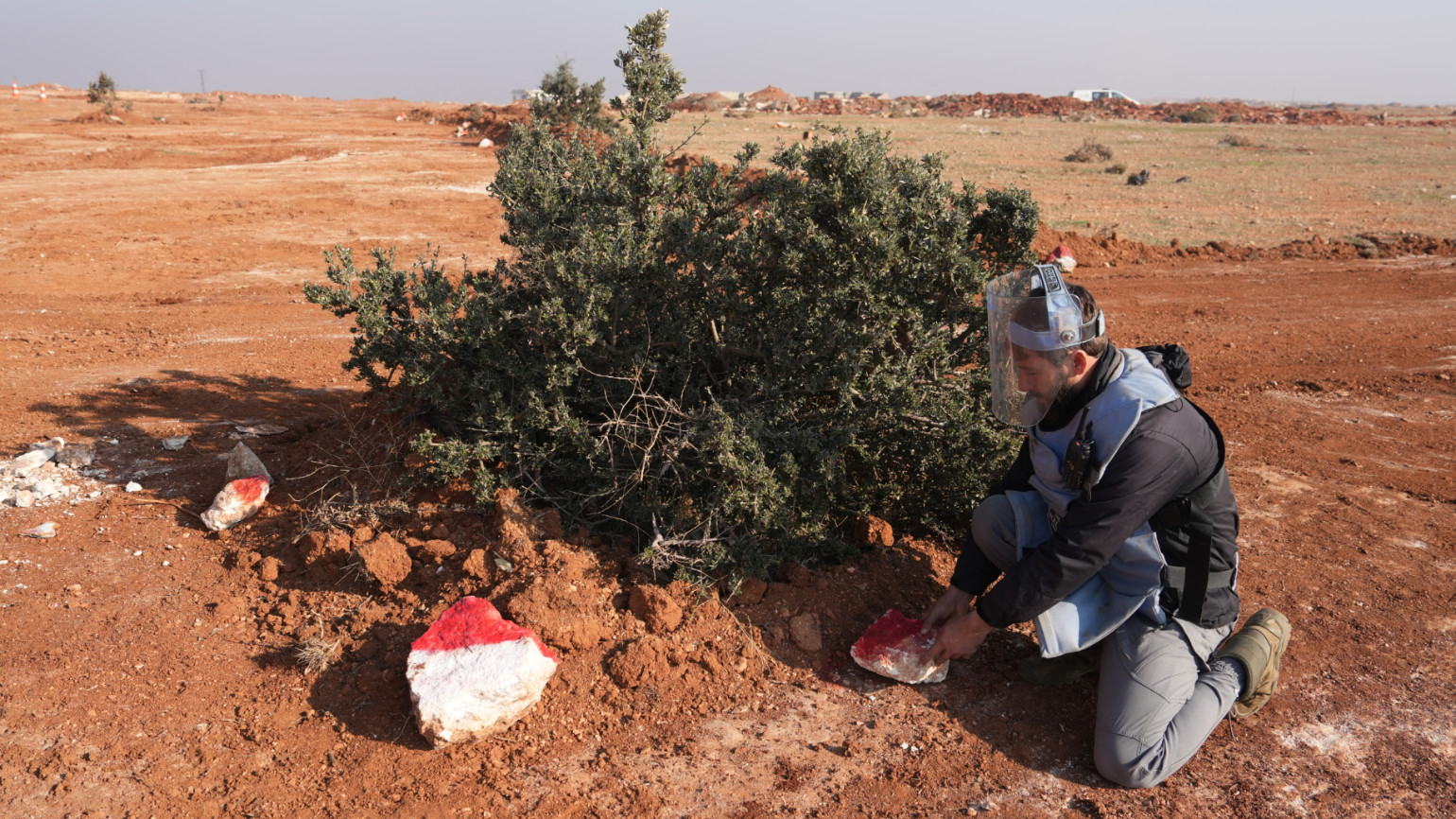
Demining charities such as the Halo Trust, the world’s largest humanitarian mine clearance organisation, have taken on the dangerous, painstaking task of clearing the land. Operating in Syria since 2017, the nonprofit now has 250 people working across the country.
“The scale of the task is enormous,” said Paul McCann, Halo’s global head of programme communications.
Focusing on a several hundred-kilometre front line running from southern Idlib to northern Aleppo, the NGO’s staffers destroy unexploded ordnance through “spot tasks” – small, controlled detonations. Their most common finds are cluster munitions, alongside artillery shells, rockets and grenades.
“We have been able to increase our training of local Syrian women and men to qualify them as bomb disposal experts, thanks to international donor support,” said McCann. “But we need to do much more. Four or five people are killed and injured by explosives in Syria each week.”
‘We could have saved his hand’
Syria’s decimated health facilities are ill-equipped to deal with emergency situations or provide long-term, specialised care to mine victims. A decade-plus of air strikes destroyed most hospitals and clinics and triggered an exodus of medical professionals – only some of whom have since returned.
At Idlib’s specialised surgical hospital, which serves a population of more than 100,000, staff struggle to cope with a steady stream of emergencies.
‘We believed it was finally safe. If we had known landmines were everywhere, we would never have returned’
– Mustafa al-Azraq
“Every day is a race against time and a lack of resources,” said Hamed Osman, the head of nursing at Idlib Surgical Specialised Hospital, speaking after a 14-hour shift.
On average, four patients arrive daily with injuries from landmines or unexploded ordnance. Most have complex wounds that require immediate surgery, blood transfusions, and specialised care.
“One of our biggest problems is the lack of medicines and surgical equipment,” said Osman.
Without proper tools and antibiotics, infections can spread rapidly, leaving doctors with little choice but to amputate. Osman recalled a nine-year-old boy rushed into hospital last week after stepping on a landmine near his home.
“We had to amputate the hand,” he said. “But with certain surgical equipment and a specialised hand surgeon, we could have saved it.”
Awareness campaigns
To prevent further injuries and deaths across Syria, aid groups call for large-scale surveying, clearance and mine-risk education.
The Manchester-based nonprofit Mines Advisory Group (MAG) has expanded its mine-risk education programmes in the country in recent months, focusing on the most heavily mined areas.
MAG teams travel to schools, homes and community centres, teaching children and adults to recognise mines and unexploded ordnance, and how to avoid them. MAG, which has extensive clearance operations in Syria, has also expanded its digital education efforts, has also expanded its digital education efforts in neighbouring Lebanon and Jordan, which host large numbers of Syrian refugees.

Using social media campaigns and targeted online advertisements, the NGO aims to reach displaced Syrians thinking of returning home, often to areas rife with mines.
“The risk of deadly accidents is higher than ever,” said MAG director Jon Brown. “Every message we deliver has the potential to prevent an injury or save a life.”
For millions of Syrians hoping to rebuild their lives, the end of fighting has not brought safety.
Until landmines and unexploded ordnance are cleared, vast parts of the country will remain deadly, and borderline uninhabitable.
For Mustafa, the dream of home has again been shattered. After Mohammed’s death, the family packed up what little they had and returned to an overcrowded displacement camp on the northern border.
“We thought the end of the war would bring safety,” the father said, “but our situation is worse now than before the fall of Assad.”
