

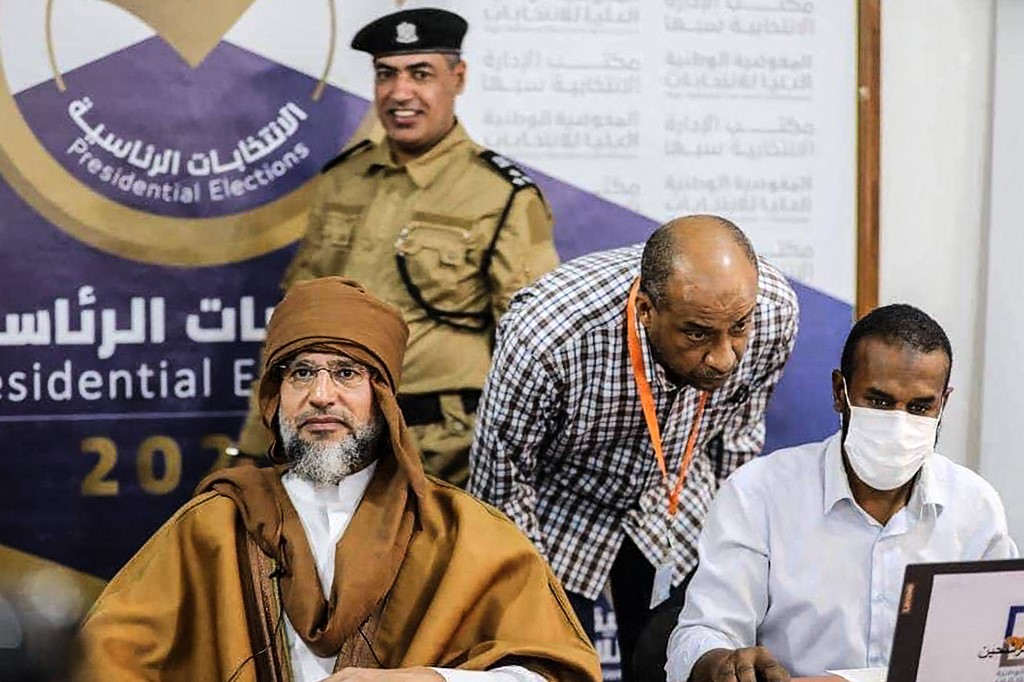
Rumours surrounding the killing of Saif al-Islam Gaddafi sparked immediate agitation on Libyan social media on Tuesday night.
A few hours later, in the early morning, Libya’s attorney general confirmed that the son of former long-time leader Muammar Gaddafi and designated heir had been “shot dead”.
Around the same time, the first images of the corpse of Saif al-Islam began circulating online. The lifeless body appeared to be lying in the back of a pickup truck, reportedly in a desert area.
According to his political advisers, Saif al-Islam was attacked by a four-man commando unit who “broke into his home, disabled the security cameras and killed him during a direct confrontation”.
At this stage, the political consequences of Saif al-Islam’s killing remain difficult to assess.
New MEE newsletter: Jerusalem Dispatch
Sign up to get the latest insights and analysis on
Israel-Palestine, alongside Turkey Unpacked and other MEE newsletters
“His importance was largely symbolic and narrative,” Jalel Harchaoui, an associate fellow at the Royal United Services Institute in London, told Middle East Eye, adding that Saif benefited from his position as “a political figure between 2005 and 2010”.
Born in 1972, Saif al-Islam was Gaddafi’s second son and the only one to have played a significant political role during the era of the Jamahiriya – the “state of the masses”, as the Libyan state was known until overthrown in 2011.
With a PhD from the London School of Economics, Saif al-Islam presented himself as a reformist. In the late 1990s, his Gaddafi International Charity and Development Foundation developed an active form of parallel diplomacy, helping to offset his father’s pariah status in the West.

Muammar Gaddafi’s son, Saif al-Islam, killed in Libya
Read More »
During the 2011 uprising that led to a civil war, Saif al-Islam was the object of an International Criminal Court arrest warrant for the crimes against humanity of murder and persecution, allegedly committed against protesters and dissidents.
Shortly after his father’s killing in October 2011, Saif al-Islam was arrested by powerful armed groups from the Zintan region and held in the mountains of the north-west of the country, some 100 kilometres south of Tripoli.
Although observers have often suggested that he had disappeared or that his whereabouts were unknown, it was in this same region that Saif al-Islam was killed on 3 February, suggesting that he may never have truly left the area.
The attorney general’s office announced it had opened an investigation into the case, while the United Nations Support Mission in Libya said it “strongly condemns this targeted killing”.
Yet, Saif al-Islam’s very existence had long been a political embarrassment for most Libyan armed factions.
His killing fits into a broader pattern of political assassinations in western Libya over recent months, most of which have gone unpunished.
A symbolic but moderate influence
On social media, segments of the Libyan public have shared posts and stories mourning the death of Gaddafi’s son.
“Saif al-Islam Gaddafi was an influential public figure with a certain degree of popularity,” a prominent Libyan journalist told MEE, speaking on condition of anonymity.
“But it is difficult to measure its true extent, as no research centres have conducted polls to assess his actual influence.”
‘Saif al-Islam Gaddafi was an influential public figure with a certain degree of popularity’
– Libyan journalist
Images circulating online on Tuesday night appeared to show groups of women crying in the streets of Sirte, a historic Gaddafi stronghold.
“His prolonged absence from the media and the lack of political communication suggest that many of his supporters backed him primarily because he was Gaddafi’s son,” the journalist added, stressing that Saif al-Islam symbolised a feeling of “security and stability that they lost after 2011”.
The conditions of his detention by Zintani militias following the revolution that led to the killing of Muammar Gaddafi allegedly left him with severe psychological trauma.
“His mental health issues prevented him from mobilising large crowds and maintaining an effective media presence,” Harchaoui said, adding that “restrictions on his mobility also constituted a major obstacle”.
Despite these constraints, Saif al-Islam had announced his intention to run in the presidential election initially scheduled for 2021 – but that was ultimately never held. The high level of popular support for his candidacy was reportedly among the factors that led to the annulment of the poll.

ANALYSIS: Gaddafists rally forces as Libya yearns for stability
Read More »
“A large number of Libyan voters, including young people who do not remember the pre-2011 era, harbour deep resentment towards the post-revolutionary elites,” Harchaoui said, in reference to the division of the country into two rival administrations since the revolution.
In his speeches, Saif al-Islam played on that resentment and regularly denounced both Prime Minister Abdul Hamid Dbeibah’s clan, which leads the internationally recognised government in Tripoli, and the Haftar family, who rules over eastern and southern Libya from Benghazi.
However, Saif al-Islam’s strategy of positioning himself outside the two factions ultimately distanced him from centres of power in both Tripolitania and Cyrenaica.
Several diplomatic sources contacted by MEE assessed that Saif al-Islam’s real influence on current political affairs was, in practice, almost non-existent.
Still, the fact that he maintained a political team and advisor underscores that he never fully abandoned his ambition to play a role in Libya’s political scene.
Plenty of enemies, no clear successor
For the time being, the most sensitive issue remains the attribution of the operation.
“I am almost certain that the case will be closed and gradually forgotten,” the Libyan journalist told MEE.
“This only deepens public anger over the culture of impunity that has become the norm in all major cases related to security and murder,” he added.
Shortly after the killing, claims circulating on social media pointed to Mahmoud Hamza, commander of the 444 Brigade and a major ally of Dbeibah’s clan.
‘It will now be more difficult for the many security actors who relied on residual sympathy for the Gaddafi era to sustain that narrative’
– Jalel Harchaoui, Royal United Services Institute
Hamza’s armed group has emerged as one of the most powerful factions in western Libya, following a series of offensives and the neutralisation of rival militias, notably the Stability Support Apparatus and Radaa, in the spring and summer of 2025.
On Tuesday evening, the 444 Brigade quickly issued a statement denying any involvement, stressing that it “has no military forces or field deployment inside the city of Zintan or within its geographical perimeter”.
Other online outlets also relayed unverified claims suggesting that the killing may have been ordered by Saddam Haftar, son of eastern commander Khalifa Haftar, whose influence in Libya’s south-west has grown steadily in recent years.
In November 2021, as Saif al-Islam was appealing a decision barring him from running in the presidential election in the Haftar-controlled city of Sabha, gunmen disrupted the hearing.
Analysts believe that Saif al-Islam was threatening both sides by proposing a third option, at the very moment they were trying to divide Libya between themselves.
Contacted by Middle East Eye, the foreign ministries of the rival governments based in Benghazi and Tripoli declined to comment on the incident.
Voices, especially in Gaddafi circles, also point to an operation led by foreign actors, while some even link the assassination to the appeal trial of former French President Nicolas Sarkozy, convicted in the case of Libyan financing of his presidential campaign in 2007.
Yet, no evidence shows that external actors have been involved, for the moment.
“Many people imagine international conspiracies or commando-style operations launched from outside Zintan,” Harchaoui explained.

Saif al-Islam Gaddafi says he was involved in Libyan financing of Sarkozy’s election
Read More »
According to the researcher, available evidence instead suggest that the killing may have resulted from “a strictly local, intra-Zintan incident”.
The city where Saif al-Islam was held has long been marked by deep internal divisions between factions aligned either with Tripoli or Benghazi.
“The fact that he lived in the city, moved in and out under the protection of his own small armed brigade, created growing tensions over the years,” Harchaoui said.
Ultimately, Saif al-Islam’s killing removes a central figure from the pro-Gaddafi narrative, which had been instrumentalised by some armed factions and small non-aligned groups seeking to position themselves outside both the Dbeibah and Haftar camps.
“It will now be more difficult for the many security actors who relied on residual sympathy for the Gaddafi era to sustain that narrative,” Harchaoui added.
All of Muammar Gaddafi’s other children are either deceased or have left Libya, and none has played a role in the country’s political life in recent years.
So far, none has publicly reacted to their brother’s death. For the time being, pro-Gaddafi and non-aligned actors are hence left without any symbolic figurehead.
