

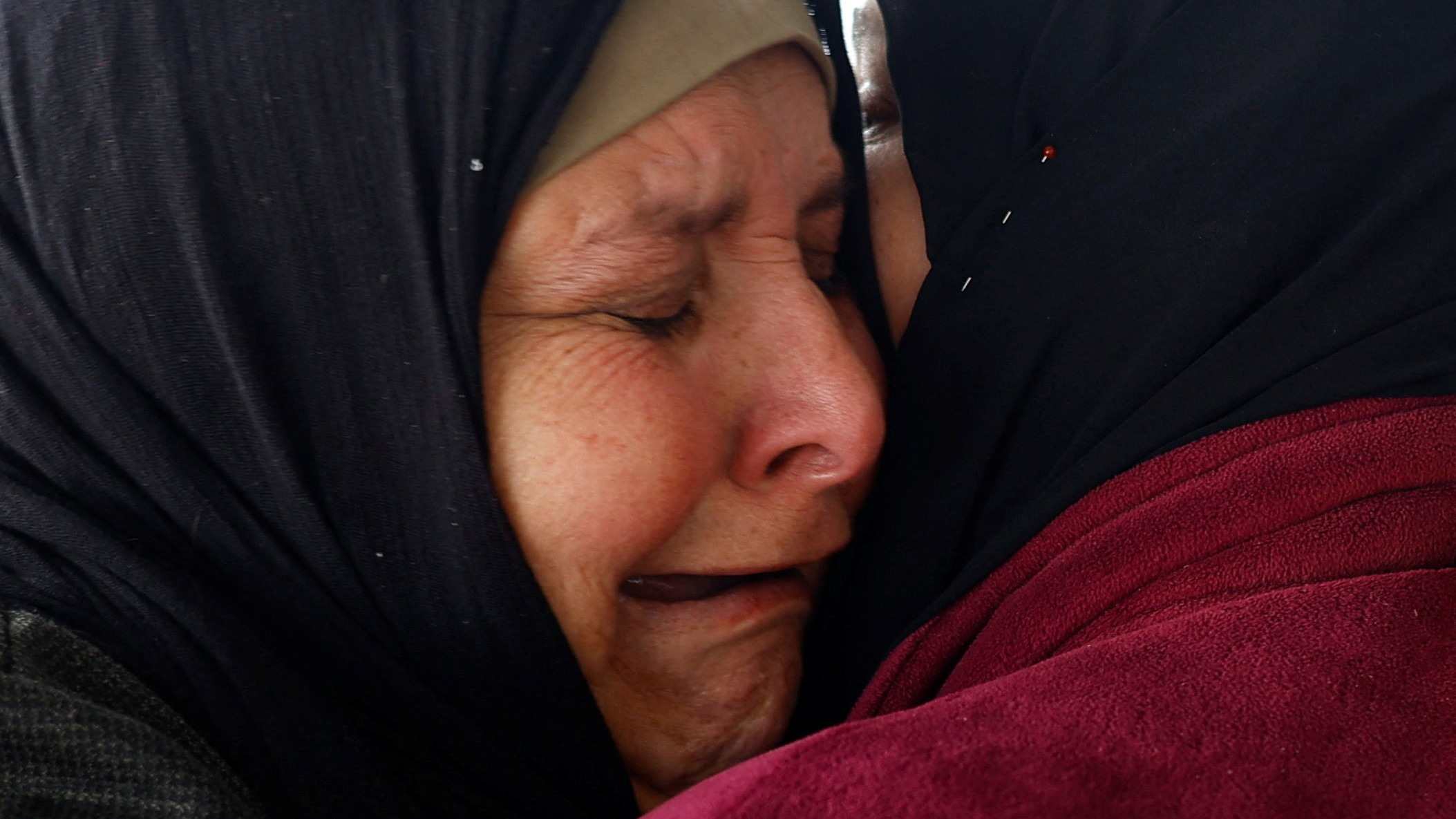
Huda Abu Abed feared only long waits and Israeli checks when she was told she could return to Gaza after two years in Egypt.
The 57-year-old Palestinian heart patient expected delays at the Rafah crossing, but she never imagined being blindfolded, interrogated for hours, witnessing her daughter beaten, and having her belongings confiscated.
Abu Abed had been evacuated to Egypt during the genocide for urgent medical treatment, accompanied by her daughter.
She was among the first group of Palestinians contacted by the Palestinian embassy in Egypt to return on Monday, following the partial reopening of the Rafah crossing – the first since May 2024.
The crossing reopened under heavy Israeli restrictions and monitoring, limiting the number of people allowed to enter or exit, and subjecting returnees to physical searches at a checkpoint in Rafah.
New MEE newsletter: Jerusalem Dispatch
Sign up to get the latest insights and analysis on
Israel-Palestine, alongside Turkey Unpacked and other MEE newsletters
Abu Abed was one of just 12 people who completed the long and exhausting journey on Monday.
Their first step was to pass through the Egyptian side of the border, where they were treated “with dignity”, Abu Abed told Middle East Eye.
But everything changed once they reached the Palestinian side, where they were first met by European border monitors, then Israeli-backed militias, and finally the Israeli army.
‘Worst treatment’ by EU supervisors
Under the new arrangement at the Rafah border crossing, travellers to and from Gaza are stopped on the Palestinian side by Palestinian staff and European Union Border Assistance Mission (Eubam) supervisors.
They are responsible for searching and inspecting people and coordinating with Israeli authorities to approve who may return to Gaza.
‘We had to wait for Israeli approval of our names before we could enter our own country’
– Huda Abu Abed, Palestinian returnee
When Abu Abed and her group reached that section of the border, she said the treatment was “the worst”.
“I had bought toys for my grandchildren and was carrying essential medication for heart disease, blood pressure and diabetes,” she explained.
“The European delegates searched my bags and confiscated the toys, my medicine, my mobile phone, and seven new phones I had bought for my children and siblings. They took everything.”
Abu Abed said only the Eubam staff decided what returnees could keep.
“The Palestinian staff were just there to search. The Europeans told them what to confiscate. Not even food was allowed – only clothes,” she said.
Despite the loss of gifts and medication, Abu Abed insisted on recovering her personal mobile phone.
“I begged them to return it. It contained important personal information and family photos. After repeated attempts and a long wait, they finally gave it back to me,” she said.
“Even after the searches ended, we had to wait for Israeli approval of our names before we could enter our own country.”
Strict quota
Under the ceasefire agreement signed in October, Israel was required to reopen the Rafah border during the first phase.
However, Israeli officials said the border would only reopen after the return of the body of the last captive held in Gaza, which was recovered last week.
Israel eventually agreed to reopen the crossing but imposed a strict daily quota: only 50 Palestinian patients could leave Gaza, each accompanied by two people, while another 50 were allowed to return to the Strip.

From Epstein to Gaza: The depravity of the western elite is now fully exposed
Read More »
Returnees were limited to Palestinians who had fled Gaza during the genocide.
Those who left before 7 October 2023 and remained stranded abroad are still barred from returning.
As of late January, at least 30,000 Palestinians had registered with the Palestinian Embassy in Cairo to return to Gaza, according to an embassy official.
Under Israel’s quota, even if the border operated six days a week, allowing 50 people per day, it would take just short of two years for those in Cairo alone to return. Tens of thousands more remain stranded in other countries.
On the first day of the reopening, 42 people were supposed to return.
However, 30 of them were turned back, but it remains unclear who sent them back or where they are now.
‘Pack your belongings and get out of Gaza’
The 12 Palestinians allowed to return on Monday included nine women and three children.
After leaving the Rafah crossing, they boarded a bus escorted by an Israeli jeep at the front and another at the rear.
After a short drive, they were stopped south of Khan Younis by an Israeli-backed gang led by Ghassan al-Dahini, a criminal with past links to the Islamic State (IS).
“They ordered everyone off the bus,” Abu Abed said.
“An Israeli officer told one of them, ‘Bring that old woman.’ They grabbed me by the arm and handed me over to the Israelis.”
The Dahini-led gang is part of a wider militia network in Gaza created with Israel’s backing and linked to the Popular Forces, an armed group founded by Yasser Abu Shabab.
The group is involved in criminal activity in eastern Rafah and is opposed to Hamas. After Abu Shabab’s death in December 2025, Dahini emerged as a prominent leader.


Israeli officers took Abu Abed to a military barracks made of two caravans with checkpoint lanes, then forced her into an interrogation room.
“There were hundreds of Israeli soldiers in the barracks. They searched me with an electronic device, then a female soldier forced me to remove my abaya for a personal search,” she said.
“They made me wait about half an hour, then blindfolded and handcuffed me before taking me to the interrogation room.”
In the interrogation room, the officer questioning Abu Abed wore a balaclava, concealing his face, and spoke Arabic in a commanding tone, according to her.
“One male and one female officer were present. The male officer relentlessly asked: ‘Who do you know from Hamas? Is anyone in your family affiliated with Hamas? Why does Hamas use you as human shields? Why return to Gaza? Why didn’t you stay in Egypt?”
He added: “Tell all the people of Gaza: pack your belongings and get out.”
Beaten and humiliated
Her interrogation lasted two to three hours, with the first 30 minutes blindfolded.
Abu Abed later learned that her daughter, Rotana Atiyya al-Raqb, who is in her 30s, had been taken to a separate room, where a female Israeli officer beat and humiliated her.
“She dealt with her violently, grabbed her arm, and hit her head. She then told her, ‘Why did you come to Gaza? I would have brought your husband and children to follow you in Egypt. You should have stayed there.’”
Another woman, Sabah Ismail al-Raqb, returning with five daughters, was doused with cold water, blindfolded, handcuffed, and interrogated for about 90 minutes.
‘They told me they would facilitate my immigration… Then they asked me to collaborate, but I refused’
– Sabah Ismail al-Raqb, Palestinian returnee
“They told me they would facilitate my immigration, but I refused. Then they asked me to collaborate, but I refused again,” she said.
“The officer threatened me with detention and repeatedly questioned me about Hamas and my relatives. He threatened to beat me if I did not give convincing answers.”
The Israeli officer refused to release Raqb until a European convoy arrived and intervened on her behalf.
All 12 women and girls were allowed to board the bus again. They were taken to Nasser Hospital in Khan Younis, southern Gaza.
“After what we went through, I say no one should travel outside Gaza,” Abu Abed said.
“They want to force us out by all means.”
