

KUWAIT: The National Council for Culture, Arts and Letters (NCCAL) launched the second edition of the World Crafts Forum in Kuwait on Sunday, at the Kuwait National Library, in partnership with Al-Sadu Society and the World Crafts Council, as part of the 31st Qurain Cultural Festival.
The forum features nine panel discussions bringing together craft leaders, policymakers, researchers and artisans to examine the role of crafts in the creative economy. The sessions aim to produce practical recommendations that will be issued as the Kuwait Declaration. Running alongside the forum is an international crafts market, held from February 1 to 3 at the Kuwait National Museum in cooperation with Gardenia and open to the public. The market includes around 30 local and international artisans and offers a space for direct interaction, cultural exchange and support for craft-based livelihoods.
Dr Mohammed Al-Jassar, Secretary-General of NCCAL said that Kuwait’s hosting of the forum reflects its commitment to preserving traditional crafts and safeguarding national heritage. “Preserving crafts and passing them down from generation to generation is a challenging yet crucial task,” he said.
Al-Jassar stressed the importance of maintaining traditional crafts as an integral part of the nation’s heritage and identity.

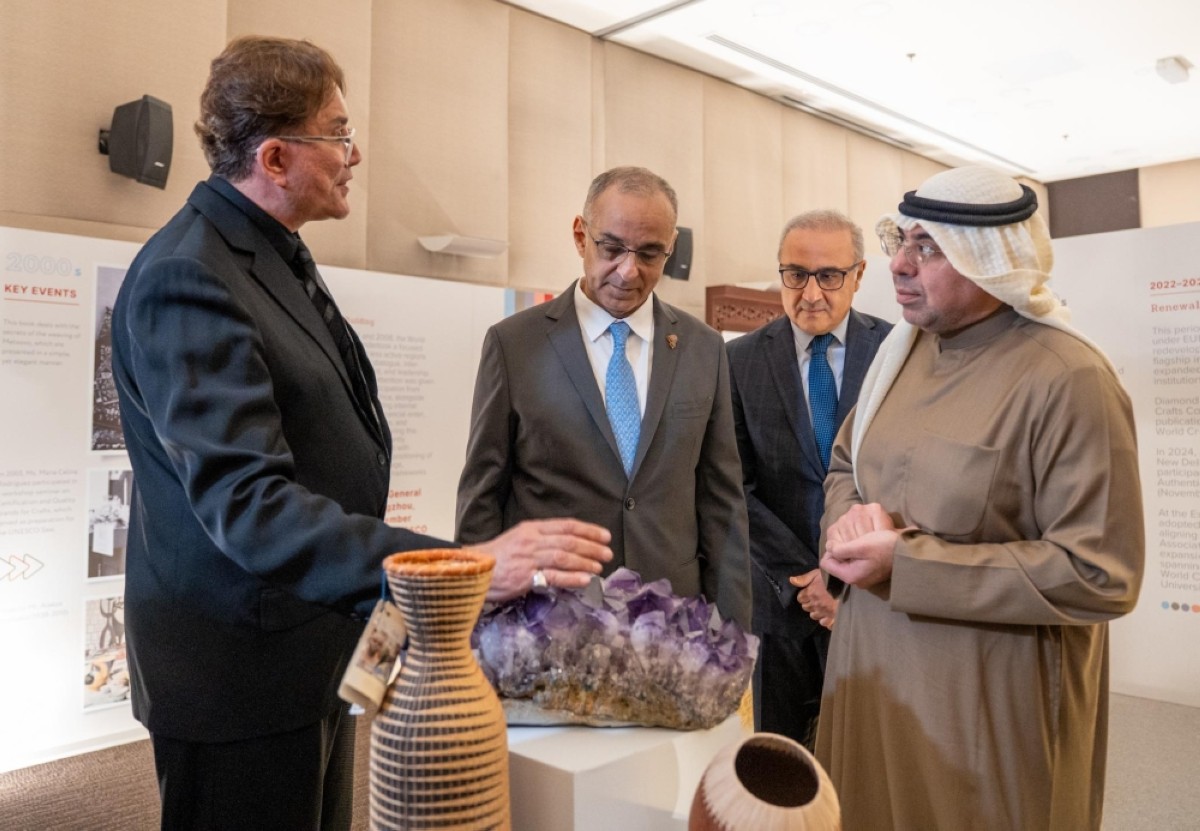
The forum includes an international crafts market featuring 30 local and international artisans. — KUNA photos


Sheikha Bibi Al-Sabah is seen with officials at the launch event.
He said Al-Sadu Society has worked tirelessly to preserve the Sadu craft in Kuwait. “The efforts of those in charge of this cultural institution have contributed to Kuwait being declared a global city for the Sadu craft.”
Director General of the Al-Sadu Society, Sheikha Bibi Al-Sabah praised the role of the political leadership, NCCAL and the World Crafts Council in supporting the society’s efforts. “Crafts have touched all segments of society around the world as a national identity and a tool for emotional expression of humanity and its culture,” she said.
President of the World Crafts Council Saad Al-Qaddoumi thanked His Highness the Amir, His Highness the Crown Prince, the Ministry of Information and Culture and NCCAL for making the forum possible.
“It is both an honor and responsibility to open the second World Crafts Council here in Kuwait, a country whose cultural leadership and institutional continuity have made it a trusted platform for global dialogue on crafts, culture and creative economies since 2013,” he said.
He said that the World Crafts Council was established on a simple yet powerful conviction that crafts are not preferred cultural expressions but living systems of knowledge, identity and livelihood. “Across continents and generations, crafts have sustained communities, transmitted cultural memory and enabled economic resilience, often in cases where few alternatives exist,” he said.
Qaddoumi added that the global craft sector supports hundreds of millions of livelihoods, many of them women-led and community-based, operating through the low-impact climate-responsive production system. He added that Kuwait’s role in this journey is both historic and foundational. “The institutional relationship between the World Crafts Council and the State of Kuwait dates back to 2012, when Dr Ghada Hijjawi-Qaddoumi, who was Kuwaiti, was elected as president of the World Crafts Council.”
He added that this made Kuwait the headquarters of the World Crafts Council, AISBL, for the region of Asia-Pacific at the time, marking the beginning of a partnership with Kuwait’s national cultural institutions between 2013 and 2019.
He said that the legacy continues today, as Kuwait assumes a foundational leadership role in the establishment of the World Crafts Council’s Arab State Region, with institutional support from NCCAL and the stewardship of Al-Sadu Society.
Qaddoumi honored the artisans, past, present and future, whose hands continue to connect cultures, sustain communities, and shape humanity’s shared future. “Together, let us ensure that crafts do not merely endure the future, but actively define it,” he said.
