

Palestinians abused in Israeli prisons are dying in unprecedented numbers due to medical neglect, and their bodies are not being returned to their families
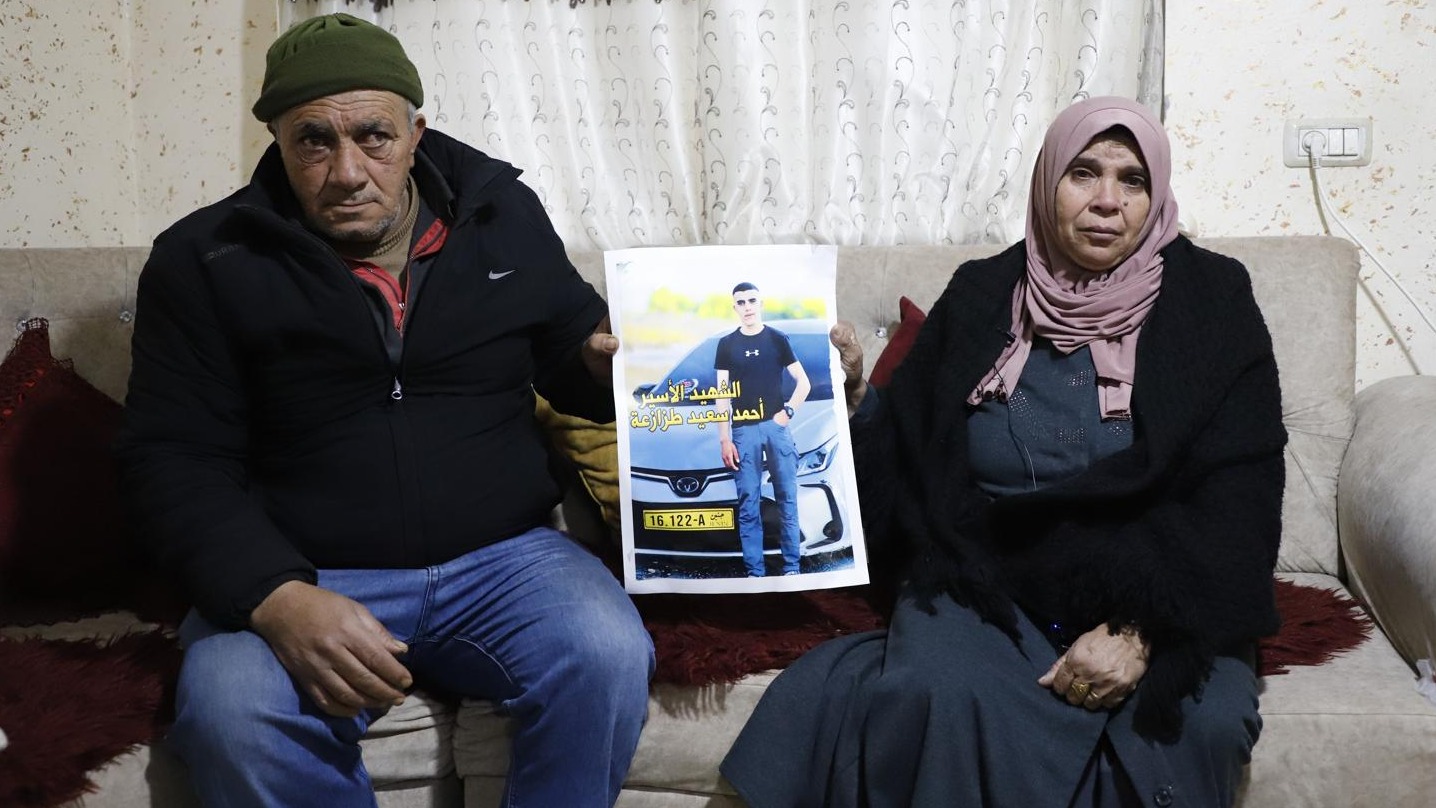
The parents of Ahmad Tazaza are plagued by grief and guilt over their son’s death last August in Israel’s notorious Megiddo prison.
Ahmad was a healthy young man, aged 20, with no history of known medical problems when they handed him over to the Israeli authorities in the occupied West Bank in January 2025.
His parents say they still do not know why their son, the youngest of three brothers, was a wanted man. But the circumstances of his detention were not dissimilar to those faced by thousands of other young Palestinians.
Ahmad was held as an administrative detainee, a form of arbitrary indefinite imprisonment without charge, trial, or access to lawyers. In September 2025, there were officially 10,465 Palestinian men held as “security prisoners”, including 7,425 from the West Bank and East Jerusalem, according to Israeli Prison Service data.
Over a period of months, the Tazaza home in the northern West Bank town of Qabatiya had been repeatedly targeted by Israeli security forces looking for him, and the family had been harassed and threatened.
New MEE newsletter: Jerusalem Dispatch
Sign up to get the latest insights and analysis on
Israel-Palestine, alongside Turkey Unpacked and other MEE newsletters
“They smashed the house and destroyed everything,” Najah Abdul Qader, Ahmad’s mother, told Middle East Eye.
“He was not at home; he was working at the market and was sleeping at the market that night. They took his brother and his father. In the morning, they released them and said, ‘We want him.’”
In a later phone call, Qader said, an Israeli soldier had threatened to bomb the house if Ahmad did not hand himself in. He had narrowly escaped already on one occasion by jumping out of a car as it was crushed by an Israeli bulldozer.
Eventually, having failed to find him, Israeli forces came and detained his brother a second time. Saeed Tazaza, Ahmad’s father, recalls what happened next with tears welling in his eyes.
“They said: ‘We will not release him until you bring your [other] son.’ His brother is married with two children. So we told Ahmad we wanted to see him. We caught him and took him.”
Accompanied by their other son, Ahmad’s parents delivered him to the Salem checkpoint near Jenin.
“We handed him over,” said Qader. “He looked at us and I knew he would not return. I felt he was not coming back when he turned his face and walked away.”
As Ahmad disappeared, his parents told themselves they had saved his life; that he would spend some time in prison and then be released.
“I handed my son over because I was afraid for him. I was afraid he would die,” said his father. “We were forced, and we handed him over. What could we do? This is our fate.”


The couple were aware of the harsh treatment and suffering that lay in store for their son as a prisoner.
“He said to me, ‘Mum, they torture people in prison’. I told him, ‘Let them torture you, but not kill you, not shoot you’. Today in the street they shoot a person who has done nothing,” said Qader.
“I regret it now. I handed him over to death with my own hands. I handed my son to my enemy. But that’s it. We wanted to protect him.”
Denied medical treatment
Ahmad Tazaza died aged 21 at Megiddo prison on 3 August 2025, according to a post-mortem report seen by MEE.
The report, dated 8 August, was written by a doctor working for Physicians for Human Rights Israel (PHRI), a rights groups which, when permitted by Israeli authorities, sends observers to monitor autopsies of Palestinian prisoners.
It noted that Tazaza was “reported to be healthy” at the time of his detention.
His prison records indicated that he had suffered from diarrhea and scabies, and he had complained of a sore throat a few days before his death. On 2 August, he was seen by the on-call physician who noted blood stains on his trousers.
The report said: “During the clinic visit, Mr. Tazaza requested to go to the toilet and later collapsed to the floor, losing consciousness and vital signs. Resuscitation attempts were initiated, but despite intubation and CPR, he was pronounced dead.”
According to the report, the autopsy revealed possible indicators of a serious blood cancer condition such as acute leukaemia or aggressive lymphoma. There was no evidence of “sudden death causes”, it said.
But, in the absence of his body, which is still being held by the Israeli authorities, Ahmad’s parents strongly dispute the account of his death presented by the post-mortem report.
They had been unable to see Ahmad or speak to him during his eight months in prison, and had mostly relied on news about him passed on by other prisoners after their release.
They were told of his death by an International Committee of the Red Cross liaison officer, though the ICRC has not had access to Palestinians in Israeli prisons since 7 October 2023.
“His health was good. He had never been examined by a doctor in his whole life. There was absolutely nothing wrong with him,” his mother said.
One man, who had visited the family before he died, said Ahmad had asked him to pass on the message that he needed a lawyer, and told them their son was in good health.
Speaking on condition of anonymity, out of fear that he would be arrested again, the same man told MEE he had seen Ahmad four days before his reported death, and he had appeared fine.
After his release, the man said, he had heard there had been a crackdown in the section of the prison where Ahmad was being held. Some said Ahmad had been bitten in the throat by a dog and the wound had become infected.
“Other prisoners said he died because they didn’t provide him with medical treatment after they beat him and he had a serious injury in the neck,” he told MEE.
The man had spent 18 months in prison, he said.
“The conditions are beyond anything you can imagine. They beat you from the moment you are arrested to the moment you leave. There is no safety. You go to sleep with fear, you shower with fear. They raid the cells every day.”
MEE has not been able to verify these accounts of Ahmad’s death. The Israeli Prison Service had not responded to MEE’s request for comment on the matters raised in this article at the time of publication.
But the details are consistent with testimonies of former prisoners recorded by Israeli human rights organisations including B’Tselem and PHRI.
In a report last week, B’Tselem described Israel’s prison system as a “network of torture camps” which, it said, “must be understood in the context of Israel’s coordinated onslaught on Palestinians as a collective since October 2023”.
Prisoners had been subjected to “frequent, institutionalized, organized violence and abuse”, including sexual violence and attacks by dogs.
Living conditions were described as “inhuman”, with prisoners held in filthy, overcrowded cells and denied adequate food, and denial of medical care to prisoners constituted a form of torture in itself, B’Tselem said.

‘I have the prison inside me’: The emaciated Palestinian bodybuilder broken by Israel
Read More »
Out of 84 prisoners known by B’Tselem to have died in prison, the bodies of just four had been released, it said.
On Sunday, Israel’s Haaretz newspaper reported that Israel is currently holding the bodies of at least 776 identified Palestinians and 10 foreign citizens, including at least 88 who died in Israeli custody, citing figures collated by Al-Quds Legal Aid and Human Rights Center (JLAC), a Palestinian rights organisation based in Ramallah.
It said the figures indicated that Israel was holding the bodies as a deliberate “policy of revenge and intentional inflicting of suffering on families”.
In November, PHRI reported that at least 94 Palestinians had died in Israeli prisons between October 2023 and August 2025, as part of what it described as an official policy targeting detained Palestinians, which had led to an unprecedented number of deaths.
It said Israel’s prison service and military had systematically covered up the circumstances in which prisoners had died, including by failing to notify families of deaths in custody, refusing to return bodies, conducting post-mortems without a family-appointed physician being present, and delaying post-mortems.
Since November, the number of confirmed deaths has risen to at least 101, Naji Abbas, PHRI’s director for prisoners and detainees, told MEE.
“In the past year the main cause has been medical negligence,” said Abbas.
“When we say medical negligence here, we are not talking about negligence in the pre-war sense, such as delayed appointments, cancelled appointments, or procrastination.
“We are talking about a policy, effectively an official policy, of preventing medical treatment. Today, the Palestinian prisoner or detainee has no ability to see a doctor when and where they need to. This possibility does not exist.”
Former detainees also told MEE how they had been denied treatment for serious medical conditions while in prison.
Muhammed Shalamesh was arrested aged 17 in January 2024 and spent the next two years in prison, held under administrative detention conditions.
During that time, Shalamesh said he had been subjected to regular beatings and made to undertake forced labour for four months.
But he said he had also endured worsening chronic pain because of the denial of treatment for injuries suffered when he was shot by Israeli soldiers at the entrance to Jenin refugee camp in June 2023.
Shalamesh lifts his black hoodie and white t-shirt to reveal the scars where bullets hit him in the chest and the abdomen. Most of the middle finger on his right hand – where he was struck by a third bullet – is missing.

“Gradually, the pain increased, the pain from my injuries kept getting worse. I continued to suffer until I could no longer stand on my feet,” he said.
“I went to the doctor and told him I needed treatment and that I could not sleep at night. He told me, ‘You came here to die, not for us to treat you.’
“I asked him, ‘You’re not going to treat me?’ He said, ‘No. If I could kill you, I would kill you.’”
Shalamesh’s condition continued to worsen. Whilst being moved to Negev prison, he said he was beaten with iron batons inside the prison transfer van.
Eventually, Shalamesh said, he was given painkillers, but only after his condition had seriously deteriorated and days before he was released and finally taken for treatment at Ramle Prison Hospital.
“When they saw that my condition had reached its worst, they began to treat me, but it was not proper treatment. They saw that I was about to be freed and that my condition had deteriorated to the point where I could die in prison,” he said.
“Despite being injured, I was treated like everyone else. I saw people who died in prison due to lack of treatment, repression, beatings, and the absence of medical care. I was afraid that at any moment I might die because of the lack of treatment.”
‘Like the year 1800’
Ahmad Zaoul and his wife, Um Khalil Zaoul, are still searching for answers about their death of their 26-year-old son, Sakhr Zaoul, in Ofer prison on 14 December 2025.
Sakhr, whose family is from Husan, near Bethlehem, had been in Ofer for just two weeks, having been moved there from Etzion prison where he had been held since his arrest in June.
He had previously spent three years in prison and was classified as a security prisoner, held in administrative detention.
Prior to his arrest, Sakhr had no health problems, his father said, and had been making plans to open his own restaurant.
“During his detention, we relied on those who were released to tell us about him. They said he was fine and in good health. But in the last two weeks, there was no news at all,” he told MEE.
Following his death, Sakhr’s parents learnt from former prisoners that their son had fallen ill but had not received medical treatment.
“We were told that his condition involved swelling, vomiting blood, and a high temperature,” Ahmad Zaoul said.
Sakhr’s post-mortem report records that he was “healthy” at the time of his arrest, and had been prescribed antibiotics six days before his death.
At 1am on 14 December, prison medical staff were called to assist him, but shortly afterwards, he vomited blood and collapsed. At 2.30am he was pronounced dead.
The report notes that Sakhr had undergone heart surgery as a young boy, and may have died as a result of hemoptysis – blood flooding his lungs – caused by complications linked to the operation.
But Sakhr’s body has not been returned to the family, and his parents believe his death is more likely linked to the violence meted out on detainees and conditions in the prisons.

“They kill our children and then look for excuses, saying maybe he was ill,” said Um Khalil Zaoul.
“My son had an operation when he was six. He grew up, was imprisoned, and was beaten up a hundred times over. And now they say he died because of an operation he had at the age of six?
“If it affected him, then release him and I would treat him, send him to a hospital, let me know, don’t let me wake up in the morning to find that I no longer have a son.”
Naji Abbas, of PHRI, notes that the post-mortem reports seen by the families of Ahmad Tazaza and Sakhr Zaoul are preliminary and that further investigation is necessary to determine the causes of their deaths with greater certainty.
He acknowledges, too, that their findings will remain contested and open to challenge while the Israeli authorities continue to hold their bodies.
But he said that both men’s deaths highlighted the fatal threat posed by deliberate medical negligence to all Palestinian prisoners.
Abbas said: “This policy, combined with starvation and assaults, places all 10,000 prisoners at risk. Today, even the smallest infection can lead to death. This reality resembles the year 1800. Even a skin infection, entering the bloodstream through a wound, can lead to the collapse of all body systems.”
Ahmad Tazaza’s clothes are still hanging in his wardrobe at home, his mother, Najah Abdul Qader, told MEE.
Since his death, she said, she had experienced “black days, every day. I sleep crying and wake up crying. If crying were to bring him back, I would cry day and night”.
Without a body to bury, Ahmad’s parents cling to hope he may be alive, repeating a story they have heard of a prisoner who turned up in Bethlehem after previously being reported dead.
“I want to see him. I want to see him even if he’s dead,” said Qadir.
“They say he died, and I don’t believe he died. But God willing, he will come out alive. I want to see him. It reassures a person’s heart, if he is dead, to bury him with one’s own hands and know that he has a grave. Why are they holding him? What do they want from him?”
