

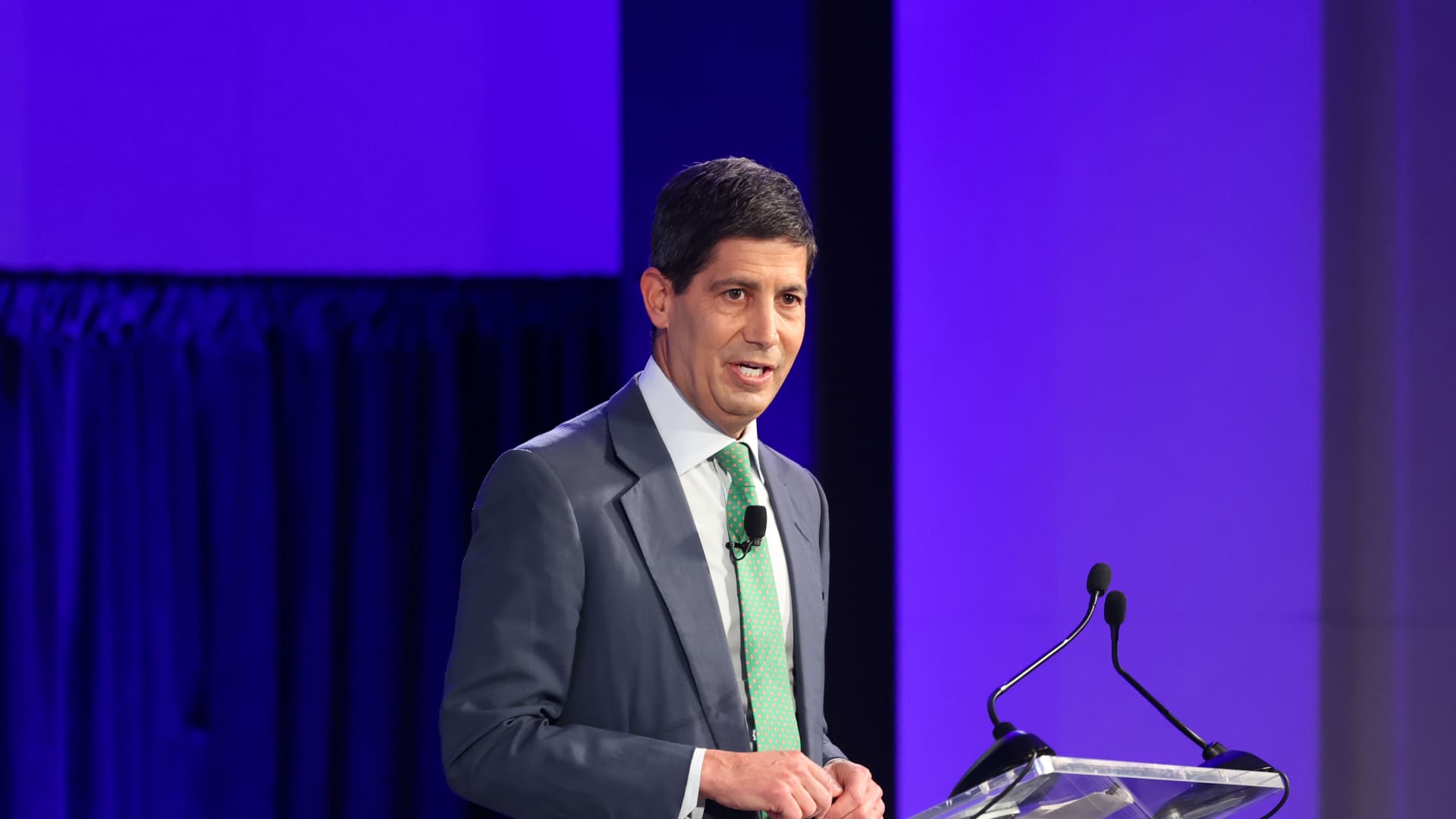
Kevin Warsh, former governor of the US Federal Reserve, during the International Monetary Fund (IMF) and World Bank Spring meetings at the IMF headquarters in Washington, DC, U.S., on Friday, April 25, 2025.
Tierney L. Cross | Bloomberg | Getty Images
Markets got what they wanted.
U.S. President Donald Trump tapped Kevin Warsh to lead the Federal Reserve, and investors exhaled. Markets were reassured by Warsh’s experience in the central bank — he served between 2006 and 2011, a period marked by the Global Financial Crisis — and the perception that he won’t always bend to Trump’s will.
“Kevin Warsh’s nomination for Fed Chair is exactly what markets were hoping for, as he’s a steady hand, well known in market circles and is expected to maintain the independence of the central bank, which is critical for markets,” said Richard Saperstein, chief investment officer of Treasury Partners.
The U.S. dollar strengthened following Trump’s announcement, signaling the market’s approval of Warsh’s credibility and perceived autonomy.
Risk assets, however, fell. On Friday, major U.S. indexes closed lower on the back of flagging tech stocks.
Commodities faced a severe sell-off. Spot gold and spot silver — seen as safe-haven assets to hedge against U.S. volatility — plunged nearly 9% and 31.4% on Friday, respectively, with latter hitting its worst day since March 1980. Both precious metals continued to tank Monday during Asia hours, with gold falling around 8% and silver slumping roughly 10.5% as of 2:30 p.m. Singapore (1:30 a.m. ET).
Cryptocurrency also plummeted, with bitcoin trading around $75,103, the first time it’s dropped below $80,000 since April.
The fallout in Asian markets was as severe. South Korea’s Kospi sank more than 5%, which triggered a temporary pause in trading, according to an official note. Hong Kong’s Hang Seng Index lost nearly 3% and Japan’s Nikkei 225 shed approximately 1%.
Oil prices also slid, with global benchmark Brent falling 5.3% and U.S. crude losing 5.5%. Their price movements, however, were more a result of Trump telling reporters on Saturday that Iran was “seriously talking” with the U.S., calming fears of an oil supply shock.
For the week ahead, tech giants Alphabet and Amazon will report earnings on Wednesday and Thursday, respectively, giving investors some hope that strong reports could turn around the risk-off sentiment in markets.
What you need to know today
Kevin Warsh, explained. While at the Fed from 2006 to 2011, Warsh played an important role in the design and implementation of programs to stabilize credit markets. However, Warsh emerged from the era as a Fed critic.
‘Confident’ government shutdown will end by Tuesday, said U.S. House Speaker Mike Johnson on Sunday. He added that he believes he has the votes to end the partial government shutdown by Tuesday.
China’s factory activity grows at fastest pace since October. The seasonally adjusted RatingDog China General Manufacturing PMI, compiled by S&P Global, rose to 50.3 in January from 50.1 in the previous month, as expected. That marked the strongest level since October, when the private survey came in at 50.6.
Asia-Pacific markets fell Monday. South Korea stocks plunged, triggering a pause in trading, while other regional indexes also slumped. Major U.S. indexes fell Friday, with the S&P 500 posting its third straight losing day but still notching a gain for January.
[PRO] Eyes on Alphabet and Amazon earnings. In a busy week of earnings, the Google-parent is set to announce results on Wednesday after the bell, while Amazon’s comes out on Thursday after markets close. CNBC’s Fred Imbert breaks down what to expect.
And finally…
Why the catastrophe bond market is so hot right now
The issuance of catastrophe bonds ballooned to $25.6 billion in 2025, according to specialist data provider Artemis.bm, eclipsing the 2024 record of just under $17.7 billion by a whopping 45%. First created in the 1990s, CAT bonds refer to a type of financial instrument designed to raise money for insurers in the event of a natural disaster, such as a hurricane or earthquake.
The emergence of this asset class as an increasingly mainstream financial instrument comes at a time when the climate crisis is leading to an increase in both the frequency and intensity of extreme weather events.
— Sam Meredith
