

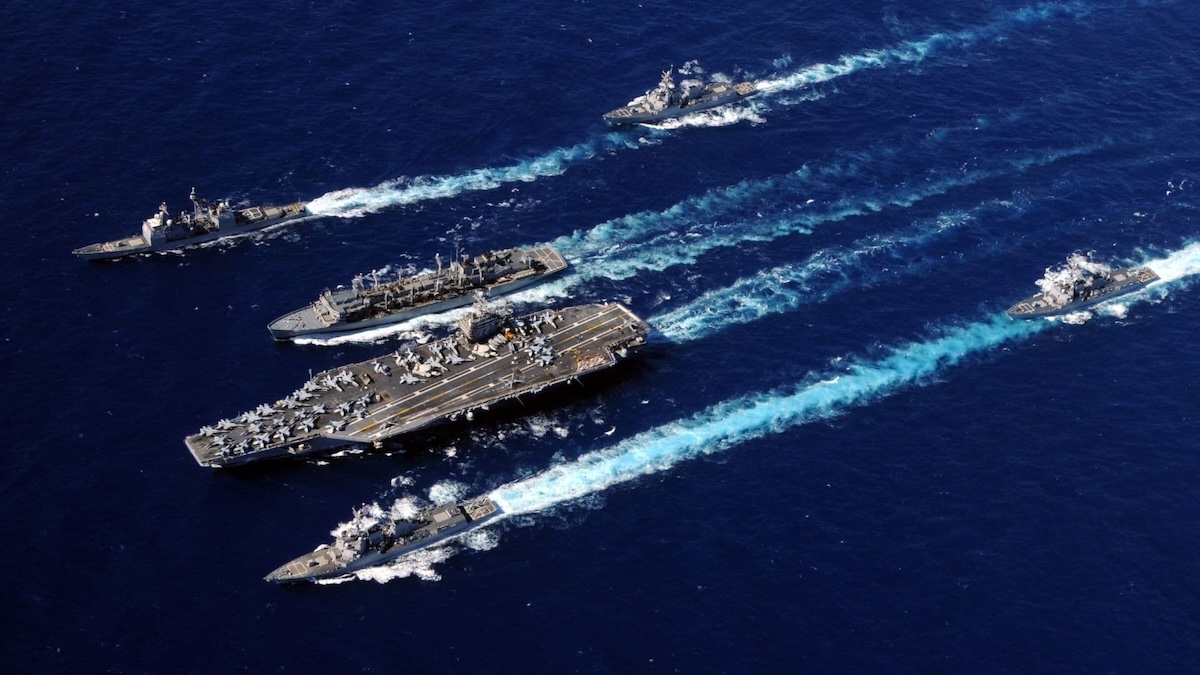
Every country’s foreign policy, said a wise Asian leader many years ago, combines elements of theology with practical diplomacy. However, in today’s unpredictable world it can be hard to tell the difference between practical actions and theological gestures. Perhaps Iran is therefore fortunate to be ruled by theologians, for the Ayatollahs must now judge whether Donald Trump’s dispatch of what he calls a “massive armada” to their shores is merely a symbolic, even theological act, or conveys real intentions of belligerence.
Definitely, the prospect of a second wave of American bombing of Iran in less than nine months needs to be taken seriously. Yet unlike the Israeli-American attacks on the country’s nuclear facilities last June, or the American raid on Venezuela earlier this month, it is hard to discern what the purpose of a new war on Iran would be.Bottom of Form
So much of Trump’s presidency has involved noisy statements and theatrical gestures that it is tempting to see his latest threats against Iran as performance rather than reality. Yet sending an armada involving the aircraft carrier USS Abraham Lincolnis an expensive sort of gesture. Once military forces are in place, it is tempting to use them. Doing so without a clear purpose, however, risks being more theological than practical.
Trump has said that Iran must do two things to avoid being attacked. The first is “no nuclear.” The second is “stop killing protestors.” But as he had previously claimed that last June’s American bombing had already “obliterated” Iran’s nuclear facilities it is not obvious what more the Iranian government can do now, beyond declaring (as it has already done) that it has no plan to develop nuclear weapons.
He made that same demand about not killing protestors well before Iran’s recent slaughter of tens of thousands, yet did nothing to stop it. Now that the regime’s brutal crackdown has already brought the situation on its streets back under control, to the families of the dead Trump’s second demand will sound like a sick joke.
This lack of purpose is probably why two of America’s closest allies in the region, Saudi Arabia and the United Arab Emirates, have said they will not allow their airspaces to be used for a new attack on Iran. An attack without a clear objective, they seem to think, just risks retaliation and perhaps escalating into a war that lasts a lot longer than last year’s 12-day Israeli-US battle with Iran.
Targeting Khamenei?
So, what will happen? The safest bet is to assume that despite his allies’ opposition and the emptiness of his demands, Trump will go ahead and order an attack. The most likely target is the Iranian political leadership, including Supreme Leader Ayatollah Ali Khamenei, if Israel’s spies are able to pinpoint his location. Trump’s success in kidnapping Venezuela’s President Nicolas Maduro will make him want to pull off a repeat in Iran, but this time through bombs rather than special forces, for sending in troops would be too risky.
This American president sees things in terms of trophies, so killing or removing a top leader will look a higher priority to him than merely inflicting damage. Nonetheless, if Ayatollah Khamenei cannot be found, Trump may instead resort to an attack on the facilities and barracks of Iran’s Revolutionary Guards. This would at least enable him to blame the slaughter of protestors on that elite military corps, and to claim to be punishing the perpetrators.
As with his raid on Venezuela, Trump will not care about what happens next in Iran after his attacks. For him, the display of force is an end in itself as long as it does not cause him political problems at home. It would give him the personal gratification of removing or disrupting a weaker but troublesome adversary. And from the point of view of America’s national interests it would have the same added virtue as the Venezuela raid, namely that it would weaken an ally or partner of China and Russia while confirming those countries’ inability to support their friends.
This fits a pattern in American foreign policy under Trump which has been particularly difficult for old allies in Europe and Asia to adapt to. The display of force, whether through bombs, tariffs or sanctions, is central to Trump’s behavior, but it is largely detached from any coherent strategy. The display can almost be seen as a form of theology rather than practical action. The values championed by this man’s America are simply about power.
Despite his claims, there is no real “Donroe Doctrine” comparable to his 19th-century predecessor Monroe’s objective of dominating the western hemisphere for strategic reasons. He covets Greenland as a display of power, not for some imagined national security purpose. By no stretch of imagination does Iran fit into that doctrine, but nor are any other principles involved beyond the flexing of muscles and support for Israel.
Such a display abroad matches his administration’s domestic strategy of turning the Immigration and Customs Enforcement (ICE) agency into a military force accountable only to the White House. The targeting by ICE of Democrat-run states such as Minnesota and Oregon for the agency’s efforts to arrest alleged illegal immigrants, and the execution of protestors who stand in the agents’ way, is a display of power. It doesn’t really matter how many illegal immigrants end up being deported.
Europe, the UK and Ukraine
For Europe, the UK and other allies the only way to cope with this is to make themselves less vulnerable to American displays of power. That explains the EU’s rush this week to complete its trade agreement with India and the visit by Britain’s Prime Minister Sir Keir Starmer to China. A theological foreign policy would have argued against those deals, for India’s big purchases of Russian oil are financing that country’s war effort in Ukraine and China is providing technological support to Russia as well as buying its oil and gas. But the practical lure of diversifying trade away from the United States and reducing the impact of American tariffs overcame any scruples over Ukraine.
What is needed urgently, however, is to balance those moves towards India and China by providing immediate support for Ukraine. President Volodymr Zelenskyy complained last week that late deliveries of air-defense missiles from European countries had left Ukraine defenseless against Russian attacks on civilians and energy infrastructure during the current bitter winter period. If displays of power are now the currency of international affairs, Europe needs now to display some power of its own, to rescue poor, shivering, bullied Ukraine.
This English original of an article first published in Italian by La Stampa is republished with permission from Bill Emmott’s Global View.
