

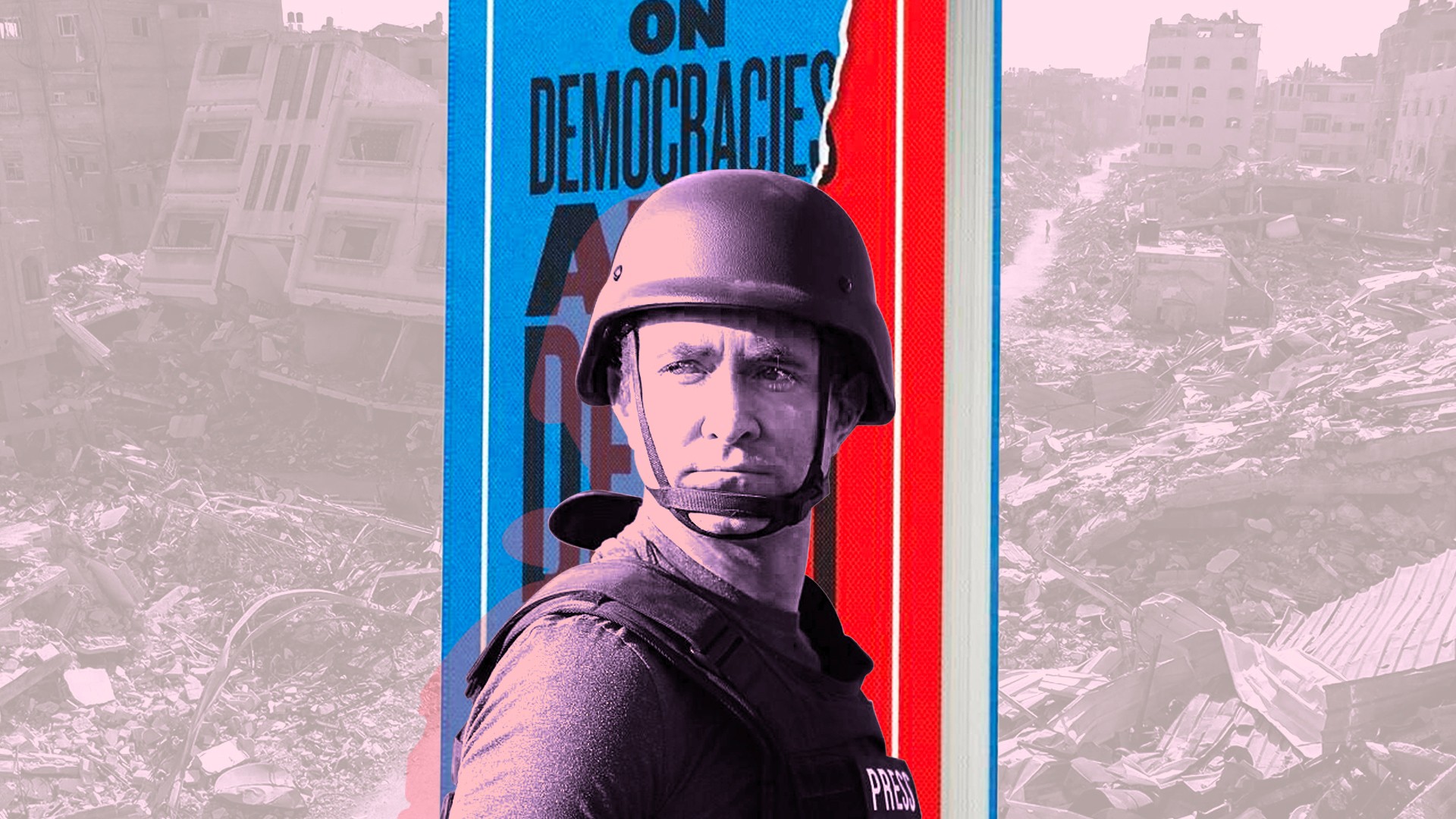
On Democracies and Death Cults: Israel, Hamas and the Future of the West is marred by poor or non-existent sourcing, elementary errors of historical understanding and context, and embarrassing factual mistakes
Those of us who have the privilege to report on current events have the freedom, within limits, to make powerful arguments and express our own opinions.
These limits include an obligation to observe standards.
We should strive to be accurate.
We have a duty to provide context.
We must not distort the truth or suppress relevant information.
New MEE newsletter: Jerusalem Dispatch
Sign up to get the latest insights and analysis on
Israel-Palestine, alongside Turkey Unpacked and other MEE newsletters
The polemicist Douglas Murray made the case for standards in an article for the New York Post in April in which he attacked the ignorance of fellow guests on the popular Joe Rogan show.
A number of these, complained an outraged Murray, “have been spewing claims that are demonstrably false. Many are also people who are simply in no way expert at what they are talking about”.
Murray said that people had the right to hold an opinion, but he added: “It’s just that there should be a price to pay for spreading bullshit.
“And part of that price is that you should be called out”.
In this article we take Douglas Murray at his word.
We show that his bestselling book On Democracies and Death Cults: Israel, Hamas and the Future of the West is marred by poor or non-existent sourcing, elementary errors of historical understanding and context, and embarrassing factual mistakes.
To use his own language, we call out his bullshit.
The London protests
Let’s first take a look at Murray’s coverage of the Palestine solidarity protests.
Murray opens his book with an unforced error as he reports that:
“[t]he first big march against Israel in London took place on 15 October”.
The big demo actually took place on 14 October.
Murray adds that:
“whenever the crowd spotted anyone they identified – rightly or wrongly – as Israeli, they chased them”.
Murray provides no footnote to source this claim. We have searched and can find no evidence to support it.
There were a number of Jewish participants in the demonstration on 14 October; one of them, Katy Colley, was interviewed by Sky News’ Adele Robinson.
Middle East Eye asked Colley whether she had witnessed, or perhaps heard of, any reports that corroborated Murray’s statement.
“No, none whatsoever, I never saw any aggro,” she said. “In fact, I’ve never seen any aggro on any of the marches I’ve been on (and I’ve been on most of them), other than when the police start causing it. And so no, I didn’t see anyone at all who was chased, I didn’t see anyone who identified themselves as Israeli”.
Robinson reported that there were “pockets of unrest” but concluded that “the demonstration passes largely peacefully”.
The Sky News reporter also observed that “there is condemnation from all those we speak to about the atrocities committed by Hamas last weekend.” She did not describe anything that remotely substantiated Murray’s assertion that this gathering of tens of thousands of people chased anyone they believed to be Israeli.
The following Saturday, Murray stated:
“Over 100,000 anti-Israel protesters gathered in the capital. That demonstration included the group Hizb ut-Tahrir, an Islamist group that is banned in a number of Muslim and European countries.
One of their members in the United Kingdom, Luqman Muqeem, had already declared that the Hamas attacks of 7 October “made us all very, very happy” and had shared a message on social media about “killing the Jews”. At the 21 October rally the group’s members held a huge banner reading “Muslim Armies! Rescue the people of Palestine”. One of the speakers in London shouted out, “What is the solution to liberate people in the concentration camp called Palestine?” In reply the crowd shouted, “Jihad, jihad, jihad!”.
We fact-checked the above. It is correct that Muqeem said that the attacks of 7 October “made us all very, very happy,” but Murray failed to make clear that he had nothing to do with the main march in London.
The 21 October 2023 demonstration was organised by the Palestine Solidarity Campaign. Metropolitan Police Assistant Commissioner Matt Twist said that the “overwhelming majority of people” at the October and November 2023 marches organised by the PSC were there to demonstrate “lawfully and peacefully”.
There was a separate demonstration that day organised by Hizb ut-Tahrir outside the Egyptian and Turkish embassies where there were indeed calls for “jihad”.
As reported by The Guardian, “The Hizb ut-Tahrir rally was separate from a much larger pro-Palestine rally of about 100,000 people in London.”
Murray misleadingly conflates the mass rally with the demonstration organised by the now proscribed Hizb ut-Tahrir.
Murray also writes that “some” protestors “wore depictions of hang gliders, of the same type as those that had descended on the Nova party. Two young Muslim girls spotted with these – presumably celebratory – emblems were eventually found and appeared before a Muslim judge, who let them go without charges.”
We fact-checked this paragraph. Three women were arrested for displaying hang glider images: Pauline Ankunda, 26; Heba Alhayek, 29; and Noimotu Taiwo, 27.
They were women in their late twenties, not “young girls”. MEE was unable to find out their religious affiliation.
‘As poor a guide Murray is to protests in London, his grasp of conflict in the Middle East turns out to be even shakier’
Murray is correct to indicate that the judge, Tanweer Ikram, has a Muslim name, but he does not explain why he considers this relevant.
The judge did not “let them go without charges,” as Murray tells his readers. This statement is not just incorrect but illogical. The women had already been charged, which is why they were at the Magistrates’ Court. Presumably he means they were not given custodial sentences.
The judge convicted all three women of arousing suspicion that they were supporting a proscribed terrorist organisation, and as such were each handed a 12-month conditional discharge.
In general Murray paints the mass protests for a Gaza ceasefire as a cesspit of violence, bigotry, intimidation and antisemitism.
In support of this sweeping indictment, he offers up a mere handful of cases of alleged wrongdoing – without any attempt to show that they are representative of the hundreds of thousands of people who gathered. And even there, he gets critical facts wrong.
The Middle East
As poor a guide Murray is to protests in London, his grasp of conflict in the Middle East turns out to be even shakier.
Murray tells readers that:
“when civil war broke out in Yemen in 2014, the [Iranian] mullahs backed and armed the Houthi-led militias as they took over that country”.
The war in Yemen actually erupted in mid-2014 when the Houthis, who claim to champion the interests of the Zaidi community, felt they were being marginalised following the cancellation of fuel subsidies and a UN-sponsored National Dialogue process that sought to address the country’s chronic political, security and economic problems.
After the Houthis rejected the proposal for a new federal structure for the country, the Iran-aligned movement began its advance south and seized the capital Sanaa.

What did Houthis achieve in 18 months of attacks on the Red Sea?
Read More »
Capitalising on growing frustration among diverse segments of the population, their continued advance prompted an Arab coalition to intervene in March 2015.
Armed with US-made bombs and British-made fighter jets, Saudi Arabia and its allies launched a ruinous war on Yemen in which more than 200,000 people were killed, with many dying due to the dire humanitarian situation.
Murray fails to note that Iran reportedly advised the Houthis against taking the Yemeni capital Sanaa in 2014, and that it was only when the US-backed Saudi-led coalition attacked Yemen in 2015 that Iran’s support for the Houthis increased from being quite limited to being substantial and meaningful.
Murray also makes no mention here of the US- and UK-backed Saudi intervention, which was responsible for two-thirds of the civilian casualties during the war in Yemen, as confirmed by the UN human rights chief in 2016.
Murray alleges that Iran “has spent recent years assiduously expanding its colonies” and muses: “What has Gaza become but a colony of Iran?”
Hamas, which began administering Gaza in 2007 after winning the 2006 Palestinian legislative elections in a landslide, benefited from Iranian support. But Murray fails to tell his readers of the compelling evidence that Hamas retained significant political autonomy.
Notably, whereas Iran backed the government of Bashar al-Assad during the Syrian civil war, Hamas supported the opposition.
Murray’s claim that Gaza is a “colony” of Iran also ignores their distinct theological and political underpinnings. His suggestion is especially absurd given his support for Israel’s actions in Gaza – which bear much more obvious resemblance to colonialism.
One might ask: is Iran the country that has unlawfully occupied Gaza since 1967; unlawfully blockaded Gaza for nearly two decades; imposed control over Gaza’s airspace, borders, coastal waters, and population registry; and that established and maintained illegal settlements in Gaza for decades?
For that matter, is it Iran that currently has troops deployed throughout Gaza; that has in fact razed Gaza to the ground; and whose ministers are openly talking about depopulating Gaza in order to build illegal settlements there? No – that country is called Israel.

How Iraq’s calm became a deadly threat for one pro-Iran leader
Read More »
Murray’s insights into colonialism do not stop there, as he writes:
“After the overthrow of Saddam Hussein in 2003, the Iranian theocracy moved in to colonize and dominate postwar Iraq”.
It is indisputable that Iranian influence in Iraq has grown significantly after the 2003 invasion. This is only to be expected given the deep cultural and religious links between the two countries.
Murray, however, provides no evidence for his claim that Iran acted to “colonize” Iraq. Murray talks casually about “the overthrow of Saddam Hussein” without mentioning in this passage the fact that this “overthrow” was carried out by the US and Britain in an illegal invasion of the country – one he publicly supported.
This invasion, spearheaded by two countries thousands of miles away from Iraq and followed by a brutal years-long military occupation, feels to us like a clearer example of colonialism.
According to reports, British multinational oil and gas company BP has extracted at least £15bn worth of Iraqi oil since 2011 while the US embassy in Baghdad is a sprawling complex roughly the size of Vatican City. Foreign Policy magazine calls it “the physical manifestation of American hubris in Iraq”.
To omit any mention of this, while accusing Iran of “moving in to colonize and dominate postwar Iraq,” is really quite shameless.
Gaza and the West Bank
Murray reports that:
“Hezbollah was planning an 7 October-style attack from the north”.
This claim is speculative and does not make much sense. What is clear from the public record, but unmentioned by Murray, is that Hezbollah initially did its best not to get drawn in after the 7 October attack, and only gradually expanded its cross-border operations as a result of Israel’s increasingly savage assault on Gaza.
As Adham Saouli has pointed out in the peer-reviewed Al-Muntaqa journal: “Hamas’s attack [on October 7th], which Hezbollah confirmed it was unaware of… generated anxiety and uncertainty for Hezbollah”.
Murray asserts that:
“[t]he Israeli government knew – and the Palestinian Authority had always made clear – that no Palestinian state could have Jews in it. The one absolutely clear precondition for such a state was that no Jews could exist within its borders”.
As so often, Murray provides no evidence for this assertion and no footnotes to support it. We haven’t been able to find any source apart from Israeli Prime Minister Netanyahu – a proven and habitual liar with an obvious conflict of interest – asserting it without evidence.
‘As so often, Murray provides no evidence for this assertion and no footnotes to support it’
It is possible that Murray has got confused. Palestinian politicians have stated that Israeli settlements could not continue to exist as extraterritorial enclaves subject to Israeli jurisdiction within an independent Palestine, a position explained in this Times of Israel article.
In all the relevant public statements we can find, Palestinian leaders have been clear that Jews, in common with members of all religions, would indeed be welcome to apply for Palestinian citizenship.
Murray writes about visiting “the town of Barkan in Samaria”. Barkan is more accurately described as an illegal West Bank settlement.
Meanwhile, on a trip to an abandoned Hezbollah camp in Lebanon, Murray notes that:
“[i]nto the trunk of a tree a bored Hezbollah fighter had carved a swastika.”
Murray does not explain how he knows a Hezbollah fighter did this. Perhaps the same telepathic connection that allows Murray to report that this alleged Hezbollah fighter was “bored” is also how he came by Hezbollah’s alleged top secret military plans to invade Israel? As so often: no footnotes.
Murray claims that Israel “has equal rights for everyone in the country,” citing as evidence that the Arab and Druze population “have equal health care, housing, and voting rights as anyone else”.
Equal health care? A detailed study of health outcomes of Palestinian citizens of Israel (PCI), conducted by Osama Tanous et al in Global Public Health two years ago, found that “nine out of the ten towns with the highest overall mortality rate in Israel and all ten towns with the highest mortality rate from heart diseases are towns inhabited entirely by PCI”.
Tanous et al write that the Palestinian death rate in Israel is 2.96 times higher from motor vehicle injuries, 2.69 times higher for respiratory diseases, 2.25 times higher for diabetes, and 1.85 times higher for hypertension compared to the Jewish population. This explains why Palestinian citizens of Israel have “a life expectancy 3–4 years shorter than the Jewish Israeli population”.
Equal housing? This is what Human Rights Watch reported in May 2020: “The Israeli government’s policy of boxing in Palestinian communities extends beyond the West Bank and Gaza to Palestinian towns and villages inside Israel… The policy discriminates against Palestinian citizens of Israel and in favor of Jewish citizens, sharply restricting Palestinians’ access to land for housing to accommodate natural population growth. Decades of land confiscations and discriminatory planning policies have confined many Palestinian citizens to densely populated towns and villages that have little room to expand.
“Meanwhile, the Israeli government nurtures the growth and expansion of neighboring predominantly Jewish communities, many built on the ruins of Palestinian villages destroyed in 1948. Many small Jewish towns also have admissions committees that effectively bar Palestinians from living there.”
As Avi Shlaim and Jamie Stern-Weiner have pointed out in a recent book, “In the half-century after independence, the state established more than seven hundred Jewish localities and zero Arab localities, excepting several townships built to facilitate the concentration and dispossession of Bedouin Arabs”.
Murray is correct to say that Palestinians in Israel have the right to vote, but Human Rights Watch has observed that this right is limited in value given the structural discrimination that Palestinians in Israel face, adding that “The fact that no government in Israel’s history has ever included representatives of a Palestinian-led party highlights the political disempowerment of the community”.
Murray entirely omits that Palestinians in Israel are not entitled to legislatively call for the state to be a state of all its citizens, and Palestinian refugees are barred from returning to their homes and homeland because they’re of the ‘wrong’ ethnicity.

As genocide continues in Gaza, the West Bank is pushed into a new Nakba
Read More »
Murray states that the Palestinian uprising of 1987-93 – known as the “First Intifada” – was “among the bloodiest periods in Israel’s history”. The First Intifada (as opposed to the Second Intifada) was an overwhelmingly nonviolent campaign of civil resistance in the occupied territories.
Here’s another Murray howler, this one relating to Unrwa, the UN agency for Palestinian refugees. He writes that:
“Even after up to a dozen UNRWA employees were found to have taken part in the 7 October massacres, support to Unrwa from the British government and others continued”.
In January 2024 the British government responded to unsubstantiated allegations from Israel by suspending funding for UNRWA, joining Germany, Italy, the Netherlands, Switzerland, Finland, the United States, Australia, and Canada. The UK resumed funding in July 2024, under the newly elected Labour government. Murray misleads readers with his claim that up to a dozen Unrwa staff members were “found” to have participated in the 7 October attacks.
After an investigation by the UN’s Office of Internal Oversight Services, nine Unrwa staff members – out of a total staff of over 30,000 – were judged to have possibly participated in the attacks, and their contracts were terminated.
We have drawn on the excellent analysis of Murray’s failures of basic journalistic integrity by Nathan Robinson in Current Affairs. Robinson examines Murray’s claim that one bodyguard of the now-dead Hamas leader Yahya Sinwar worked as a teacher and was employed by Unrwa.
Robinson establishes that “the allegation stems from the fact that a U.N. teacher’s passport was found near Sinwar after his death”. But “the passport did not belong to Sinwar’s bodyguard but to another man who is still alive”.
Unrwa Commissioner-General Philippe Lazzarini also refuted the charge, which had been spread around Israeli media, adding that “once again, unchecked information is used to discredit UNRWA and its staff”.
These corrections had been made in public by prominent figures before Murray’s book was published. Murray’s book does not reject or attempt to refute them; it just proceeds as if they did not exist.
Robinson also pours cold water on Murray’s assertion that Sinwar’s wife “was even clutching a $32,000 luxury Birkin handbag” made by Hermes while hiding out in the tunnels beneath Gaza.
This claim, which seems to have originated from an Israeli army (IDF) spokesman, had been widely debunked already before Murray’s book was published.
Robinson concludes: Every time Murray makes a claim it is wise to look it up because you will discover how he is carefully misleading you. Consider the sentence: “One speaker used the platform of Columbia’s protest movement to promise more massacres [like October 7th].” Now I would assume from this Murray was talking about a speaker at an event, not just a random person who showed up and shouted something. But turning to the video evidence Murray cites, it appears that someone did shout this at pro-Israel protestors, but it was a random masked man shouting outside Columbia, not a “speaker” using any kind of platform.
Robinson’s Current Affairs article contains many other examples of what it calls “deliberately misleading propaganda and even outright serious factual errors in need of correction”.
It is well worth reading in full. In a thoughtful review in The Critic magazine, Ben Sixsmith has brought further errors to light.
7 October
Murray writes that:
“Hamas knew what they were doing in not just killing but also kidnapping Israeli civilians. Part of the social contract in Israeli society – and the Israeli military in particular – is that no person should be left behind. A core tenet of the state is that if one Israeli is caught, then the government and people will do anything they can, at any price, to get the hostage back”.
Up to a point. Another “core tenet of the state” is that if one Israeli is caught, the Israeli military “will do anything they can, at any price” to stop the Israeli from being taken into enemy territory – even if it means killing them. This is the Hannibal Directive, which was utilised on 7 October and which Murray doesn’t mention.
Murray quotes a source related to several of the hostages taken on 7 October as follows:
“This is humanity against evil. There’s no other way to say this. What happened there… I don’t know when, and if we even saw it in the history of humankind. In this dimensions. With zero purpose. Why would you kill a baby? Why would you see a baby, ten months old, one year old, two years old, and shoot him?”
‘It would not be difficult for a competent journalist, or even a third-rate polemicist, to make credible allegations of war crimes against Hamas… But even when he has an open goal before him, Murray can’t help but miss’
Targeting of babies – as described in this passage – didn’t happen. Two babies were killed on 7 October – one when a Hamas fighter shot through the door of a safe room in which a family was hiding, and the other was a baby who sustained a bullet injury while still in the womb, when a Hamas fighter opened fire on the car in which her parents were driving; the baby died 14 hours after being born.
As filmmaker Richard Sanders – who investigated the atrocities of 7 October for an Al Jazeera documentary – has explained: “It’s not to excuse people, but it was not the cold blooded murder of someone standing over a baby and then taking the decision to kill it”.
It would not be difficult for a competent journalist, or even a third-rate polemicist, to make credible allegations of war crimes against Hamas. There is an abundance of evidence proving such charges. But even when he has an open goal before him, Murray can’t help but miss.
No one walked up to a baby and decided to shoot them. By contrast, Israeli army snipers have been systematically shooting people in Gaza, including children, in the head, as consistently documented by foreign doctors who have volunteered there, and backed up the evidence of CT scans – see here, here, and here.
Murray doesn’t mention that the source quoted above has his facts wrong, or that Israeli soldiers have been systematically and prima facie intentionally shooting children in Gaza.
Israeli sources
Murray says that:
“I followed the facts wherever they led me”. In fact, Murray routinely accepts Israeli accounts of events without examination or context.
Take this example:
“Where most countries would seek to protect its civilians, Hamas always had a stated aim of using them as human shields”.
Murray later adds:
“It may seem strange to the Western way of war that anyone would even use an elderly, disabled woman as a human shield, but for Hamas it is normal operating procedure”.

Israel has shown how to carry out a genocide and get away with it
Read More »
Set aside the abysmal prose. Murray’s source for his allegation that Hamas used “an elderly, disabled woman as a human shield” is an unnamed Israeli major. He cites no evidence for the claim that Hamas’s “stated aim” is to use civilians as human shields (as per usual, no footnotes are provided). It is fair to say, however, that Murray’s language reflects a common Israeli version of events which has been disputed by human rights authorities.
Bill van Esveld of Human Rights Watch stated in October 2024: “We don’t have evidence that Palestinian armed groups are hiding right next to civilians and not allowing the civilians to leave”.
Maha Hussaini of Euro-Med Human Rights Monitor has pointed out: “‘We conducted dozens of interviews with civilians and with Palestinians in areas that were designated as combat zones. But we have not documented one case of Palestinian armed members using civilians as human shields. There has to be a purpose in using a civilian as a human shield. Civilians here have been one of the main targets of the Israeli army since the beginning of the attack. So there wouldn’t be a purpose in using a civilian as a human shield because the civilian himself is a target”.
Murray does not mention, still less attempt to refute, these judgments. He also neglects to inform his readers that Breaking the Silence, an NGO made up of former Israeli soldiers, has noted that Israel’s practice of using Palestinian civilians in Gaza as human shields is “both systemic and systematic,” while The Independent has reported on Israeli soldiers using Palestinian schoolboys as young as 12 as human shields.
An Israeli soldier who served in Gaza testified that nearly every Israeli army platoon in Gaza keeps a civilian as a human shield, concluding: “We operate a sub-army of slaves”.
This soldier also detailed an incident where an elderly man was used as a human shield; when he made a mistake, he became so frightened of what would happen to him that he soiled himself.
Dodgy History
Publisher Harper Collins says that Murray’s book “places the latest violence in its historical context”. The book does provide a certain amount of historical data, but it’s unreliable, partisan, and leaves out crucial elements.
The author describes the 1967 and 1973 wars as wars of annihilation aimed at Israel. Some historians may have portrayed events in that way, but many others have not. Norman Finkelstein’s in-depth account of the Six Day War, for example, argues that Israel deliberately provoked its neighbours.
University of California Professor Ze’ev Maoz, in his book Defending the Holy Land, concludes that all of Israel’s wars – with the partial exception of 1948 – were wars of choice. He also shows that not one single UN member state placed sole blame on the Arab parties for the 1967 war. All blamed either Israel or both sides.
There was no serious attempt to wipe out Israel in 1973, as Murray claims.
Egypt launched the Yom Kippur War in order to recover the Sinai peninsula, illegally conquered by Israel in the 1967 War. As Israeli historian Benny Morris told Al Jazeera: “Sadat gambled correctly; he wanted to dislodge the logjam. He wasn’t going to get Sinai back unless he did something hard and he decided a war would do it and he was right”.

War on Gaza: Netanyahu, Hamas and the origins of the 2023 Nakba war
Read More »
Murray tells readers that the background condition of Hezbollah’s emergence in Lebanon was that the “country had fallen into civil war”. He makes no mention within this context of Israel’s US-backed invasion of Lebanon in 1982, in which up to 20,000 Lebanese and Palestinians were killed – overwhelmingly civilians.
No mention either of the Sabra and Shatila massacre, when over 2,000 Lebanese Shiites and Palestinian refugees were murdered by the Israeli-backed Phalangist forces, with Israel overseeing the killing.
Harper Collins tells readers that Murray has written a “gripping and essential read for all who seek to understand the complexities of the Israeli-Palestinian conflict”.
This description may qualify as an offence under the Trade Descriptions Act.
Here is Murray on Israel’s 2008-2009 assault on Gaza, “Operation Cast Lead”: “Soon major Israeli cities like Ashdod were able to be hit by Gazan rocket fire, and eventually – in 2008 – Israel launched its first operation into Gaza since the withdrawal. Operation Cast Lead was explicitly launched by Israel in order to stop the firing of rockets from Gaza into Israel”.
Murray is wrong to say Operation Cast Lead was the first operation since Israel’s disengagement from Gaza. In the summer of 2006, for example, Israel launched Operation Summer Rains, which destroyed Gaza’s only power station and killed at least 197 Palestinian civilians, including 48 children.
Murray is misleading readers when he implies that Operation Cast Lead was aimed at stopping rocket-fire. There had been a truce in place from mid-June 2008. This halted rocket-fire from Hamas, which only resumed in November 2008 when Israel – not Hamas – broke the ceasefire.
The Guardian reported on 5 November that year: “A four-month ceasefire between Israel and Palestinian militants in Gaza was in jeopardy today after Israeli troops killed six Hamas gunmen in a raid into the territory. Hamas responded by firing a wave of rockets into southern Israel, although no one was injured”. Murray would have done well to read Avi Shlaim’s latest work, Genocide in Gaza, which deals directly and lucidly with the topic of the 2008 ceasefire.
New York Times Jerusalem bureau chief Ethan Bronner reported that Israel’s aim was “to expunge the ghost of its flawed 2006 war against Hezbollah in Lebanon and re-establish Israeli deterrence… [Israel] worries that its enemies are less afraid of it than they once were, or should be. Israeli leaders are calculating that a display of power in Gaza could fix that”.
Baruch Goldstein
Murray recalls his visit to the grave of Baruch Goldstein, the American-Israeli terrorist who massacred 29 worshippers in the Ibrahimi Mosque in Hebron in 1994.
Murray writes:
“I had heard that some people in the Jewish community in the area viewed Goldstein as a hero and I asked to find a way to his grave to see whether it was a place of veneration or not. It was satisfyingly hard to find, and in the hills when we asked directions it was difficult to find anyone who knew of the site. We eventually found it in what was clearly a little-visited plot.”
A decade ago one of us, accompanied by an Israeli guide, made exactly the same journey. We found the grave behind a row of shops in a public park in the Israeli settlement of Kiryat Arba. It was easy to find because almost everyone we asked knew where it was.
Goldstein’s resting place was a shrine as well as a grave. Part of the Hebrew inscription read: “To the holy Baruch Goldstein, who gave his life for the Jewish people, the Torah, and the nation of Israel”. Beside the grave, a glass container contained two candles and some spent matches. Mourners had also individually laid many small stones, part of the Jewish mourning tradition.
Murray’s depiction of Goldstein’s grave as “hard to find” forms part of his broader claim that Goldstein’s legacy, however reprehensible, is also marginal in Israeli politics and public life: “Do remnants of Goldstein’s disgusting ideology linger on? Certainly. But is it a central part of Israeli or Jewish political life? No. There are no streets named after him in Tel Aviv, no squares named in his memory in Haifa”.
It is true that no streets or squares are named after Goldstein. In this context Murray ought to have informed readers that Israel’s Minister of National Security Itamar Ben Gvir – who has been overseeing the torture of Palestinian detainees after 7 October – can be fairly characterised as a follower of Goldstein.
‘As so often in this book, Douglas Murray omits relevant information that undermines his argument’
Joshua Leifer wrote in The Guardian in March 2025 about the connection between Ben Gvir and the violent ultra nationalist Kahanist movement which inspired Goldstein: “Itamar Ben-Gvir, a lifelong Kahanist agitator and convicted criminal, became national security minister, responsible for overseeing the police. Since 7 October 2023, Kahanism has become mainstream. It is the political style that relishes the dehumanisation of Palestinians. It is the ethos according to which Jewish lives are seen as more valuable than all others. It is the ideology behind the normalisation of population transfer and ethnic cleansing. Netanyahu’s Likud has undergone a process of near total Kahanisation, to say nothing of the settler right.”
Haaretz revealed that in April 2023, Ben Gvir was filmed giving a speech in front of a wall-hanging glorifying Goldstein, surrounded by security from the prime minister’s office. The drape, quoting scripture, referred to “martyrs” Kahane and Goldstein and read: “Their blood will rise,” adding, “For I will avenge their blood, which I have not yet avenged. For the Lord dwells in Zion”.
Haaretz has also reported that Ben Gvir “makes sure to attend celebrations at the Ha’Raayon Hayehudi [The Jewish Idea] Yeshiva that Kahane founded and where the curtain over the Ark of the Covenant has an inscription praising the murderer Baruch Goldstein”.
Images that surfaced from Gaza in June 2024 revealed that Israeli soldiers had left behind graffiti on the ruins of a building in Khan Younis in southern Gaza, reading: “We are all Baruch Goldstein”.
As so often in this book, Douglas Murray omits relevant information that undermines his argument.
He is of course at liberty to argue that even notwithstanding the above, Goldstein is a marginal figure. Had he been intellectually honest he would have informed his readers that Israel’s minister of national security is one of Goldstein’s fans, then made the case that Goldstein’s legacy was marginal nevertheless.
This sort of selective history is more likely to misinform than enlighten readers. Assuming a person with no prior knowledge, they would come out of this book understanding less than before.
Before publication we wrote to Douglas Murrray, highlighting the many passages where he has not provided a source to substantiate his claims, and which we could not verify. We asked for his help, and wanted to give him a chance to defend himself. We approached him through his publisher, his agent, his personal website and what we understand to be his direct email.
In our letter we also reminded Murray of his attack on fellow guests on the Rogan Show who “have been spewing claims that are demonstrably false” and “are simply in no way expert at what they are talking about”.
In the light of his support for experts we asked Murray: “Does this mean that you accept the expertise of mainstream human rights organisations alleging genocide in Gaza? The expertise of humanitarian agencies that say there is starvation in Gaza? The expertise of the 900+ UK lawyers, including former Supreme Court justices, who said that arms sales to Israel should end, and that sanctions should be imposed? Do you accept the expertise of the genocide scholars who have said this is a genocide?”
Murray did not reply to this, or any of the other questions we put to him. As we document in our book on British complicity in the destruction of Gaza, Murray is far from the only British journalist or commentator who has credulously swallowed the Israeli narrative, made unsubstantiated claims, skewed the facts and misled the public through omission.
‘Worthless either as journalism or history’
It should be stressed that Murray can be a very fine writer indeed, as he proved in Bloody Sunday: Truth, Lies and the Saville Inquiry, widely regarded as a scrupulous and fair-minded work which demonstrated an ability, not on display here, to come to grips with every point of view.
Murray spent many months in Israel, and his new book powerfully conveys the trauma and horror felt by Israelis in the wake of the October 7th atrocities. The book has been praised by US President Donald Trump as a “powerful read from a Highly Respected author”. A Times of Israel blogger calls it “one of the most important books ever written”.
In Britain it hit the best-seller list and was serialised in the Daily Mail. According to The Spectator it mapped “the long historical path that led us here, and examined – through first-hand testimony and serious scholarship – how the civilised world is losing its grip on moral clarity”.
Large parts of this book, however, are worthless either as journalism or history.
The failure of such a seasoned polemicist as Murray to come to terms with his tragic subject matter suggests that it may be impossible to defend Israel since 7 October without resort to falsehood, bad history, misrepresentation, and omission. Meanwhile Harper Collins, a respected publisher, faces its own test of integrity.
When the paperback edition is in due course published, Murray has a duty to correct the numerous factual mistakes in his deeply misleading book.
Harper Collins, for the sake of its own reputation as well as Murray’s, should make certain that he puts right the errors which have turned On Democracies and Death Cults: Israel, Hamas and the Future of the West into a scholarly as well as journalistic car crash.
The views expressed in this article belong to the authors and do not necessarily reflect the editorial policy of Middle East Eye.
