

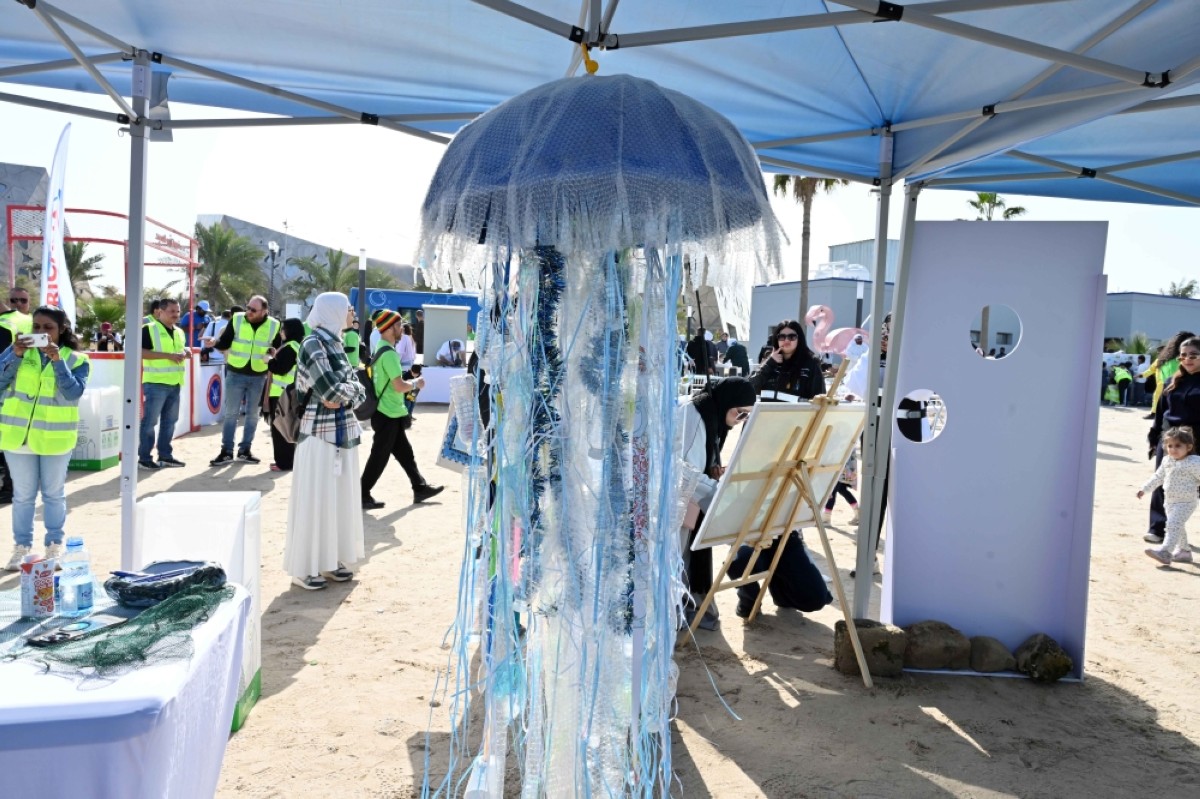
KUWAIT: What people leave behind on Kuwait’s beaches doesn’t simply disappear, it can return to us through the fish we eat, the injuries we risk and even the medical treatments we may one day rely on. This idea was at the heart of the beach cleanup held Saturday in Shuwaikh, which brought together around 500 participants, some of whom highlighted how closely beaches are connected to everyday human life.
The event was organized under the patronage of Dr Faisal Salman Al-Humaidan, Director General of the Kuwait Institute for Scientific Research (KISR), in cooperation with the Kuwaiti Diving Team and Kuwait Municipality. For the Kuwaiti Diving Team, beaches are the meeting point between human behavior and marine environment. Dr Dhari Al-Huwail, head of international relations at the team, said plastic pollution, especially microplastics, remains one of the most serious threats to Kuwait’s coastline.

Dr Dhari Al-Huwail

Dr Abdullah Al-Enezi

KUWAIT: Children participate in the beach cleanup held Saturday in Shuwaikh.

Metal items recovered from Kuwait’s beaches are displayed at the event.
Plastic in our plates
A plastic bottle left on the sand may seem harmless, but over time it breaks down into tiny particles that are impossible to remove. “Marine life consumes them, fish carry them up the food chain, and eventually they reach humans, and live in our bodies,” he said. “One soft drink bottle can remain in the environment for up to 200 years.”
Not all dangers on the beach are visible. Metal-detecting enthusiast Hamad Al-Husseini said many risks are buried just below the surface. “People look at a beach and think it’s clean and safe,” said Al-Husseini, a retired art education supervisor. “They don’t realize what might be hidden underneath.” He warned against walking barefoot, even on beaches that appear clean. “Sharp or toxic objects can cause serious injuries or infections,” he said, adding that in case of witnessing suspicious items, individuals should immediately contact professionals.
Using specialized equipment, he and his team recover metal items from the sand, some hazardous, others unexpectedly valuable. “We’ve found things you wouldn’t imagine—diamond rings, expensive watches, phones—all from the beach,” he said. Their work also serves the community by returning lost valuables to their owners.
“When we announce what we’ve found, people recognize their items and come to claim them,” he added. “Sometimes an item is worth thousands. Our joy is in the discovery, but the owner’s joy is even greater.”
Medicine from the sea
The importance of clean beaches extends beyond environmental preservation into medical research. Dr Lulwa Aldabbous from KISR’s Marine Research Institute explained that many marine organisms found in Kuwaiti waters hold potential for pharmaceutical applications. “This sea we have is full of organisms that could be used to develop medical treatments,” she said. “We document marine species in Kuwait’s waters, and some have already undergone DNA analysis.” This work supports research into using marine organisms for drug development. “Some algae and marine species contain compounds with anti-cancer and anti-hypertensive properties,” she added. “Sea cucumbers, sea urchins, and algae—all can contribute to medical treatments.” Protecting coastal areas, she emphasized, is essential to safeguarding these resources.
Uses of marine algae
Wajan, A Kuwait University marine science student presented a project focused on reusing algae. By extracting natural pigments, she was able to produce safe, non-toxic crayons. “If a child accidentally puts it in their mouth, it won’t cause harm,” she said, adding that similar pigments have also been tested among her colleagues for use in makeup, particularly blusher tints and lipsticks.
The algae used is local and abundant. When algae blooms die, they can reduce oxygen levels in the water and harm marine life. “Instead of throwing it away, we reuse it,” she said. The campaign featured a variety of interactive activities. Dr Abdullah Al-Enezi, Acting Executive Director of the Environment and Life Sciences Research Center, said it included scientific experiments, interactive marine life learning, creative projects that turn waste into art and treasure and mineral hunts that combine learning with adventure.
Turning waste into art
Dr Manal Al-Kandari, a scientific researcher at the Kuwait Institute for Scientific Research, emphasized that beaches are among the most sensitive marine environments when it comes to waste accumulation, due to the high level of human activity. The ongoing buildup of waste in marine areas harms natural habitats and disrupts the balance of ecosystems, she added. Al-Kandari called for caution when visiting these areas to protect them from harm. Beach clean-up campaigns, such as the one held Saturday, play a vital preventive role in reducing these risks and protecting biodiversity.
Artist Sahar Saan demonstrated how such events can support environmental sustainability by transforming discarded plastic bottle caps into an art installation shaped like a wave. The art piece represents one of Kuwait’s most commonly used plastic items. “It may look attractive,” she said, “but it also shows how easily this waste can end up in the sea.”
For Saan, creative reuse is more than an artistic challenge—it’s a way to change perceptions. “Plastic can be turned into art or everyday items,” she explained. “When people start seeing waste differently, their behavior starts to change.”
