

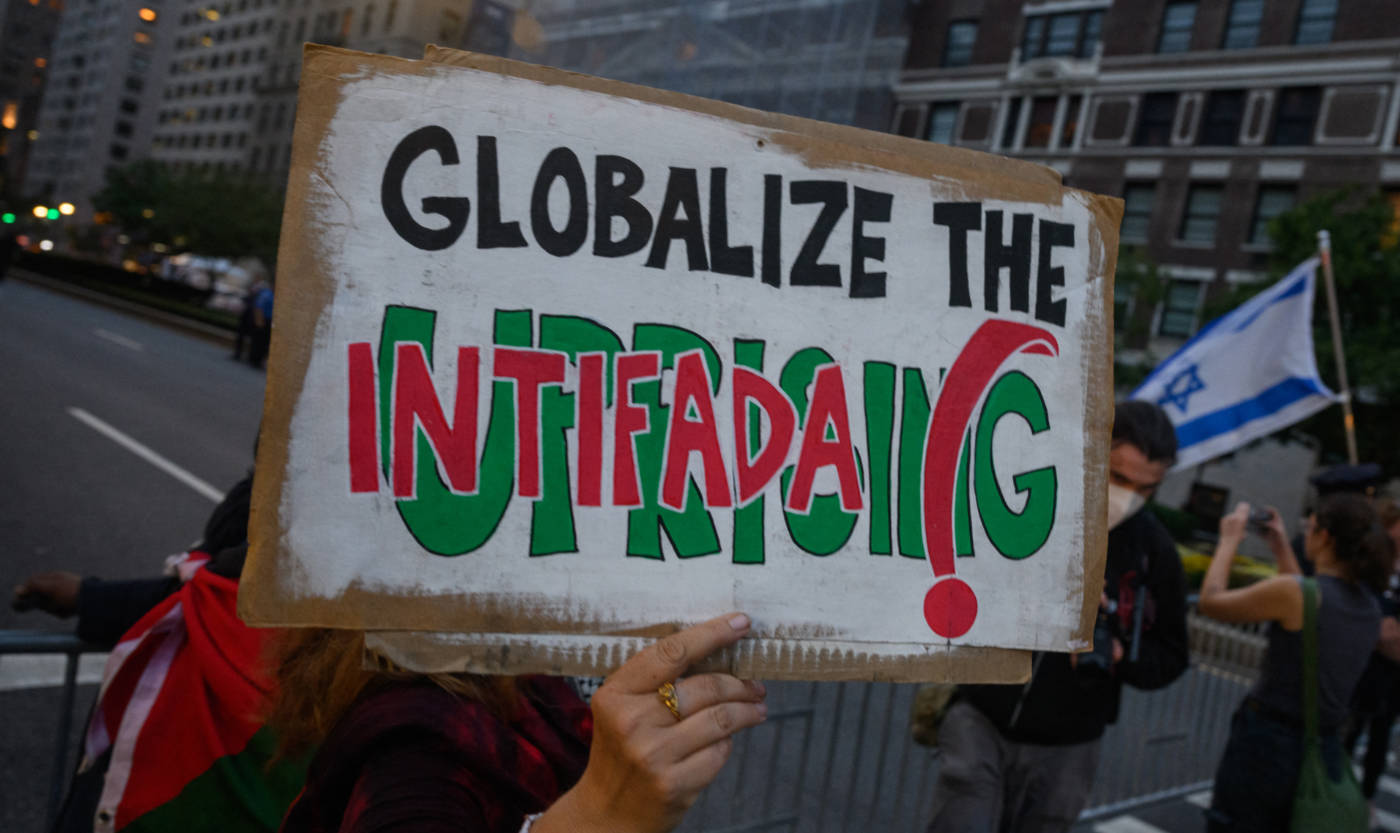
Few phrases associated with pro-Palestine activism have become as contentious as “globalise the intifada”. The slogan has been criticised by politicians and others, not least after the antisemitic Bondi Beach attack in Australia in December (the attackers did not use the phrase nor express support for Palestine).
Pro-Palestine activists have said that the slogan is not antisemitic. Instead, they say, it calls for an international uprising against Israel’s genocide in Gaza, which has killed more than 71,000 Palestinians since October 2023.
In the UK, three people were charged this week for shouting the slogan under legislation that the government has said is aimed at racial hatred.
What does intifada mean?
“Intifada” is Arabic. It is best described as a “shaking off” or “shaking up” against political oppression that equates to “uprising” or “rebellion”.
New MEE newsletter: Jerusalem Dispatch
Sign up to get the latest insights and analysis on
Israel-Palestine, alongside Turkey Unpacked and other MEE newsletters
It has been used to refer to uprisings within and beyond the Arab world, such as the Jewish uprising in the Warsaw Ghetto during World War Two.
Civilian uprisings referred to as intifadas include the 1952 Iraqi Intifada against the Hashemite monarchy; the Sahrawi Intifadas against Moroccan occupation in the early 2000s; and the Arab uprisings in 2011 in countries including Tunisia and Egypt.
But it is most associated with Palestine and resistance against Israel, which has occupied the Palestinian Territories since 1967.
Since the late 1980s intifada has been used to refer to two specific Palestinian uprisings: the First Intifada (1987-1993) and the Second Intifada (2000-2005).
What was the First Intifada?
The First Intifada was a Palestinian uprising between 1987 and 1993 amid increasing Israeli repression and settlement in the occupied Palestinian Territories.
It was largely led by community organisers, young people and women rather than the political leadership of the Palestinian Liberation Organisation (PLO), which was exiled at the time in Algeria.
Tactics included non-violent demonstrations, strikes, refusal to pay taxes, civil disobedience and throwing stones at occupying Israeli troops.


Many of those involved lived in refugee camps, created following the Nakba of 1948, during which Zionist militias killed around 13,000 Palestinians and displaced 750,000 others before the declaration of the state of Israel. Another 300,000 were displaced to camps during the 1967 war when Israel occupied Gaza and the West Bank
The First Intifada began on 9 December 1987, when an Israeli military truck struck two parked Palestinian vans at the Jabalya refugee camp in Gaza, killing four Palestinians.
During the conflict, the PLO, which was led by Yasser Arafat and was engaged in peace negotiations mediated by the US, said it rejected terrorism and recognised Israel’s right to exist along the 1967 boundaries outlined in UN Resolution 242.
The First Intifada ended in 1993 after the first of the US-brokered Oslo Accords peace treaties. By then, more than 1,000 Palestinian civilians, including around 250 children, had been killed by Israeli forces, according to figures from the Israeli Human Rights group B’Tselem. Around 150 Israelis, including 100 civilians, were killed.
What was the Second Intifada?
By autumn 2000, the peace process had ground to a halt, with the Oslo Accords viewed by many Palestinians as a failure.
On 28 September 2000, Ariel Sharon, the Israeli leader of the right-wing Likud party, visited Al-Aqsa Mosque in Jerusalem, one of the holiest sites in Islam, accompanied by Israeli riot police.
Sharon was reviled by Palestinians: in 1982, as then Israeli minister of defence, he oversaw the Israeli military’s support for the Sabra and Shatila massacres in which up to 3,500 people, many of them Palestinian refugees, were killed by Lebanese Phalangist militias.
When Palestinians in Jerusalem protested against Sharon’s visit to Al-Aqsa, Israeli authorities responded with lethal force. The protests spread to the West Bank and Gaza. The dead included Muhammad al-Durrah, an unarmed 12-year-old killed on the Netzarim Junction, central Gaza, on 30 September 2000. Video of his murder sparked international outrage and became the defining image of the Second Intifada.

During the uprising, Palestinian groups made increasing use of suicide bombings against Israelis, of whom approximately 1,000 were killed, according to B’Tselem. Meanwhile, Israeli forces killed upwards of 3,000 Palestinians, most of whom were civilians.
Israeli forces also assassinated more than 200 Palestinian political leaders. Marwan Barghouti, a senior Fatah figure and key leader of the uprising, dodged several assassination attempts before being arrested in April 2002. He remains in an Israeli prison.
In February 2005, Palestinian Authority President Mahmoud Abbas and Israeli Prime Minister Ariel Sharon agreed to a truce at a conference in Sharm-el-Sheikh, Egypt, although the fighting persisted for several months afterwards. Israel pulled out of Gaza by August 2005.
When did the phrase ‘globalise the intifada’ emerge?
The slogan’s exact origin is uncertain – but one of the first reports of its use was made by journalist Esther Kaplan more than 20 years ago.
In the 2003 volume Wrestling with Zion: Progressive Jewish-American Responses to the Israeli-Palestinian Conflict, under the chapter “Globalize the intifada”, Kaplan reported on an anti-war march against the policies of then-president George W Bush, writing:
“More participants in the first significant antiwar march, in Washington, D.C., in April 2002, carried signs about Palestine than about Iraq. One speaker at the rally neatly expressed Palestine’s new centrality in the left imagination with a call to “Globalize the intifada!”
The phrase has been used more frequently since the Hamas-led attack on Israel on 7 October 2023, and Israel’s subsequent genocide in Israel.
It drew significant attention in April 2024, when it was displayed on placards by student protesters amid a police crackdown at Columbia University in New York City. The campus protests, which spread worldwide, were described as “the student intifada” by participants.
Why do groups and politicians oppose the phrase?
The phrase “globalise the intifada” attracted criticism even before the attacks of 7 October. In August 2021, following a Free Palestine march in New York, the American Jewish Committee wrote:
The chant “globalize the Intifada” should horrify us all. The First and Second Intifadas were waves of terrible violence that left 1,300+ Israelis dead, many killed in suicide bombings targeting buses, cafes, and malls. This is a call for mass murder.
In December 2025, some UK police forces said they would ban the chanting of the slogan in the wake of the Bondi Beach attack.
In response, Phil Rosenberg, president of the British Board of Deputies, said: “We have long warned that people chanting slogans like ‘Globalise the Intifada’ are inciting violence, and we have been making the case for robust enforcement in relation to this slogan with government at all levels for some time.
“We have seen the results of hate-filled slogans in murderous attacks around the world, including in Manchester, the Capital Jewish Museum in Washington, DC., Boulder Colorado, and this week in Bondi Beach.”
How have police in the UK justified the ban?
Two UK police forces, the Metropolitan Police, which covers London, and Greater Manchester Police (GMP), announced on 17 December that they will arrest people for chanting “globalise the intifada” or holding placards displaying the slogan.
No new legislation banning the slogan has been introduced. Other UK police forces have not made similar announcements.

Three people were charged on 26 January with “using threatening, abusive or insulting words or behaviour intending thereby to stir up racial hatred”. The offence carries a maximum sentence of seven years imprisonment.
The three were arrested along with a 17 year old boy (who has not been charged) for allegedly shouting the slogan at a London protest in support of the hunger-striking Palestine Action prisoners on 17 December.
In a joint statement, the Met and GMP said they began policing the slogan after the Bondi Beach attack on 14 December, which was carried out by two gunmen believed to have been “inspired” by Islamic State. The Bondi Beach attackers did not use the slogan “globalise the intifada”, nor are they Palestinian.
The UK police forces said that “antisemitic hate crime has surged, protests have intensified, and online abuse has grown since 2023” and that “Violent acts have taken place, the context has changed – words have meaning and consequence. We will act decisively and make arrests.”
The UK police said in the statement that they had been “consistently” advised by the Crown Prosecution Service, which prosecutes criminal cases in the UK, that “many of the phrases causing fear in Jewish communities don’t meet prosecution thresholds. Now, in the escalating threat context, we will recalibrate to be more assertive.”
In December 2023, the Met arrested nine people for hanging a banner reading “globalise the intifada” from a squat in central London, under Section 18 of the Public Order Act, which criminalises written material deemed to “stir up racial hatred”.
What have pro-Palestinian groups said?
Activists have said that the phrase “globalise the intifada” does not call for violence against Jews.
Ben Jamal, the director of the Palestine Solidarity Campaign, which organises major UK pro-Palestine marches, told Middle East Eye: “An absolutely legitimate reason people use the slogan is to call for worldwide support for an end to the oppression of the Palestinian people through all means of legitimate resistance.
“That’s not a call for violence against civilians or Jewish people – and to say that is actually, in my view, a form of anti-Palestinian racism.”
Jamal added that reports of the slogan being chanted frequently at pro-Palestine demonstrations were false.
The International Centre of Justice for Palestinians said that the law had been made without enough thought.
“Policing must be rooted in the law, not in buckling to reactionary political pressure. Not only did CPS advise the police that this phrase doesn’t meet prosecution thresholds, but the ‘ban’ is both reckless and nonsensical, inappropriately conflating acts of violence with protesters opposing the ongoing genocide in Gaza.”
What have UK politicians said?
Keir Starmer, the UK prime minister, has not commented on the CPS’s decision to begin charging over the phrase, but told parliament on 14 October that the slogan “internationalise the intifada” is “a call to attack Jewish communities around the world”.
Wes Streeting, the health secretary, doubled down on the decision, describing those who do not think the phrase calls for violence as “daft”. He said on 15 December: “I have to say to those people clearly and robustly, what on earth do you think ‘globalise the intifada’ means?” He added that the phrase “is received by and seen as support for terrorist action against Jewish people”.
Meanwhile, rights groups have raised concerns about action against protests and freedom of expression in the UK.
Demonstrators in the UK have been arrested for chanting the slogan “from the river to the sea, Palestine will be free”, despite police previously stating that doing so is not an arrestable offence. Keir Starmer said on 16 October that he believes the phrase is antisemitic.
More than 2,700 people have been arrested under the Terrorism Act for holding signs saying “I oppose genocide. I support Palestine Action” since the group was banned in July. The arrests have drawn condemnation from the UN rights chief Volker Turk.
What about Australia?
After the Bondi attack in Sydney, Chris Minns, the premier of New South Wales, described the phrase as “hateful, violent rhetoric” and announced a parliamentary inquiry into banning expressions such as “globalise the intifada”.
He said on 22 December: “You’ve seen what the consequences of globalising the intifada are. It’s the deaths of 15 innocent people on the beaches of Bondi beach simply for practising their religion in a peaceful way.”

Minns, a figure on the right of the governing centre-left Labor Party, has been accused of rushing the parliamentary inquiry into the ban, which is due to produce a final report at the end of January.
The New South Wales parliament has also passed a new “omnibus law” that gives the state’s police commissioner unprecedented powers to ban protests for up to three months. Tougher laws restricting gun ownership have also been introduced at the state and at national level.
What’s been said in the US?
New York City mayor Zohran Mamdani declined to condemn the phrase on NBC’s Meet the Press on 29 June, but said “that’s not the language that I use”.
In the US House of Representatives, a bipartisan resolution was introduced in July urging national leaders to “condemn the slogan ‘Globalize the Intifada’ as a call to violence against Israeli and Jewish people across the world”.
The resolution, which is still under House discussion, claims that “throughout history, this slogan has been a rallying cry for violence against Israeli and Jewish people”.
