

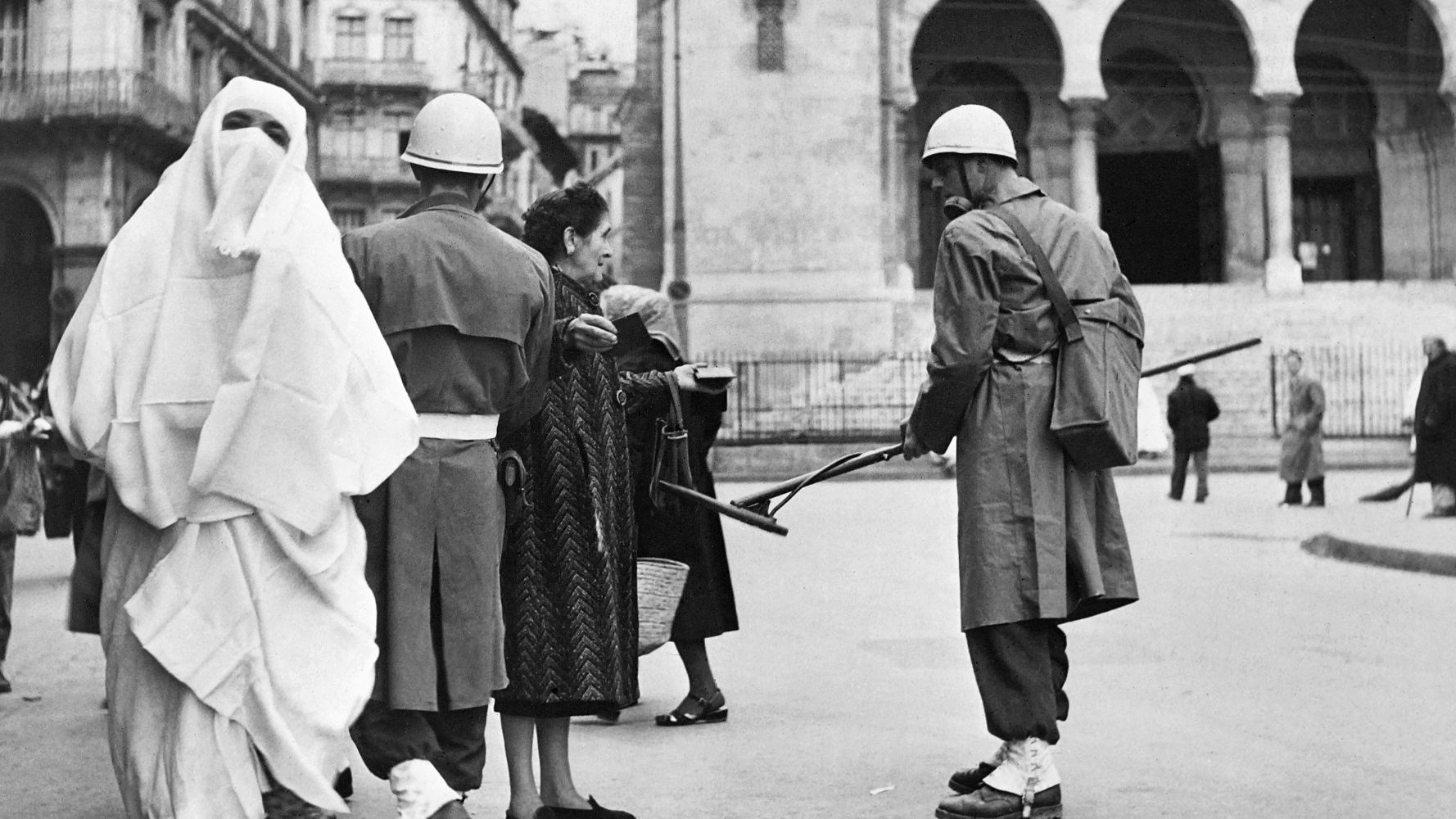
Terrence G Peterson’s Revolutionary Warfare: How the Algerian War Made Modern Counterinsurgency is a deeply researched and strikingly lucid account of how one colonial war reshaped the meaning of modern warfare.
At its core, the book tells a disturbing but essential story: That the French war against Algerian independence did not merely involve battles, arrests, and repression, it pioneered a vision of war in which society itself became the battlefield.
Conflicts in which civilians were the primary terrain and social reform a weapon of counterrevolution.
Peterson situates the Algerian War not as a tragic aberration or a final spasm of colonial violence, but as a formative moment in global military thinking.
The doctrines that emerged from Algeria did not end with the French defeat in 1962.
New MEE newsletter: Jerusalem Dispatch
Sign up to get the latest insights and analysis on
Israel-Palestine, alongside Turkey Unpacked and other MEE newsletters
They travelled outward, shaping how western militaries understood insurgency, stability, and governance across the Cold War world and beyond.
Revolutionary Warfare asks readers to confront a sobering reality.
Many practices now associated with modern counterinsurgency were born not from humanitarian concern, but from a determined effort to preserve empire in an age of decolonisation.
Rethinking the Algerian War
For decades, public debate about the Algerian War has focused on torture, military insubordination and the collapse of the French Fourth Republic.
These issues matter, and Peterson does not minimise their importance. Yet his study shifts attention to something more structural and in many ways more unsettling.
He shows how French officers, administrators, and experts came to believe that defeating the Algerian National Liberation Front required nothing less than the wholesale reorganisation of Algerian society.
The war, in this telling, was not simply fought against guerrillas in the mountains or bomb networks in the cities.
France has admitted to the ‘torture and murder’ of Algerian freedom fighter Ali Boumendjel, whose death in 1957 was covered up as a suicide during Algeria’s war of independence against French colonial rule pic.twitter.com/KHtOIlUSfz
— Middle East Eye (@MiddleEastEye) March 3, 2021
It was waged against social relations, political loyalties, family structures, and everyday life.
French commanders concluded that conventional military force was insufficient. Instead, they embraced an expansive doctrine they called “pacification”, a blend of coercion, surveillance, welfare provision, propaganda and administrative control.
Peterson demonstrates that this approach was not improvised in desperation. It was systematic, ideologically grounded, and deeply informed by postwar French faith in state-led modernisation.
The army cast itself as a force capable not only of defeating insurgents, but of reshaping society in ways civilian institutions supposedly could not.
Pacification as social reform
One of the book’s central achievements lies in its careful reconstruction of “pacification’ as a coherent project.
Peterson shows how French officers fused older colonial practices with new postwar ideas drawn from social science, demography, psychology, and development theory.


They believed poverty, underdevelopment, and social dislocation created fertile ground for revolution.
Control and reform of civilian life, therefore, became inseparable from military strategy.
Under this framework, schools, medical clinics, youth clubs, women’s programmes, and housing projects became instruments of war.
The army sought to reorganise villages, manage populations through forced resettlement, and insert itself into the most intimate spaces of social life.
These initiatives were often presented as benevolent, even progressive. Peterson’s analysis reveals how tightly they were bound to coercion and surveillance.
The language of reform masked a hard truth. Pacification aimed to isolate Algerians from the FLN and bind them to the colonial state by force if necessary.
Loyalty was measured, managed, and enforced. Civilians were no longer incidental to war. They were its central object.
Civilians at the centre of violence
Peterson’s account is particularly powerful in tracing how the French military came to see civilians as both a resource and a threat.
Control of the population became the key to victory. This belief justified practices that blurred any meaningful distinction between combatant and non-combatant.
The book details how entire communities were subjected to collective punishment, mass surveillance, and forced relocation.
Villages were emptied and reorganised, families were split apart and everyday life was militarised.
These actions were not accidental by-products of war. They were integral to a doctrine that treated social order as a strategic variable to be engineered.
Importantly, Peterson does not portray the French military as monolithic. He shows internal debates, competing agendas, and shifting alliances between civilian administrators and military commanders.
Pacification evolved through experimentation, improvisation, and conflict.
Yet the underlying logic remained consistent; war was no longer just about defeating armed opponents, it was about remaking society itself.
Modernisation meets colonial power
A major strength of the book is its integration of metropolitan French history into the story of colonial warfare.
Peterson places pacification firmly within the broader context of postwar reconstruction in France.
The same technocratic optimism that fuelled economic planning and social reform at home also shaped military thinking in Algeria.
French elites believed deeply in the power of state planning to modernise societies and resolve social conflict.
In Algeria, this belief took on a coercive colonial form.

Military-led modernisation promised to overcome what officials viewed as backwardness, instability, and susceptibility to subversion.
Peterson is careful to show how this vision intersected with long-standing colonial hierarchies.
Despite the rhetoric of equality and integration, racialised assumptions about Algerian society persisted.
French planners believed Algerians could be reshaped into compliant citizens through disciplined social intervention.
This belief underestimated Algerian political agency and profoundly misread the realities of colonial domination.
A laboratory of counterinsurgency
While grounded in Algeria, the book’s implications extend far beyond North Africa. Peterson traces how French officers actively promoted their ideas abroad, presenting Algeria as a laboratory for modern warfare.
Their theories circulated through military academies, policy networks, and alliances across the Atlantic world.

Even in death, Algerian war veteran and Hirak activist defies authorities
Read More »
American officials studying Vietnam took a keen interest in French experiences.
Concepts developed in Algeria influenced doctrines of counterinsurgency that emphasised population control, psychological operations, and civil–military integration.
Peterson’s work makes clear that these ideas were not neutral tools. They carried the imprint of colonial violence and authoritarian governance.
The Algerian War thus emerges as a pivotal moment in the global history of warfare.
It helped normalise a model of conflict in which military forces assume expansive roles in governance, development and social engineering.
This model continues to shape interventions in the Global South long after the formal end of empire.
Algerian resistance and the limits of control
A crucial contribution of Peterson’s study is its attention to Algerian experiences of pacification.
He shows how French claims of success often rested on misinterpretation and self-deception.
Apparent stability masked deep resentment and resistance.
The very populations targeted for reform eventually became central to mass mobilisations against French rule.
The dramatic demonstrations of 1960 exposed the fragility of the colonial social order and the hollowness of military-led modernisation.
Pacification, far from winning Algerian loyalty, accelerated the erosion of French legitimacy.
Peterson avoids portraying Algerians as passive subjects of policy.
Revolutionary Warfare is remarkably accessible. Peterson writes with clarity and restraint, avoiding jargon while conveying complex ideas.
He highlights how Algerian society adapted, resisted, and ultimately rejected the structures imposed upon it.
The failure of pacification was not merely tactical but instead reflected a fundamental misunderstanding of colonial power and political aspiration.
Despite its analytical depth, Revolutionary Warfare is remarkably accessible. Peterson writes with clarity and restraint, avoiding jargon while conveying complex ideas.
His thematic structure guides readers through dense material without oversimplification; each chapter builds carefully on the last, weaving together military doctrine, administrative practice, and social history.
The book draws on an impressive range of archival sources from France and Algeria.
Peterson’s command of this material allows him to reconstruct both high-level strategic thinking and its effects on the ground.
The result is a work that feels authoritative without being ponderous, critical without being polemical.
Counterinsurgency’s colonial DNA
The enduring value of Revolutionary Warfare lies in its refusal to sanitise the origins of modern counterinsurgency.
Peterson shows that doctrines often presented today as pragmatic or humane were forged in a colonial context defined by racial hierarchy, coercion, and emergency rule.
The book offers a historical lens through which to interrogate contemporary claims about stabilisation, development, and population-centric warfare.

Why Algeria’s independence was a miracle
Read More »
It demonstrates how easily the language of reform can be mobilised to legitimise intrusive and violent forms of power, and how military governance tends to expand far beyond its stated aims.
Rather than extracting lessons or offering prescriptions, Peterson insists on historical accountability.
By tracing how counterinsurgency emerged from attempts to save a collapsing empire, he invites readers to reconsider the moral and political assumptions that still underpin western military doctrine.
Revolutionary Warfare stands as a major contribution to the history of modern conflict.
It challenges comforting narratives about progress, reform, and humanitarian intent, and insists that the techniques of population control developed in colonial contexts deserve sustained scrutiny.
For a general audience, the book offers a compelling and unsettling account of how war came to penetrate every aspect of social life.
For specialists, it provides a richly documented analysis that will shape debates for years to come.
Peterson has written a work that is both historically rigorous and politically urgent.
In tracing how the Algerian War reshaped the very definition of warfare, Revolutionary Warfare reminds us that the past is not safely contained.
The ideas forged in colonial Algeria continue to echo wherever states attempt to fight political conflict by managing societies themselves.
Terrence G Peterson’s Revolutionary Warfare: How the Algerian War Made Modern Counterinsurgency is published by Cornell University Press
