

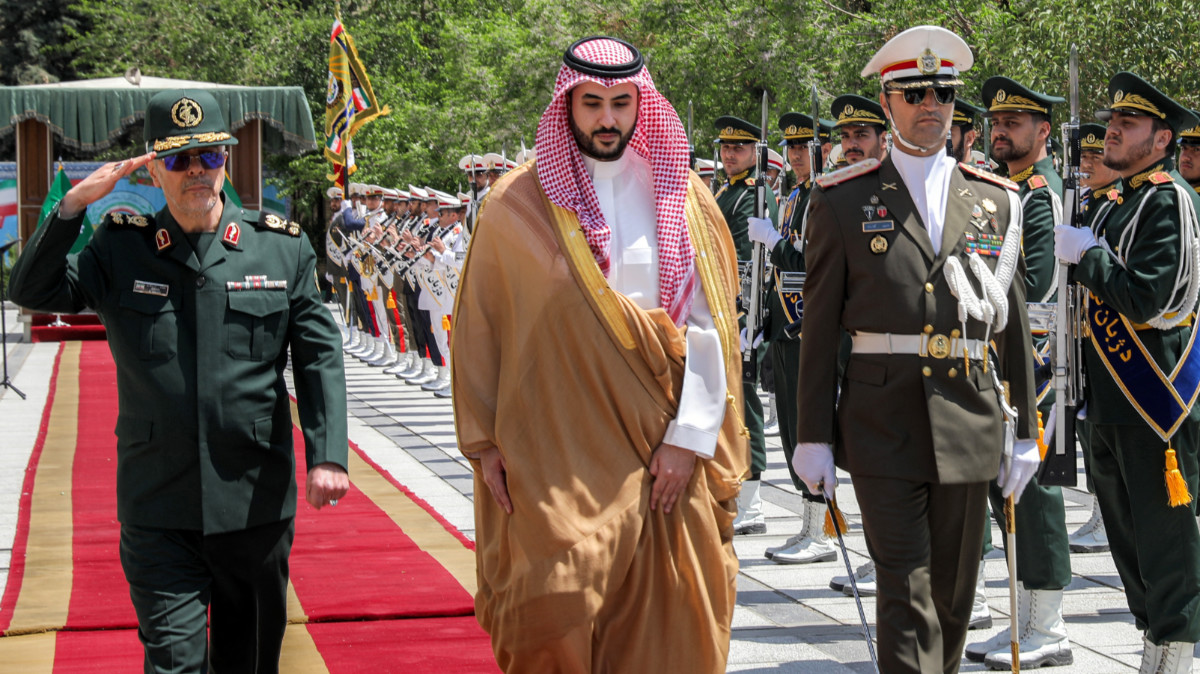
The US this week is trying to sway Saudi Arabia to get behind an attack on Iran, one US official briefed on the talking points for the Saudi defence minister’s visit to Washington and two Arab officials familiar with diplomacy told Middle East Eye.
In effect, the US and its Gulf partners appear to be talking over each other, with the Trump administration pressing Riyadh to fall in line on an attack, while Saudi Arabia is joined by Oman, Qatar and Turkey pushing for negotiations.
Axios first reported the Washington visit, alongside that of Israel’s military intelligence chief.
The US official familiar with the talking points for Defence Minister Prince Khalid bin Salman’s visit told Middle East Eye on Thursday that the Trump administration’s discussions would include how military strikes can reduce Iran’s threat to partners in the region through proxies and its ballistic missile arsenal. The US will also reassure Riyadh about its commitment to its long-term defence and security.
The two Arab officials told MEE there is an expectation that the US is offering “promises” to Saudi Arabia, but they did not elaborate on what Trump could offer Riyadh to secure its backing for an attack.
New MEE newsletter: Jerusalem Dispatch
Sign up to get the latest insights and analysis on
Israel-Palestine, alongside Turkey Unpacked and other MEE newsletters
“Everything I hear from every Gulf Arab country is that this is a really bad idea,” Douglas Silliman, the president of the Arab Gulf States Institute in Washington and a former ambassador to Kuwait, told MEE.
“To be brutally honest, he can’t promise the Gulf anything,” Silliman added, in reference to US President Donald Trump.
Quiet acquiescence
Still, one Arab official said Saudi Arabia may be convinced to quietly acquiesce to US strikes. Another official said Crown Prince Mohammed bin Salman has made it clear Riyadh is totally opposed to military action.
It’s unclear whether Trump is seeking a public commitment from the Gulf that would denounce their previous statements or covert approval behind closed doors.
The US has troops in Jordan and an aircraft carrier in the region, but may want Saudi approval to use their airspace for contingency planning, a former US defence official told MEE.
Khalid bin Salman is the crown prince’s brother and is widely understood to be his closest advisor.
Saudi Arabia and the UAE have publicly said they will not allow their airspace or territory to be used for an attack on Iran.
‘Iran can still make the Gulf not a good place to live or invest with a couple of low-cost attacks’
– Douglas Silliman, Arab Gulf States Institute
Turkey is also on a lobbying blitz. MEE reported that President Recep Tayyip Erdogan has offered to host a teleconference between Trump and his Iranian counterpart, Masoud Pezeshkian.
MEE reported on Monday that the Trump administration was weighing precision strikes on “high-value” Iranian officials and commanders involved in the crackdown on protesters. Reuters and CNN both reported the same on Thursday.
But the US faces an uphill task in trading promises for Saudi Arabian backing, current and former US and Arab officials say.
The Gulf states have reached a happy equilibrium with Iran, analysts say.
Israeli and US strikes in June 2025 have weakened the Islamic Republic, giving the Arab Gulf more leverage over it on files like Yemen and Sudan. Arab leaders are also more comfortable with Iran’s current clerical ruling elite than what they assess might result from fresh strikes: an unstable power vacuum or rule by the Islamic Revolutionary Guard Corps, experts say.
The US has undertaken a massive military build-up in the region.
US weighs precision strikes
The Abraham Lincoln aircraft carrier has been moved from the South China Sea to the Middle East. It carries F-35 warplanes and F/A-18 jet fighters, in addition to EA-18G Growler electronic-warfare planes. It is also accompanied by guided-missile destroyers.
CNN and The Wall Street Journal have reported that the US is sending additional Thaad and Patriot missile interceptors to the region.

US weighs ‘precision strikes’ on Iranian officials as military build-up surges, sources say
Read More »
Open-source flight trackers have also reported that the US has built up a squadron of F-15 warplanes at Muwaffaq Salti Air Base in Jordan. The buildup of warplanes in Jordan would give the US options, as the Gulf states resist becoming involved in strikes.
One former US intelligence official told MEE that the Gulf likely hopes its very public diplomatic push gives it some “insurance” against Iranian reprisals if the US does attack.
Saudi Arabia was subject to missile and drone attacks by Iran’s Houthis for years during its war in Yemen. The group is armed and trained by Iran. This week, the Houthis released a video saying they could resume attacks in the Red Sea.
Saudi Arabia was hardest hit in 2019 when a drone attack emanating from Iran hit its Aramco oil facilities at Abqaiq and Khurais in the kingdom’s east.
The strikes disrupted about 50 percent of Saudi Arabia’s oil production.
The current tensions also threaten an impact on the oil industry. Brent, the international benchmark, was up nearly four percent on Thursday. Iran announced “live-fire” military drills in the Strait of Hormuz to take place next week. Roughly 20 percent of the world’s oil passes through the narrow waterway.
“That was a very pinpoint attack by the Iranians with the message: ‘we can destroy a big chunk of your export facilities if we so choose’,” Silliman said.
He added that while Iran and its allies have been weakened by repeated Israeli attacks, they could still retaliate and “make the Gulf not a good place to live or invest with a couple of low-cost attacks”.
