

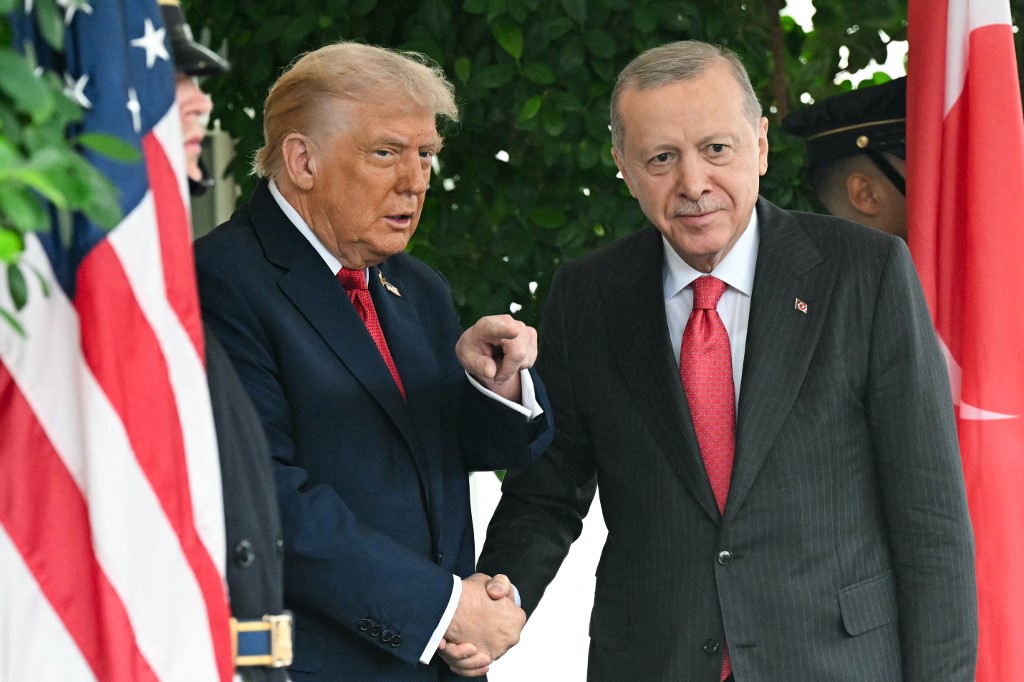
Turkish President Recep Tayyip Erdogan has offered to host a teleconference between the US and Iranian presidents to ease tensions.
The offer to avoid a potential conflict comes as US President Donald Trump threatens military action against Tehran in the coming days, according to officials who spoke to Middle East Eye.
During a phone call with Trump on Monday, Erdogan urged his counterpart to prioritise diplomacy and offered to mediate between the two countries, a Turkish official said.
While Trump expressed interest in the initiative, Iranian President Masoud Pezeshkian has yet to issue a response, according to the official.
Ankara insiders believe that Iranian Foreign Minister Abbas Araghchi, who is visiting Istanbul this week, may deliver Tehran’s response to the offer.
New MEE newsletter: Jerusalem Dispatch
Sign up to get the latest insights and analysis on
Israel-Palestine, alongside Turkey Unpacked and other MEE newsletters
Tehran’s top diplomat is arriving in Turkey on Friday for bilateral talks with Foreign Minister Hakan Fidan.
However, there is no certainty that the offer of talks can avoid military action.
Officials said that Turkey made a similar offer to Iran during the 12-day war in June, but Tehran did not take it up, expressing dismay.
Ankara has repeatedly stated that it opposes any foreign intervention in Iran. On Wednesday, Fidan said that the US and Iran should resolve their issues gradually, “file by file”.
The US is heavily influenced by Israel in its stance on Iran, with Prime Minister Benjamin Netanyahu keen to end the threat posed by Tehran’s ballistic missile programme, as well as its nuclear research.
‘Crisis postponed, not resolved’
In a bid to defuse tensions, Fidan held a series of phone calls and meetings with both Iranian and US officials, as other countries in the region have also done.
Hande Firat, a columnist for Turkey’s Hurriyet newspaper, wrote on Thursday that Ankara was pushing the message that diplomacy was the only way forward.
“Ankara’s goal was to ease the escalating crisis, bring the parties back to the table, and prevent a possible military intervention,” she wrote.
“According to diplomatic sources, without these engagements, the region might be facing a very different reality today. The crisis has been postponed, but not resolved.”

Iran’s battle for survival is the Arab world’s fight too
Read More »
Firat added that, beyond concerns over Iran’s nuclear programme and its ballistic capabilities, Netanyahu has been pushing for a US intervention as he faces parliamentary elections later this year.
She also noted that the US could return to the negotiating table if Tehran offers to cooperate with Washington on Iran’s oil reserves.
On Wednesday, Trump warned that a “massive armada” was heading towards Iran and would attack with “speed and violence” unless Tehran agrees to a deal.
Writing on his Truth Social platform, Trump drew comparisons with the US operation that led to the kidnapping of Venezuelan President Nicolas Maduro, but said the fleet deployed towards Iran was “larger” than the one sent to South America.
“Like with Venezuela, it is ready, willing, and able to rapidly fulfil its mission, with speed and violence, if necessary,” he wrote.
“Hopefully Iran will quickly come to the table and negotiate a fair and equitable deal – NO NUCLEAR WEAPONS – one that is good for all parties.”
Trump warned that “time is running out” for the country and referenced air strikes carried out against Iranian nuclear sites in June 2025.
“As I told Iran once before – MAKE A DEAL! They didn’t, and there was ‘Operation Midnight Hammer,’ a major destruction of Iran,” he said. “The next attack will be far worse. Don’t make that happen again.”
The US has been ramping up tensions with Iran in recent weeks.
Middle East Eye reported on Monday that Trump was considering precision strikes against “high-value” Iranian officials and commanders deemed responsible for the deaths of protesters during anti-government demonstrations earlier this month.
