

British warplanes have been sent to Qatar as rumours grow of an impending US attack on Iran. Many believe it could come as early as this week.
The Trump administration is considering precision strikes on “high-value” Iranian officials and commanders it deems responsible for the deaths of protesters during anti-government demonstrations that shook Iran earlier this month, Middle East Eye reported on Monday.
Meanwhile, Israeli media has reported that Britain, along with Jordan and the United Arab Emirates (UAE), would provide logistical and intelligence support to the US military in the event of an attack.
The UAE foreign ministry insisted on Monday that it will not let its airspace, territory or territorial waters be used for military action against Iran.
But the UK has refused to be drawn on whether it would involve itself in a conflict.
New MEE newsletter: Jerusalem Dispatch
Sign up to get the latest insights and analysis on
Israel-Palestine, alongside Turkey Unpacked and other MEE newsletters
Prime Minister Keir Starmer is certainly keen to maintain and strengthen Britain’s relationship with the US. Yet his government has distanced itself from the Trump administration’s foreign policy on several key issues over the past year.
Just last week it opted not to join Trump’s Gaza “Board of Peace” over the possible involvement of Russian President Vladimir Putin.
And during the conflict between Israel and Iran last summer, Britain carefully stayed out.
But how could Britain actually be drawn into a US-Iran conflict?
Typhoon jets to Doha
The Trump administration has toyed with attacking Iran for nearly a month on the pretext of the brutal crackdown on demonstrators that has seen thousands killed by government security forces.
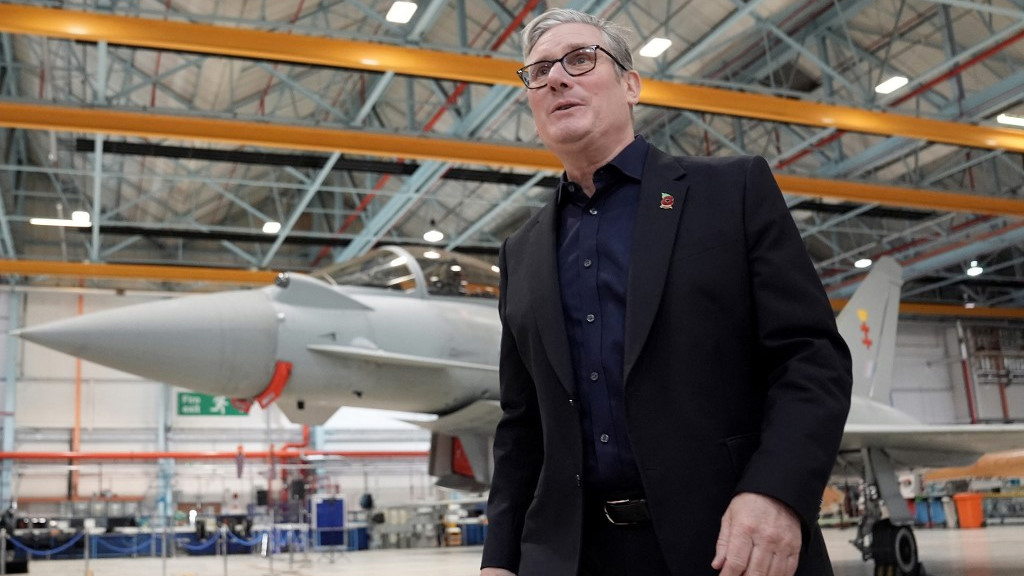
Late last week, Britain deployed a squadron of Typhoon jets to Al Udeid airbase near Doha at the invitation of the Qatari government. On Friday, the UK said it “noted regional tensions”.
The Ministry of Defence announced that the jets will form a joint RAF-Qatari unit, No 12 Squadron, to “bolster defensive capability in the region”.
“This partnership bolsters the national security of both our nations and supports stability in the Gulf region,” Defence Secretary John Healey said.
The jets are capable of shooting down Iranian Shahed-136 drones. They are thought to be a preparation for any potential Iranian retaliation to a US attack.
Last June Iran launched a rocket attack on Al Udeid base, which houses US Central Command, after US attacks on Iranian nuclear sites.
Air bases in the region
The UK has a naval support facility in Bahrain and air bases in Qatar, the UAE, Oman and Cyprus.
The Cyprus base, RAF Akrotiri, is particularly controversial because it was used to launch surveillance flights over Gaza during Israel’s genocide.

Turkey plans buffer zone if Iran government falls
Read More »
Most significant with regards to Iran, however, is Diego Garcia, a UK-US military base deep in the Indian Ocean.
The strategic base puts US bomber aircraft within 5,300 kilometres of Iran and could allow them to attack the Islamic Republic while avoiding Gulf airspace.
The British government would have to sign off on the US deploying from the base to strike Iran.
If Washington asks the Starmer government for permission to use the base for an attack, Starmer would be expected to seek advice from Jonathan Powell, his national security adviser, who was Tony Blair’s chief of staff when Britain invaded Iraq in 2003.
In October 2024, when Iran fired ballistic missiles at Israel, Britain said two UK fighter jets and an air-to-air refuelling tanker played a part in preventing escalation – but the jets did not engage targets.
However, last June the UK played no role in Israel’s initial strikes on Iran, nor in defending Israel from Iranian retaliation afterwards.
Iran had threatened Israel’s allies that they could be attacked if they help defend Israel.
Iran’s Shahed-136B kamikaze drones have the range to attack the UK-US base on Diego Garcia, which houses around 4,000 people, mostly members of the American military and contractors.
Escalating tensions
Earlier this month, the British government announced fresh sanctions on Iran in response to the government’s killing of protesters, targeting finance, energy, transport, software and “other significant industries”.

Gulf states fear US attack on Iran spoils chance at ‘concessions’ from weakened Islamic Republic
Read More »
On Tuesday, the government sanctioned Iranian businessman Ali Ansari for “hostile activity”, labelling him a “corrupt Iranian banker and businessman” and accusing him of financing the Islamic Revolutionary Guard Corps (IRGC). Ansari has denied the claims.
The UK has frozen his portfolio, which is worth more than £150 million. Yet the Labour government has repeatedly declined to say whether it would be involved in a US strike.
Cabinet minister Heidi Alexander told Sky News earlier this month that Iran posed a security threat in the Middle East.
However, she stressed: “The priority, as of today, is to try and stem the violence that is happening in Iran at the moment.”
This was in stark contrast to Kemi Badenoch, leader of the opposition Conservative Party, who said she would “not have an issue” with US-backed regime change in Iran.
Two weeks ago, Britain temporarily closed its embassy in Tehran and evacuated its staff.
In the past few days, the US has sent more warplanes, air defence systems and battleships to the region.
US Central Command said on Monday that the Abraham Lincoln aircraft carrier – which carries F-35 warplanes and F/A-18 jet fighters – had arrived in the Middle East.
All eyes are on Trump.
