


Low blocks are a hot topic in the Premier League.
The term refers to a defending team sitting deep in a compact shape to protect their goal and restrict space in central areas, making it difficult for their opponent to create chances.
Which teams come up against low blocks most frequently? And which teams are most and least effective when it comes to playing against them? Between the Lines digs into the numbers.
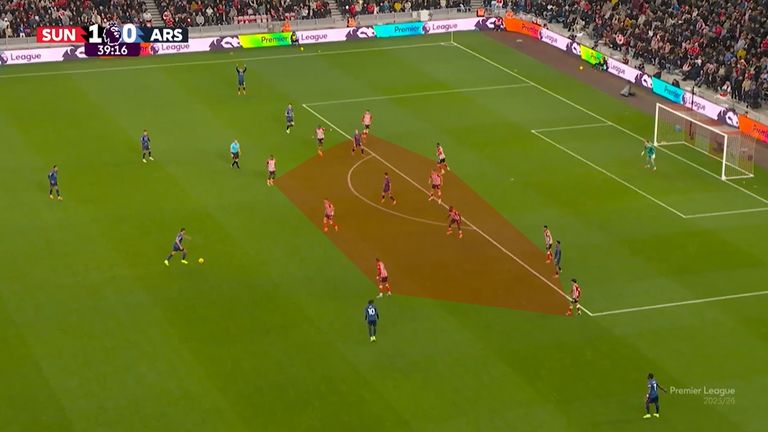
An example of a low block deployed by Sunderland against Arsenal
Slot’s right about Liverpool and low blocks
Arne Slot was told to stop talking about low blocks by Steven Gerrard after Liverpool’s Champions League win over Marseille.
“He needs to stop mentioning low blocks,” the former Liverpool captain said on TNT Sports. “Low blocks have been happening against Liverpool since I was playing. That’s just the way it is.”
Speaking to Sky Sports, Slot countered: “I can only agree with him, that I speak a lot about low blocks, because we face a lot of low blocks. And if people ask me after the game my opinion about the games I have to describe something.”

Arne Slot responded to Steven Gerrard’s advice about low blocks
The data supports Slot’s comments on low blocks.
This season, Liverpool have a higher percentage of build-up phases of play against low blocks than any team in the Premier League, at 26 per cent.
Arsenal are second, at 24 per cent, with Nottingham Forest and Newcastle third and fourth, on 23 and 22 per cent respectively.
At the other end of the scale, Leeds have the lowest percentage of build-up phases against low blocks this season, at 14 per cent, just below Crystal Palace and Burnley at 15 per cent.
Man City facing fewer low blocks
Slot has bemoaned facing more low blocks than last season this term as Liverpool’s opponents set up to frustrate them.
Again, the data backs him up.
Only Everton have experienced a bigger increase to the percentage of build-up phases against low blocks this season.
While Liverpool and Everton are facing low blocks more frequently, Manchester City are facing them less frequently.
In fact, Pep Guardiola’s side have the biggest negative differential among ever-present Premier League clubs this term, their percentage dropping from the highest in the Premier League last season at 27 per cent, to 21 per cent this term, putting them fifth.
The dip reflects changes to the way they are attacking, as well as how teams are defending against them, with Guardiola having put more emphasis on directness this season.
Aston Villa most effective
Aston Villa rank as by far the most effective team against low blocks.
Helped by a succession of strikes from outside the box this season, Unai Emery’s side have racked up 19 goals from phases of play against low blocks since the start of last term.
It is three more than any other side has managed in the same timeframe, with Manchester City next on 16. Newcastle have also enjoyed some success, scoring 15 goals against low blocks.
Excluding relegated and promoted sides, Brentford have scored the fewest goals against low blocks, with three.
Aston Villa and Brentford also come out top and bottom respectively when factoring the number of times Premier League teams have come up against opponents in a low block.
For context, Aston Villa’s 19 goals since the start of last season have come from 1,717 build-up phases against low blocks, giving them an average considerably higher than any other Premier League side at 1.11 goals per 100 phases.
Manchester City’s 16 goals, meanwhile, have come from a far higher number of build-up phases against low blocks, at 2,676, giving them a much lower average of 0.60 per 100 phases.
Arsenal’s low block problem
While Newcastle and Manchester United rank closest to Newcastle for goals per 100 build-up phases against low blocks, Liverpool and Arsenal sit closer to Brentford.
Arsenal’s issues become even clearer when looking at shot numbers.
While Liverpool do at least get a decent amount of shots off against low blocks, their average of 9.9 per 100 phases of play putting them fourth among ever-present Premier League sides in the last two seasons, Mikel Arteta’s side average the second-fewest, at just 7.8 shots per 100 phases of play.
Their lack of threat against low blocks was most recently apparent during Sunday’s 3-2 loss to Manchester United at the Emirates Stadium, when the Gunners struggled to open up their opponent’s defensive structure in open play.
In contrast to Arsenal, Manchester United have averaged considerably more shots against low blocks than any other Premier League side since the start of last season, at 12.9 per 100 phases of play, showing they fare better at breaking them down.
Read last week’s Between the Lines
Why are so many Premier League strikers struggling this season? Last week’s edition looked at the declining number of goals being scored by forwards and the reasons behind the trend.
