

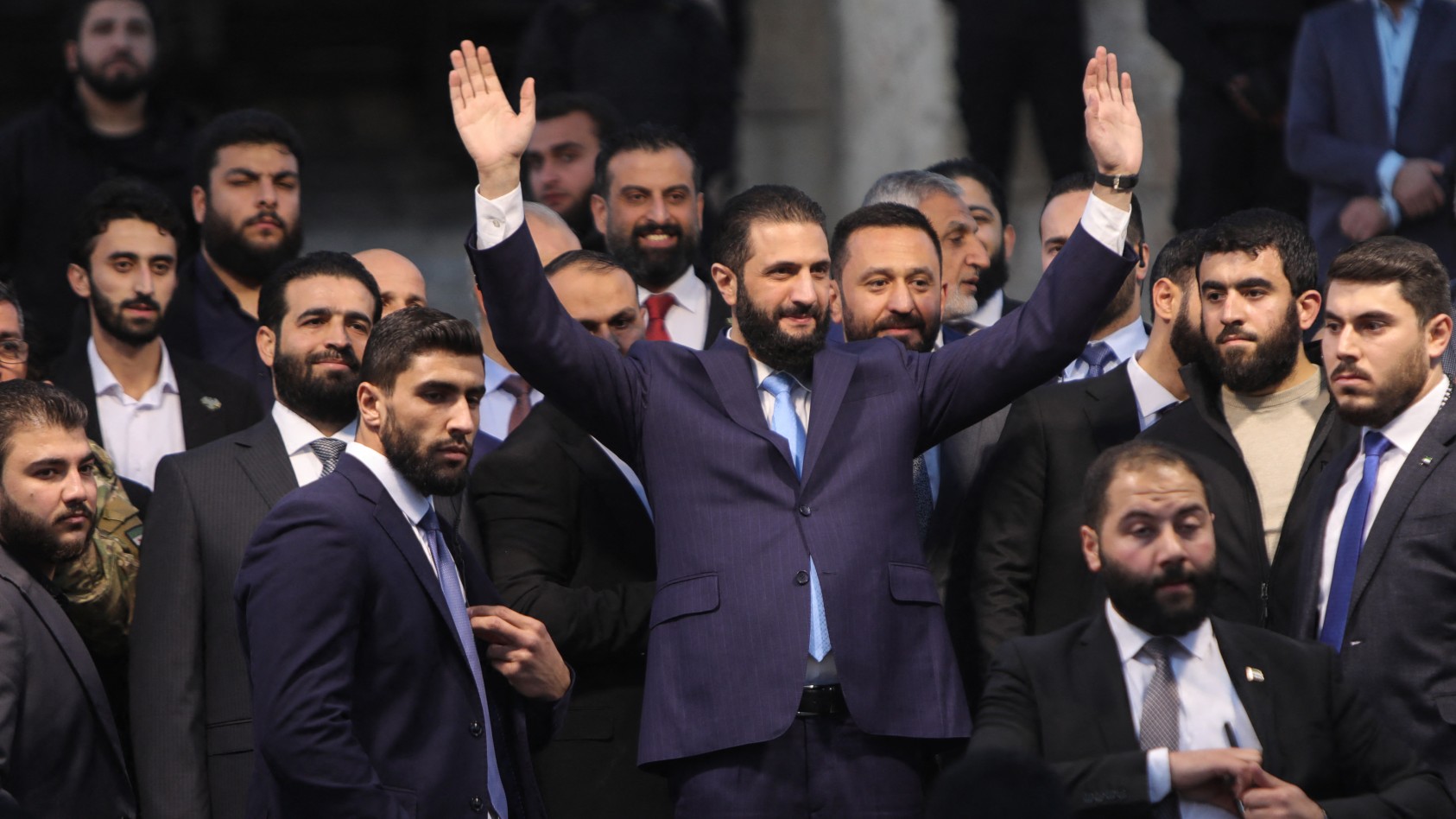
Syrian President Ahmed al-Sharaa held a private meeting with 15 intellectual and influential community Kurdish figures from the northern Syrian city of Kobane, Kurdish sources told Middle East Eye.
The meeting was held early last week as part of unannounced visit by Sharaa to Syria’s largest dam, Tabqa, which was recently captured by Syrian government forces.
The sources said that those who attended the meeting were from among the Kurdish political spectrum, and included figures close to the Kurdish-led Syrian Democratic Forces (SDF) as well as others who oppose the group.
The sources said that during the meeting, Sharaa stressed the need to fully implement his recently announced declaration recognising Kurdish civil and cultural rights.
He expressed his willingness to engage with all Kurds and repeatedly told them their rights would be protected by the new Syrian state. However, according to the sources, Sharaa criticised SDF leaders during the meeting.
New MEE newsletter: Jerusalem Dispatch
Sign up to get the latest insights and analysis on
Israel-Palestine, alongside Turkey Unpacked and other MEE newsletters
“They do not care about Kurdish rights. All they want is a piece of land to control and fight from,” Sharaa reportedly said.
“I will not allow this to happen. We want to stop the fighting [and unify Syria],” he added.
The sources said that the Kurdish delegates left the meeting feeling largely reassured by Sharaa’s pledges, even as many concerns persist over broader political questions.
For years, the SDF acted as Washington’s key partner against the so-called Islamic State group, but a shift in US policy last month saw Washington focus support on Sharaa’s transitional government – a move that critics argue weakened Kurdish leverage.
As a result, over several weeks, Syrian government forces pushed back SDF forces, taking control of Aleppo, Raqqa and Deir Ezzor.
Territories seized by government forces included some of Syria’s biggest oil fields, dams, agricultural land and prisons holding suspected Islamic State fighters, 150 of whom have already been transferred to Iraq, which says it plans to initiate legal proceedings against them.
The latest developments came after the 18 January ceasefire deal which was signed after a heated meeting where the US envoy to Syria, Tom Barrack, met with Mazloum Abdi as MEE reported last week.

Baghdad says it will prosecute Islamic State detainees transferred from Syria
Read More »
Syrian sources, meanwhile, told MEE that Sharaa’s outreach to the Kurds came few days after he hosted SDF chief Mazloum Abdi in Damascus in the hopes of consolidating the ceasefire deal.
According to the sources, while the Syrian Democratic Forces (SDF) were still resisting the Syrian army’s advance in the Jazira region despite the signed ceasefire on 18 January, Abdi arrived on 19 January in Damascus and met with Sharaa for a five-hour meeting.
Sharaa demanded that Abdi immediately implement the previous day’s agreement and offered Abdi to nominate a candidate for the position of Deputy Minister of Defence, another for the position of Governor of Hasakah, and a list of candidates for the Hasakah governorate’s seats in the People’s Assembly.
However, Abdi, who showed considerable hesitation, reneged on the commitments of the previous day’s agreement, which he had signed, and reverted to demanding full autonomy for Hasakah governorate, the integration of the SDF into the Syrian army as military units rather than as individuals, and a five-day period to discuss the terms of the agreement with other SDF commanders, during which the Syrian army would halt its advance in the Jazira region.
The Syrian sources revealed to MEE that Barrack attended the first half of the meeting and then left in anger over Abdi’s backtracking on the agreement, which Barrack himself had brokered.
Barrack apparently informed Washington of the SDF’s obstruction and retreat.
This prompted Trump to make call to Sharaa immediately after his meeting with Abdi. During his conversation with Sharaa, Trump emphasised Syria’s unity and sovereignty, a shift that left no doubt about Washington’s stance on the Syrian Democratic Forces project.
Trump also urged Sharaa to secure detention centres for suspected Islamic State (IS) fighters, which the SDF had vacated without coordinating with the Syrian government.
Neither the Syrian government nor the SDF has publicly commented on the meeting’s details.
MEE reached out to the State Department for comment but did not receive a response by time of publication.
