

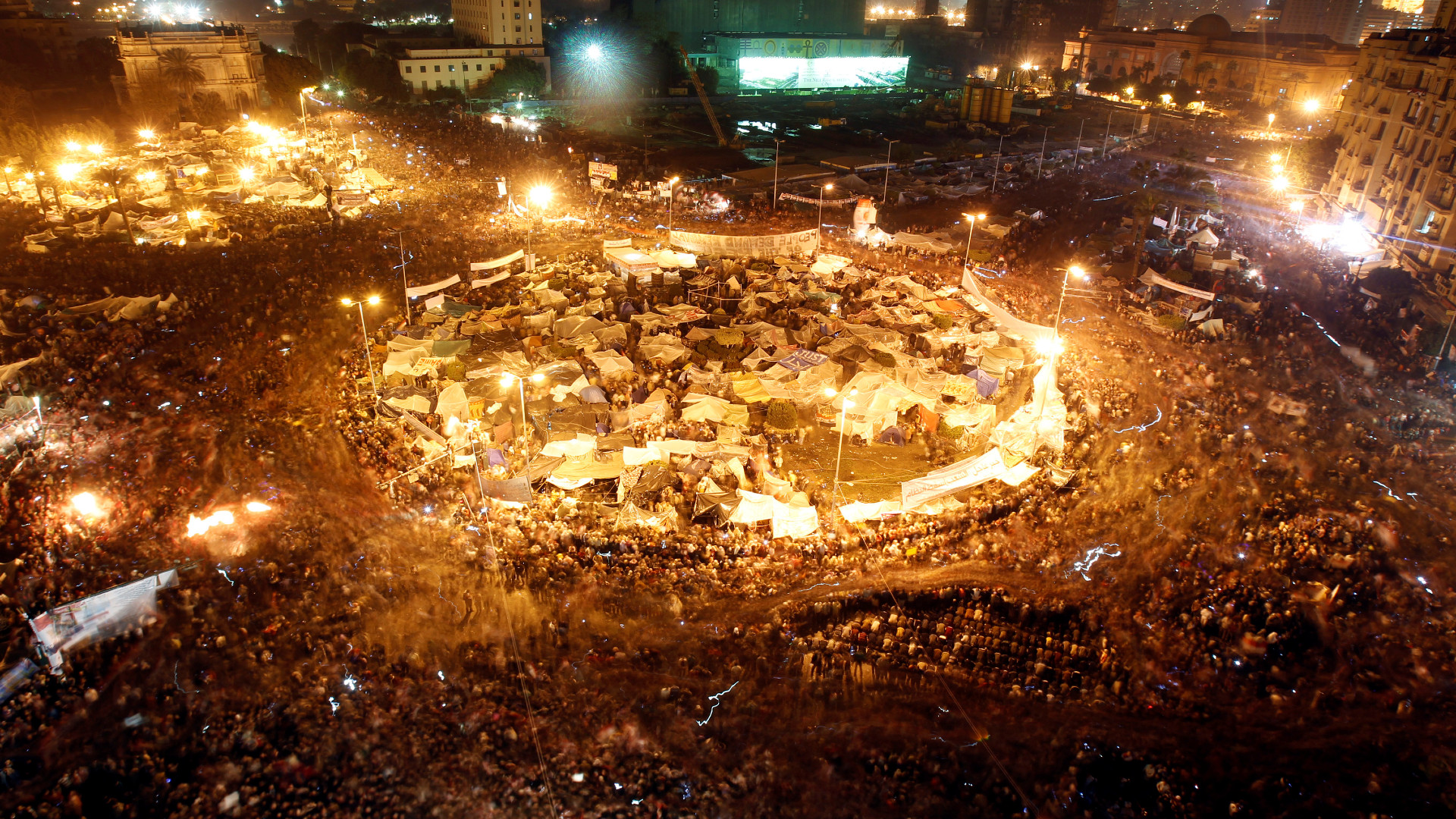
Fifteen years have passed since Egyptians last mounted an uprising against the military regime that continues to rule them.
That uprising was not an isolated event, but part of a long sequence of popular revolts, from the Urabi Revolt and the 1919 Revolution to the student protests of the early 1970s and the 1977 bread riots, culminating in January 2011.
What all these uprisings and revolutions share is that Egyptian society has continued to pose the same fundamental questions that erupted more than a century ago, without finding answers.
January 2011 was not a fleeting moment of protest. It was an earthquake that struck the depths of the deep state’s institutions, producing fractures that have yet to heal. This helps explain the unprecedented level of repression exercised by the current Egyptian regime against its citizens, especially those who played an active role in January 2011 or left a clear mark on it.
For the military establishment in Egypt, January 2011 represented a danger that could strip it of its authority and potentially lead to civilian rule – something it fears, as it dominates the economy and now controls nearly everything in the Egyptian state.
New MEE newsletter: Jerusalem Dispatch
Sign up to get the latest insights and analysis on
Israel-Palestine, alongside Turkey Unpacked and other MEE newsletters
At the time, no one in Egypt truly grasped this danger except the military institution and the presidency, which feared that the army might seize power. Meanwhile, the opposition was lost in its slogans and fantasies that “the army and the people are one hand”.
During that period, I was responsible for the political communication file at the National Association for Change. Contacts with the presidency were continuous. His inner circle was making overtures, looking for a way out. The association’s position, however, was a complete rejection of any dialogue with the regime until Mubarak stepped down.
January… was an earthquake that struck the depths of the deep state’s institutions and produced fractures that have yet to heal
Yet the most dangerous message we received at the time, from Omar Suleiman, Egypt’s then-vice president and intelligence chief, was this: if there were no negotiations at the dialogue table to agree on a political solution, a military coup would occur. At that moment, the opposition did not see the military institution as a threat but as an ally.
When I speak of the opposition here, I mean the Egyptian opposition in all its different strands, from the far right to the far left, without distinction – except for those who, from the outset, opposed the equation of freedom and democracy and worked consistently to undermine it, or who called for the use of arms and violence as a tool for change.
What is meant here is explicit, clear violence – not the regime’s practice of accusing everyone, even those who were once in its camp, of belonging to groups seeking to undermine the state and overthrow the system of rule. That accusation has become worn out and lacks any evidence.
In the end, January 2011 failed to achieve its goals because the opposition could not turn revolutionary momentum into a shared political project, with seven mistakes outlining how that leverage slipped away and enabled the military regime to reassert itself.
The missed moment
The Egyptian opposition misjudged the situation from the very first moment the revolutionary uprising erupted in January 2011.
The first of its grave mistakes occurred immediately after Hosni Mubarak stepped down, with the passage of a soft coup against power. This mistake lay in abandoning Tahrir Square without agreeing on future steps, and without recognising the value and effectiveness of the square itself.

Egypt’s January revolution: Memories of motherhood, guilt and ecstasy
Read More »
Squandering that value was tantamount to firing the first bullet at the revolution. Had people remained in the square for just one week after Mubarak’s fall, the entire scene would have been different. The Supreme Council of the Armed Forces would not have been able to stand in the face of the millions who forced Mubarak to relinquish power.
I still recall, when I was responsible for political communication at the National Association for Change, how, during various meetings, the different political forces called for evacuating the square and launching the political process without agreeing on a future vision.
Foremost among them was the Muslim Brotherhood, followed by others from traditional parties historically allied with the deep state – though my point here is not to single out any one party.
The key is that this position reflected the opportunism that characterised the political opposition, regardless of orientation, and its rush to inherit Mubarak’s regime and divide the spoils among themselves.
This was one of the loopholes exploited by those managing power at the time, who deepened political divisions and ignited a political war among all parties. That division continues to this day, and the regime has become adept at exploiting it to prolong its survival.
No shared vision
The second grave mistake was failing to formulate a project that everyone could feel invested in, one that offered a vision for the post-Mubarak era. The opposition, represented by the National Association for Change, possessed a project known as the Seven Demands – the very demands raised by the January 2011 uprising when it began.
Yet after Mubarak stepped down, these forces found themselves in an intellectual vacuum, lacking a vision for the new phase.
This led to the third mistake: the vacuum regarding goals and a vision resulted in an overconcentration on ideology as a substitute for a political project. Everyone turned away from fundamental issues such as democracy and freedom, instead building their visions on ideological foundations. Leftists saw the solution in leftist ideology. Islamists saw it in Islamic ideology.
The core demands – freedom and democracy – faded from the scene as the foundation of political discourse.
This absence, in turn, led to a fourth error: the lack of a political discourse capable of persuading the masses. The absence of a project meant the absence of the structure from which discourse is formed. Moreover, shifting into a reactive rather than proactive role made the discourse dependent on immediate events as they arose.
To this day, much of what emerges from civil forces is merely a reaction to the growing repression exercised by the regime. It is also a traditional discourse, devoid of new creative methods, founded on the same old approaches long known to – and thoroughly studied by – the security apparatus, rendering it ineffective.
Coup against democracy
The fifth mistake was forming alliances with the deep state in order to eliminate the “other” – the political rival. The National Salvation Front played this role skilfully. It possessed no political project beyond toppling the Muslim Brotherhood. The composition of the Front, which included remnants of the Mubarak regime and allies of the deep state, was one reason for this.
Over the past five years, the opposition has contributed to its own defeat and to deepening political divisions among its various components
This amounted to once again inviting the army to stage a coup against democracy. Here, there remains confusion among followers of the Muslim Brotherhood, who continue to conflate the right to peaceful protest with the coup carried out on 3 July 2013 by the military regime. Demonstrations had called for early presidential elections. Regardless of differing views on that demand, the regime chose to overthrow everyone and seize power without holding early elections, in addition to removing the elected president, Mohamed Morsi.
The sixth mistake was acquiescing to the dispersal of the Rabaa al-Adawiya sit-in without opposing it or offering even minimal resistance. Instead, slogans such as “those who sent them killed them” were repeated, and the opposition submitted to the regime’s narrative that the sit-in threatened the state’s existence, contrary to reality.
Had the Muslim Brotherhood possessed such power, its leaders could not have been removed from office. This propaganda was merely a prelude to justifying mass killing. The live broadcast of the dispersal, before the eyes and ears of all, paved the way for every future act of killing the regime would commit against anyone who defied it or attempted to stand in the opposing camp – including peaceful opposition.
The effects of the Rabaa dispersal will linger for a long time within both society and the state. After it, latent violence within society accumulated more intensely, and a state of gratuitous violence spread, to use the Frankfurt School’s expression.
The seventh mistake is the continued inability to acknowledge error and to make the demand for freedom and human rights universal, applying to everyone regardless of political or ideological position. This necessitates redefining concepts distorted over the past five years, such as political solidarity, which should be based on equality, freedom, and justice for all, rather than ideological or political affiliation.
Egypt: How Sisi’s decade of failure could spur his political demise
Taqadum al-Khatib
Read More »
Over the past five years, the opposition has contributed to its own defeat and to deepening political divisions among its various components – divisions that have become part of its vision and practice.
This indicates its inability to overcome its internal crisis, or to reposition itself around broader, more inclusive issues capable of offering solutions to the current crisis.
In the same context, the opposition appears unaware of its need for a new phase founded on national reconciliation – meaning dialogue among different parties that advocate peaceful political action as a tool for change.
Without constructive dialogue leading to a shared vision grounded in freedom and democracy, the opposition cannot once again present itself as an alternative to a regime that has violated everything to remain in power.
Neither triumph nor defeat
All of these factors, along with others, led to January 2011’s failure to achieve its goals. Yet one point must be emphasised: January 2011 cannot be viewed merely as a revolutionary event with limited results, but as a revealer of political and social structures.
The uprising exposed society’s inability to fully absorb what happened. It revealed a deep generational gap, the absence of an organised middle class, and the illusions of organisation through social media.
It also highlighted the geographic disparity between urban centres and rural areas, as well as the deeply entrenched psychological structure of the state that remained intact even after revolutionary shocks.

Egypt’s 25 January Revolution: 10 years on
Read More »
When compared to Eastern European revolutions, the structural difference becomes clear. There, organised and mature elites possessed institutional accumulation, experience confronting the state, and a vision for the aftermath of rupture.
In Egypt, by contrast, street momentum was greater, but institutional accumulation was weaker. This was not a moral failure, but a difference in context and in the composition of political society.
Thus, reducing January to a binary of success or failure is a misleading simplification. It succeeded in breaking eternal assumptions, returning politics to the public sphere, and proving that fear is not a natural law.
Yet it failed to transform into a sustainable institutional project, not solely because of its own mistakes, but also because of society and its elites.
Perhaps the true tragedy is that January 2011 was more honest and more youthful than reality could bear. It was not fully defeated, nor did it triumph as its makers hoped. It remains suspended between a historic moment of rupture and a time not yet mature – a lingering question about generation, time, and the limits of what is possible in societies that move slowly while their youth dream quickly.
The views expressed in this article belong to the author and do not necessarily reflect the editorial policy of Middle East Eye
