

In the backwash of Myanmar’s protracted exercise in military-engineered elections, the coming months will see much media commentary on the new frontmen of the junta’s “civilian” government and the degree of warmth that greets their efforts to establish the international legitimacy they will lack at home.
None of it will reflect the bedrock reality of the crisis: the viability of the new line-up in Naypyidaw, its struggle for credibility and its efforts to rescue a crippled economy will be measured not in air-conditioned ministries and think tanks around the region, but by the course of a war waged across the country’s rice paddies and hills.
In a conflict about to enter its sixth year with few certainties beyond an unbridgeable political divide and further human suffering, daunting challenges confront both belligerents: a military, or Tatmadaw, driven by a centralized vision of praetorian governance, and a loose alliance of ethnic minority and majority Bamar factions united around a federal-democratic banner.
How they respond to those challenges in 2026 will go far to shape, perhaps even decide, the outcome of a war that the Tatmadaw is unlikely to lose but, equally, will struggle to win.
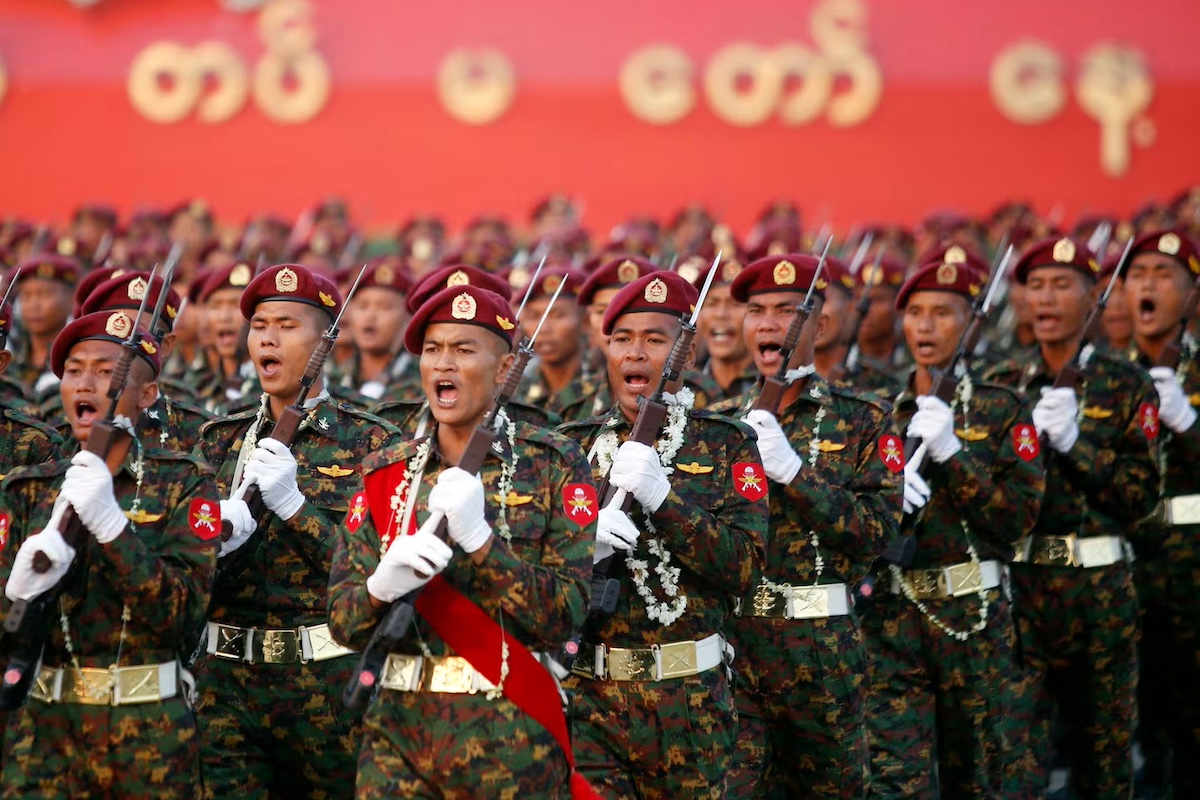
Following months of reorganization and reinforcement, the latter half of 2025 saw the military reassert a battlefield initiative lost to the dramatic opposition offensives of late 2023 and 2024.
In a multi-pronged and surprisingly well-sustained rainy-season campaign that extended through December, the army rebounded with significant advances in northeastern Shan State, eastern Karen State and central Mandalay Region.
Its confidence partially restored, the Tatmadaw now faces two distinct, yet occasionally overlapping, strategic challenges that — while similar to those of 2025 — will require different operational approaches.
‘Three Alls’ campaign
The first centers on a protracted, widely fragmented counterinsurgency that ties down tens of thousands of troops across the Bamar heartland regions of Bago, Magwe, Mandalay and, not least, Sagaing.
Anchored on urban centers which the military cannot afford to lose, this sputtering campaign aims eventually to tame, militarily and politically, opposition Peoples Defense Forces (PDFs) dominant across the rural hinterland since the early months of the war in 2021. Tatmadaw planners undoubtedly envision a process requiring at least several more years.
To date, infantry sweeps targeted on recalcitrant villages or even entire townships have relied on tactics drawn from decades of experience in Myanmar’s ethnic borderlands, where the “Three Alls” of Imperial Japan’s World War II onslaught on central China —burn all, loot all, kill all —were given free rein.
Battalion-level operations involving roving forays by a few hundred troops have typically been backed by artillery barrages from local firebases and a rising tempo of airstrikes. Deliberately hitting civilian targets to better drive a wedge between resistance forces and an increasingly exhausted rural population has become standard operating procedure.
The ebb and flow of this conflict will inevitably drag on through 2026. It would be naive to expect any radical shift in tactics from the Tatmadaw, a force in which contempt for civilians is deeply ingrained in its institutional DNA.
That said, in the context of a military-propped, Union Solidarity and Development Party-led government anxious to extend its writ, it seems likely that alongside the military’s sticks, the coming year will also bring carrots calculated to erode resistance resolve via cash payments and live-and-let-live ceasefires that offer some stability.
How far these efforts prove successful will depend largely — as discussed below — on how PDFs adapt to a war in flux.
Big military pushes
The Tatmadaw’s second strategic challenge will center on major offensives fought mainly against far larger, better organized ethnic forces.
Foreshadowed by the monsoon campaign of 2025 and bringing together a full panoply of military assets, these drives will aim to reassert control over key political and economic centers and the crucial transport arteries connecting them.
The most formidable target in the military’s crosshairs will undoubtedly be the powerful Arakan Army (AA) — with an estimated 40,000 regulars in the field, Myanmar’s largest non-state actor — which continues to control almost the entirety of the western seaboard state of Rakhine.
As well as posing an ongoing threat to the state capital, Sittwe, and Kyaukphyu port to the south — where embattled regime garrisons have held out — the Rakhine nationalist army also stands as a dangerously persistent thorn in Naypyidaw’s exposed western flank that cannot be ignored in 2026.
Absent an AA willingness to agree to a ceasefire, fighting on all these fronts, already heavy in in 2025, will almost certainly further escalate in 2026. Indeed, for the Tatmadaw, retaking ground lost in 2024 from a determined and well-entrenched ethnic enemy could involve casualty levels with political implications, even for a military-proxy administration in Naypyidaw.
Other likely targets for offensives in 2026 will be northern Sagaing, where the Kachin Independence Army (KIA) operates in support of local PDFs, and the northeastern reaches of Kachin State, where reasserting control over KIA-run border territories home to economically vital rare earth mining remains a key objective.
Whether the regime can secure the entirety of the road from Lashio to Muse on the China border without jeopardizing precarious, Chinese-imposed ceasefires reached with the large ethnic forces of the Kokang-Chinese Myanmar National Democratic Alliance Army (MNDAA) and the Ta’ang National Liberation Army (TNLA) is more questionable.
The success or failure of these major offensive operations will hinge on ongoing efforts to address two perennial weaknesses the Tatmadaw has wrestled with for decades, but which the current civil war has thrown into critical focus.
Crash conscription
One centers on quantity: chronic undermanning at the combat battalion level in a military that is already geographically over-stretched. The other is an issue of quality: lack of experience in complex, combined-arms operations in an army focused for decades on low-intensity brush wars in border areas.
Introduced in early 2024, conscription has sought to address the manpower shortfall and has inducted at least 90,000 draftees to reinforce ground forces that, under the weight of losses and desertions, had shrunk by the close of 2023 to probably not many more than 120,000 combat-capable troops.
At least on paper, the new intake is pushing towards a doubling of combat manpower, with results that in terms of notably larger battalions were clearly apparent in last year’s rainy-season campaigns.
This process has not resolved all shortfalls, but it has afforded field commanders some desperately needed breathing space and the human wherewithal — or cannon fodder — to push forward with major offensives aimed at reframing the overall contours of the war.
Whether in 2026 a crash conscription — one increasingly reliant on press-ganging and short training periods — can be maintained at the pace seen in 2024 and 2025 will undoubtedly command attention in Naypyidaw.
And if it can, what will be the impact on combat battalions manned by a growing proportion of draftees who, at least initially, lack experience and enthusiasm for the fight?
Is there a point beyond which greater numbers, the higher casualties they imply and the impact on morale become liabilities more than assets? Or, alternatively, do the pressures of combat that forge cohesive fighting units serve to fast counteract inexperience and weak motivation?
There are no simple answers to these questions. But for Naypyidaw, one of the biggest gambles of 2026 will be throwing more numbers into meat-grinder offensives, not least in Rakhine, and hoping they produce the same positive results as last year.
At the level of quality, building combined-arms capabilities through the integration of infantry, artillery, armor, drones, fixed wing airpower and logistical support have already shown signs of success. Advances made in rainy-season battles along the highways between Mandalay and Lashio in the northeast, and from Hpa-an to Myawaddy on the Thai border, reportedly owed much to improved tactical skills.
Growing resort to drone technology imported from Russia and China has been a central element in the mix, with three schools run by a new Drone Warfare Directorate set up in 2024 now training dedicated drone units that can be attached to existing formations.
Largely overshadowed by media focus on Chinese support for the regime, the increasingly close relationship between the traditionally xenophobic Tatmadaw and the Russian military has undoubtedly been an important element in this learning curve.
Beyond a wide range of Russian equipment on the ground and in the air, the cumulative impact of joint training programs, Russian advisers in Naypyidaw and in the field, and the coordinating and planning role of the Myanmar-Russia Joint Counter-Terrorism Committee (MRJCTC) has been significant in building a new capacity for combined-arms operations.
Coordinating resistance
To date Myanmar’s armed resistance has owed its resilience to resolve, ingenuity and the sheer breadth of a nationwide popular revolt. But in 2026, in the face of a resurgent Tatmadaw, those strengths risk becoming diminishing assets unless reinforced by change in two key areas — one organizational, the other tactical.
First, Naypyidaw’s electoral gambit — on top of the Tatmadaw’s rainy-season advances and a slump in resistance morale — have catalyzed a growing recognition that military reform and greater coordination are now strategic imperatives.
The most striking manifestation of the new realism was the emergence in mid-December 2025 of the Spring Revolution Alliance (SRA). Bringing together a wide spread of 19 armed factions, including ethnic actors and independent Bamar PDFs, the new grouping seeks to sidestep festering mistrust between larger ethnic armed organizations (EAOs) and a National Unity Government (NUG) rooted in the Bamar-centric politics of Aung San Suu Kyi’s National League for Democracy (NLD).
At the military level where its focus is directed, the SRA offers the prospect of a joint chiefs-of-staff body that seeks to galvanize strategic coordination, including with major EAOs and NUG-affiliated PDFs.
Against this backdrop, the central challenge for its leadership in 2026 will be responding to an iron law of insurgent warfare: hit-and-run guerrilla forces can never prevail against an entrenched, cohesive military.
Absent a political implosion of the regime — a vanishingly improbable scenario — armed resistance in Myanmar’s heartland must either shift to a higher level of warfare, requiring the formation of centrally coordinated mobile brigades operating semi-conventionally over wider areas, or, alternatively, face a period of stalemate followed by gradual marginalization fueled by co-option, warlordism and banditry.
Events in the second week of 2026 underscored the fluidity of these tensions. In a show of force prior to the second tranche of elections on January 11, multiple PDFs in Bago Region north of Yangon struck regime bases in a string of townships along major north-south highways with an unprecedented burst of coordinated, hard-hitting attacks.
In the days that followed, however, army units supported by air power responded to retake lost positions and effectively reestablish the status quo ante.
Fiber-optic bullets
The tactical element with the potential to reshape this battlefield in 2026 turns on fiber-optic first-person-view (FPV) drone technology.
In essence, fiber- optic FPV drones — which in 2025 transformed the war in Ukraine — currently represent the only means by which resistance forces in Myanmar can strike regime airbases, fuel depots, ammunition dumps and other key military infrastructure from stand-off ranges of up to 20 kilometers.
At its simplest, navigating a hand-launched FPV suicide drone via a hair-thin fiber-optic cable spooling out behind it enables a behind-the-lines “pilot”, equipped with a headset and toggle to remotely direct the aircraft to its target in a flight impervious to the electronic jamming that now shields all strategic facilities in Myanmar.
Since late 2025, some opposition forces have already quietly tested the technology to good effect. The challenge in 2026 will be to stimulate the assembly and deployment of a few broadly standardized drone models over wide swaths of the country, where production, tactics and impact have so far been fragmented among a plethora of local groups.
At the beginning of a pivotal year, meaningful change will require recognition across senior, typically older, levels of the resistance that fiber-optic FPVs are not an optional niche technology but a uniquely effective means of leveling a battlespace that, month by month, risks tilting against them.
Only then can the sourcing of commercially available components from China’s sprawling online markets enable dispersed assembly at a scale capable of impacting the trajectory of the war — first in the hundreds, and then, within months, in the thousands.
