

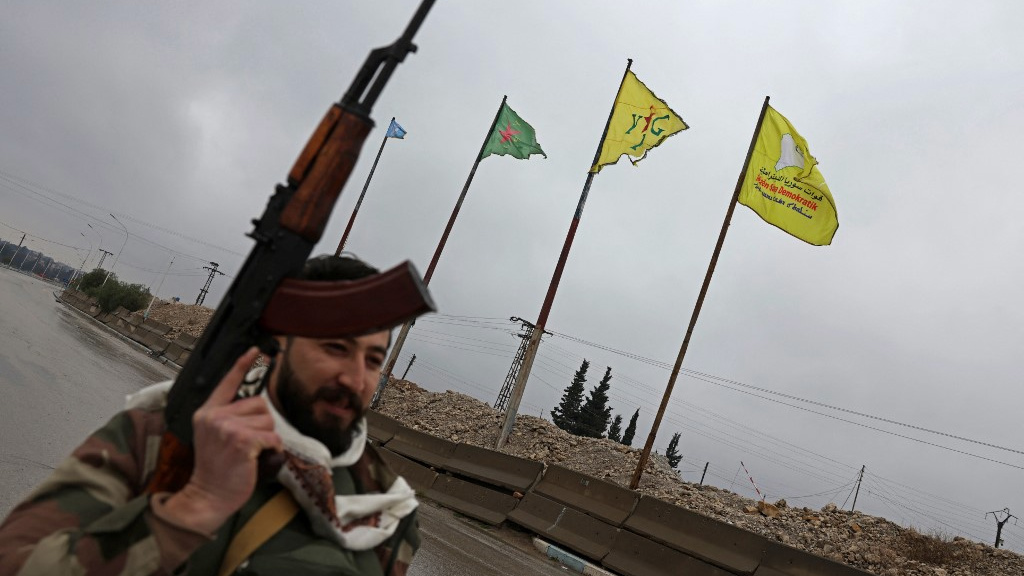
A decisive military offensive by the new Syrian government has brought to an end the separatist dream of the Kurdish People’s Protection Units (YPG) in the country’s northeast.
After securing most of the country, the Syrian government turned its attention to the northeast, a region rich in oil and farmland that was still occupied by YPG fighters, rebranded as the Syrian Democratic Forces (SDF). For Syria to be truly unified, stable and prosperous, it had to reclaim its most vital territory.
Initially, President Ahmed al-Sharaa’s strategy was not one of confrontation. The government engaged in numerous rounds of talks, offering the YPG a path to integration into the Syrian state and army – a move aimed at unifying the country and beginning the arduous process of reconstruction.
But the YPG perceived these initiatives as a sign of weakness rather than a genuine offer for sustainable peace. This misinterpretation was dangerously amplified by a confluence of external factors: open support from Israel, coupled with political cover from Kurdish authorities in Iraq, created an illusion of invulnerability for YPG leaders.
They believed they could leverage this support to evade integration deals and solidify their control over the occupied territories – many handed to them by Bashar al-Assad’s government at the start of the 2011 revolution to be used as a buffer against Turkey, others captured with significant US military support.
New MEE newsletter: Jerusalem Dispatch
Sign up to get the latest insights and analysis on
Israel-Palestine, alongside Turkey Unpacked and other MEE newsletters
But the YPG’s inevitable clash with the state came this month, as the Syrian army, supported by allied Arab tribes, advanced quickly. The YPG’s rapid collapse was expected by those familiar with its history: the group, operating under a Kurdish banner, was never a genuine grassroots force. It lacked popular support even among most Kurds and was completely dependent on foreign political and military backing.
Throughout the Syrian conflict, the group shifted its loyalty from the Assad regime to Iran, then Russia, then the United States and the European Union, and finally Israel. At no point since 2011 could it have held its ground against its opponents without massive funding, weapons and air support from the US and others.
Clinging to false hope
The YPG’s defeat was met with celebrations in cities like Tabqa and Raqqa, where people had long resented its rule. For so long, western media and foreign decision-makers have romanticised the YPG and its Kurdistan Workers’ Party (PKK) affiliates as freedom fighters and champions of democracy.
But the crimes it has committed against civilians in the last few days – including the use of young suicide bombers, attacks on civilian towers, destruction of bridges and releasing Islamic State fighters from prison – highlight its true nature. The YPG’s prisons have drawn comparisons with those of the Assad regime after journalists were able to gain access to them.
Recent weeks have been marred by a cycle of agreements made and broken. While the Syrian government, with backing from the US, France and Turkey, pushed for the YPG’s integration, the group’s leaders backed away from its commitments.
This episode also highlights the importance of not relying on foreign powers for internal legitimacy, as those who once bought you can easily sell you out
This was driven by two factors: firstly, hardline PKK leaders within the YPG’s command structure saw any compromise with the new Syrian state as a betrayal of their separatist goals, and secondly, the YPG was clinging to false hopes that Israel and the US would intervene at the last minute to save them.
The YPG’s reliance on Israeli and American support was a crucial factor. The YPG assumed that Israel would attack Syrian government forces if it moved to retake the northeast. A former spokesperson for the group told Israeli media that the group was disappointed in Tel Aviv and that the public blamed Israel for what had unfolded.
A meeting in Erbil on 17 January between US envoy Tom Barrack and YPG commander Mazloum Abdi made the situation even clearer. Barrack reportedly criticised Abdi for delaying the integration agreement and trying to drag Israel into the conflict.
The message was unmistakable: Washington would not risk its own interests for the YPG’s separatist ambitions. Despite calls from the US and France for peaceful integration, it had to finally decide that support for the YPG was conditional on its becoming part of the Syrian state – a reality the YPG leadership failed to understand or accept until it was too late.
Major miscalculation
The new Syrian government has made a crucial effort to distinguish between the Kurdish people and the YPG militia. Sharaa issued a decree recognising Kurdish citizenship rights and making Kurdish a national language in a move aimed at isolating the YPG leadership and showing that the conflict was with a separatist militia, not an entire ethnic group.
This is a distinction western media often fails to make, intentionally blurring the lines to stir up ethnic conflict. The Syrian government’s approach reflects the need to separate the two in pursuit of national unity.

Syria after Assad: The SDF is officially dead. What comes next?
Read More »
The international community largely supports Syria’s territorial integrity. Turkey welcomed the ceasefire, and even the Kurdistan Regional Government in Iraq, which had supported the YPG, backed the deal. On X, Barrack said that the YPG’s original purpose had expired and that the US supported Syria’s national unity.
Indeed, the events of this month mark the end of the YPG’s separatist dream. The Syrian government’s military victory, backed by a broad international consensus, is overwhelming. The YPG’s miscalculation – overestimating its foreign support and underestimating the Syrian state’s resolve – led to its rapid downfall.
The focus now shifts to the difficult tasks of integration and reconstruction. The Syrian government has regained control of its vital economic resources and secured its borders. This chapter will impact the calculations of smaller and weaker isolated separatist groups in the south, as well as pro-Assad forces in the west.
This episode also highlights the importance of not relying on foreign powers for internal legitimacy, as those who once bought you can easily sell you out.
If the latest deal on Hasakah holds, the main threat to Syria will come not from the inside, but from foreign powers – particularly Israel. Tel Aviv would never have jeopardised its alliance with the US or risked a military confrontation with Turkey over the defeated YPG.
But the question remains: what will Israel do after losing some of its cards in Syria? As Israeli forces continue to occupy parts of the country, this will remain the most significant threat facing a new Syria in the foreseeable future.
The views expressed in this article belong to the author and do not necessarily reflect the editorial policy of Middle East Eye.
