

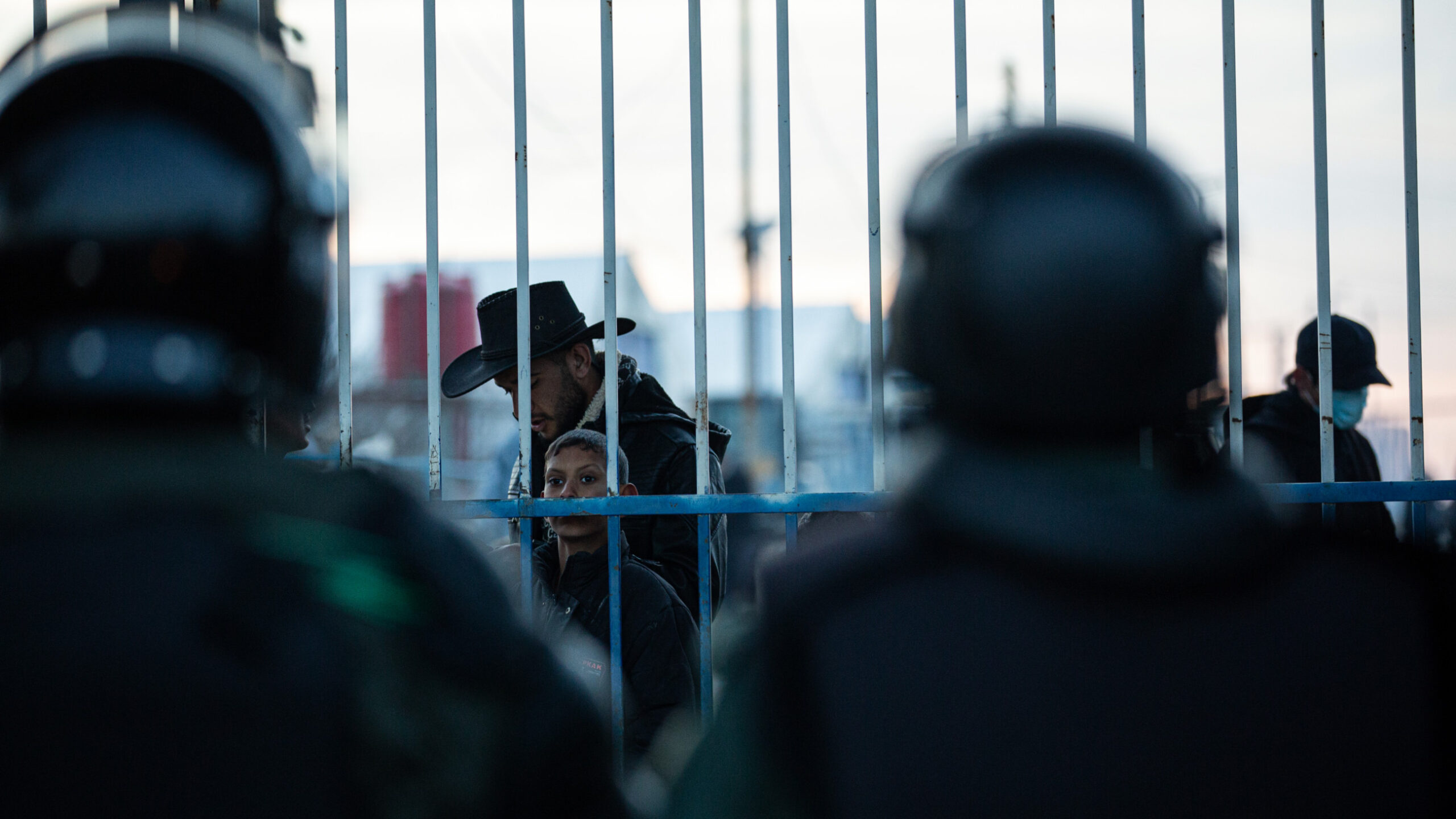
A tense calm pervades al-Hol prison camp in Syria’s Hasakah province. Days earlier, there were scenes of chaos as mass escapes unfolded after the Kurdish-led Syrian Democratic Forces (SDF) withdrew without warning.
For several hours, the camp housing thousands of suspected relatives of Islamic State (IS) fighters was unguarded, and detainees rushed the perimeter to escape before government forces arrived to take control of al-Hol.
“The SDF soldiers left as government forces were approaching,” said Yahya, an 18-year-old who has spent six years in al-Hol. “We jumped over the fence.”
Officially, no mass escape has been acknowledged at al-Hol. Testimonies from inside the camp, however, suggest otherwise.
Yahya told Middle East Eye that several detainees, including one of his neighbours, managed to flee. He himself returned.
New MEE newsletter: Jerusalem Dispatch
Sign up to get the latest insights and analysis on
Israel-Palestine, alongside Turkey Unpacked and other MEE newsletters
“I couldn’t leave my family behind,” he said.
Breaches were opened in parts of the fencing, while smugglers reportedly took advantage of the chaos to organise clandestine exits.
‘The SDF soldiers left as government forces were approaching. We jumped over the fence’
-Yahya, al-Hol detainee
Syrian government forces entered the heavily fortified camp on Wednesday as control was transferred from the SDF, which had managed the facility for seven years, with Damascus vowing to secure it.
Residents of the camp say arrests and transfers were carried out with little or no information about the reasons for their detention.
Behind the fences, a deep sense of injustice is widely shared.
“I have relatives linked to IS,” admitted Oum Zeinab, a 48-year-old mother detained in the camp. “But I was never part of it.”
On 21 January, thick plumes of smoke rose above the fences. One detainee, speaking anonymously, summed up the strategy bluntly: “We want to make the camp unliveable so they’re forced to transfer us.”
‘Here, we just wait’
Nearby, children watch the soldiers’ movements through barbed wire. Some were born in the camp; others have known little else.
For days, rumours had spread that guards were leaving and that something was about to happen.
“We thought we were going to be released,” said Anas, 14. “Here, we just wait.”


Al-Hol holds around 24,000 people, including some 15,000 Syrians and 6,300 women and foreign children from 42 nationalities. One of the world’s largest informal detention centres linked to IS, it has become a flashpoint following the rushed handover of Kurdish-controlled IS detention sites to government forces.
A government official told MEE that Syrian forces had secured the camps they had seized and were working to restore water and electricity.
“Fixing the conditions is critical, as we know one of the biggest reasons for radicalisation inside these camps is poor living conditions,” the official said.
He added that the government plans to allow UN agencies and international NGOs access to support people inside the camps.
The UN Refugee Agency said on Friday that poor security conditions at al-Hol have prevented its staff from entering.
In recent days, the SDF, which was the main partner of a US-led coalition in the fight against IS, has faced a rapid advance by Syrian government forces into areas it had controlled since 2012.
Under mounting pressure, the SDF signed an agreement with Damascus on 18 January, providing for a gradual reassertion of state authority across the region.
At a prison complex 100km southwest of al-Hol, the transfer quickly spiralled out of control.
Another powder keg
At al-Shaddadi prison camp, the main gate opened on to a trail of orange prison uniforms discarded across the ground, leading all the way to the cells.
Inside the concrete complex, which held men accused of belonging to IS, cell doors had been torn off.
In the first cell, remnants of fresh bread and half-eaten oranges still lay on the floor. Rooms designed to hold around 10 men sometimes housed 30 to 40 detainees. The building, poorly maintained and partially flooded, reeked of damp and neglect.
When Syrian government forces seized the prison from the SDF, no detainees remained inside.

Around 20 soldiers now in charge of the facility gave their version of events. For them, responsibility is clear.
“Before leaving, the SDF released the prisoners to distract us, take advantage of the chaos and flee,” said Abu Omar, head of security at the site and a member of the 44th Division of the Syrian army.
According to government forces, 120 detainees escaped al-Shaddadi during the transfer. The exact circumstances remain unclear.
‘There are certainly more militants on the run. It’s extremely dangerous’
– Syrian military source
Abu Omar said 81 men had since been recaptured in the town, leaving 39 still at large. Those who escaped or were later apprehended included men described by soldiers as coming from regions such as North Africa and Europe.
“Some speak with a foreign accent,” said one soldier. He added that subsequent clashes with SDF forces lasted nearly seven hours.
“They betrayed the agreement. It’s not the first time,” he said.
The SDF has strongly denied the accusation. It said no prisoners were released voluntarily and that other forces attacked or overwhelmed the prison, resulting in a loss of control and the escape of some detainees.
The SDF has also published images purportedly showing prisoner releases, but the footage does not correspond to al-Shaddadi prison.
A local resident, speaking anonymously, said Bedouin tribal groups hostile to the SDF were present around the prison before government forces arrived and forced open the gates, believing the detainees were “unjustly held”.
‘Extremely dangerous’
At the site, Abu Amar and his men stressed their longstanding hostility towards IS.
“We’ve been fighting them since 2013,” he said.
Most of his soldiers come from the former Free Syrian Army, notably Jabhat Thuwar Suriya, a group formed in Idlib that has fought IS across several parts of northern Syria to defend its positions.
They say they were among the first forces to confront the militant group long before its proclamation of the so-called “caliphate”.
Abu al-Hassan, one of the soldiers, said he survived a mass execution by IS in 2013, in which only three of 46 captured men lived. Abu Amar lost his brother to an IS sniper in 2015.
“For them, we are ‘apostates’, traitorous Muslims, because we reject their caliphate,” he said.

To pre-empt mass breakouts amid the security transition, the United States began transferring high-risk IS detainees on 21 January, flying around 150 prisoners to secure facilities in Iraq.
Military officials say up to 7,000 detainees held in northeastern Syria could eventually be relocated as part of a broader contingency plan, reflecting concerns that the detention system could collapse under pressure and trigger large-scale escapes and a renewed insurgency threat both regionally and beyond Syria’s borders.
Roughly 9,000 IS-affiliated detainees were held across detention sites in northeastern Syria, a significant proportion of whom are considered highly dangerous militants.
While authorities say control has been restored in al-Shaddadi, internal voices cast doubt on the official account.
A Syrian military source, speaking privately to MEE, said: “The escape figures are based on the prison register found at the entrance. But there are certainly more militants on the run. It’s extremely dangerous.”
Additional reporting by Areeb Ullah in London.
