

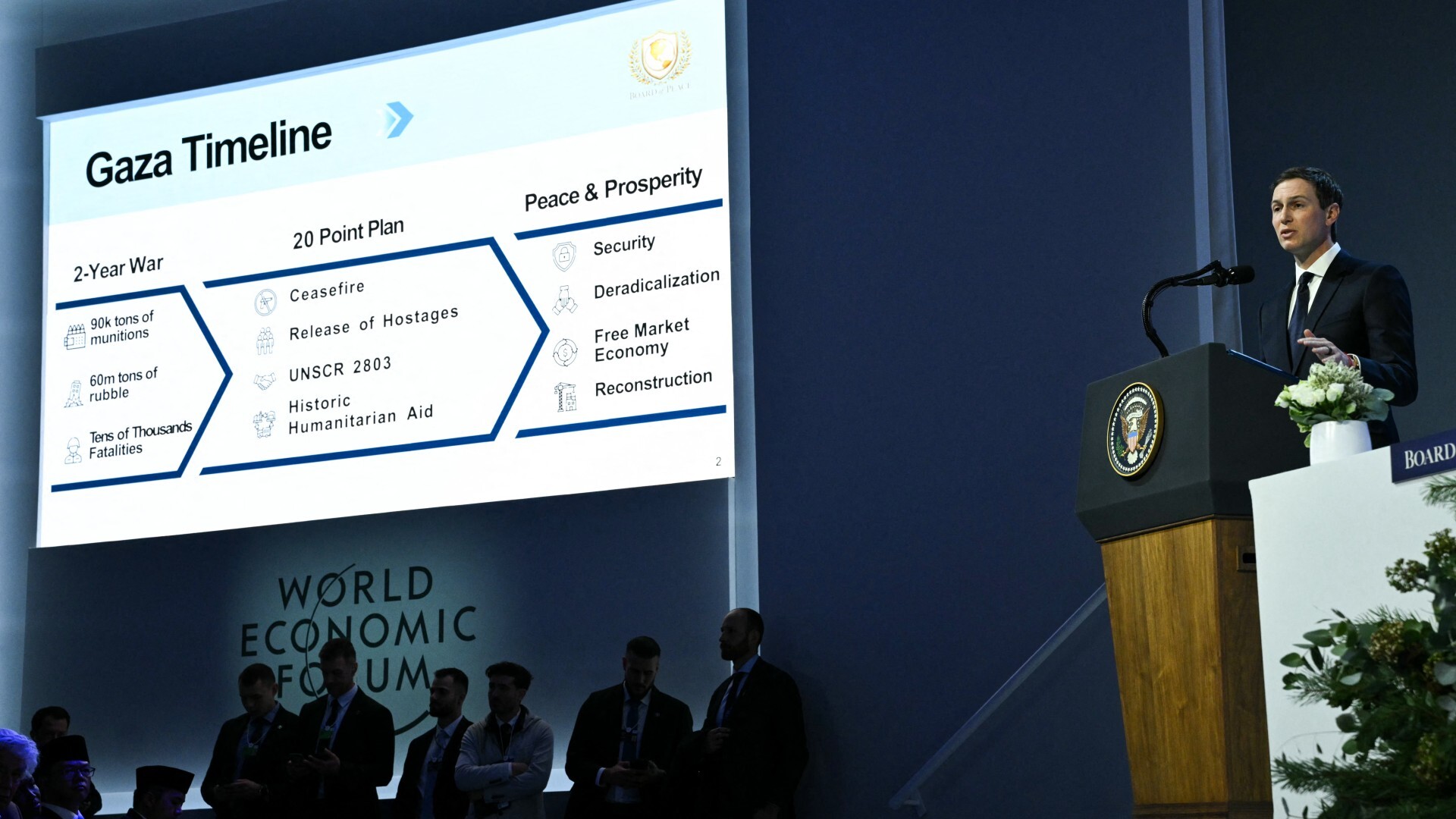
Jared Kushner’s vision for a “New Gaza”, featuring gleaming AI skyscrapers and coastal resorts, came under intense criticism after its unveiling at the World Economic Forum in Davos, Switzerland, on Thursday.
Kushner, who is US President Donald Trump’s advisor and son-in-law, presented what he says is a comprehensive economic vision for the future of the enclave, rebuilding the territory from scratch with residential towers, data centres, and seaside resorts, and framing the initiative as part of Trump’s push to advance an Israel–Hamas ceasefire strained by repeated violations.
He said the plan would be guided by “free market” principles.
“We want to use free market economy principles. A lot of what President Trump spoke about that he’s doing in America, we want to bring the same mindset and the same approach to a place like Gaza.”
Describing the scale of destruction, Kushner told the audience that Gaza had endured “a two-year war, 90,000 tons of munitions”, leaving “over 60 million tons of rubble” and “tens of thousands of fatalities”.
New MEE newsletter: Jerusalem Dispatch
Sign up to get the latest insights and analysis on
Israel-Palestine, alongside Turkey Unpacked and other MEE newsletters
The plan sparked backlash on social media, with users accusing it of reshaping Gaza through what they described as colonial-style engineering and permanent surveillance, while severing the territory from its Arab culture and character.
Meral Hussein-Ece, a member of the UK House of Lords, wrote on X: “So there we have it. It was always about land theft & profits above human beings.”
Legal scholar Ramy Abdu warned that Palestinians were facing “a plan to eliminate their very presence, based on domestication, subjugation, and control”.
The idea is not entirely new. Trump previously suggested turning Gaza into a “Riviera” during earlier discussions about post-war reconstruction, presenting it as a potential Mediterranean tourism hub. The comments sparked controversy at the time, with critics saying the vision reduced Gaza’s future to a real estate project while ignoring Palestinian rights and the realities on the ground. Several of the US’s Arab allies rejected the plan outright at the time.
The proposal also drew comparisons to other high-profile development projects in the region. Monica Marks, a scholar at New York University Abu Dhabi, wrote on X: “Looks as if the same consulting firm that did the mock-up for Saudi’s white elephant project, The Line, did the mockups for Trump’s Gaza Riviera fantasy.”
Activist Melanie D’Arrigo accused the Trump administration of exploiting the crisis for profit, writing: “The world sees death, destruction and injustice – and they see dollar signs.”
Others questioned the proposal’s premise and implications. Hugh Lovatt, a senior policy fellow at the European Council on Foreign Relations, wrote that anyone familiar with Gaza could see how unrealistic the plan was, describing it as “bulldozing whole neighbourhoods to create a new ersatz social, political and economic entity”, and warning that similar approaches could later be applied to West Bank refugee camps.
Arabic-language users also reacted online, with some saying the plan would see seized property resold to Palestinians at inflated prices and turn Gaza’s population into an exploited labour force serving the Israeli economy, accumulating wealth for Israel at the expense of a people stripped of land and rights.
Journalists and writers also voiced alarm. Journalist Barry Malone wrote, “I can’t believe this is really happening. I feel sick to my stomach,” while novelist Susan Abulhawa said the proposal would mean that “the indigenous traditions and social fabric of this land will be obliterated utterly”.
Diplomat Mohamad Safa summed up the outrage, writing on X: “They are selling Gaza in Davos.”
Trump on Thursday officially announced the “Board of Peace” charter during the World Economic Forum in Davos.
The board, intended as an international conflict-resolution body, includes a reported $1bn fee for permanent membership and was unveiled alongside the broader vision for Gaza’s post-war future.
