

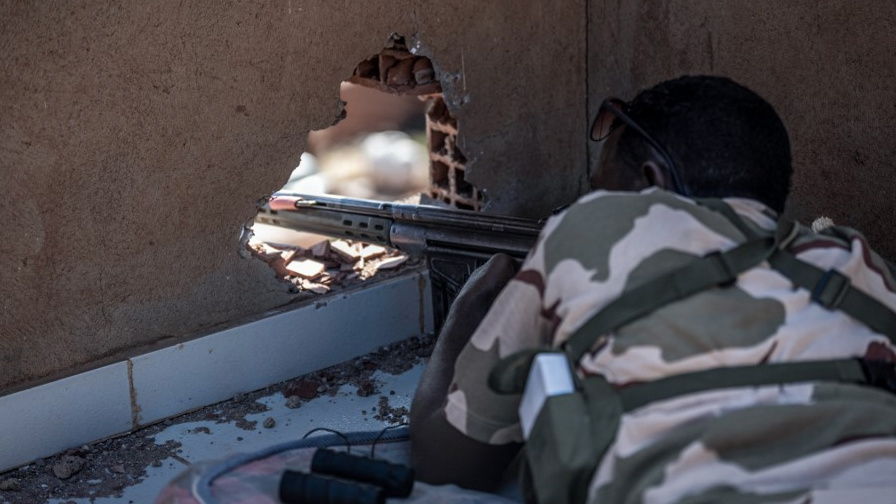
There is a particular kind of silence that follows a gunshot. It is not merely the absence of sound; it is the disappearance of a witness.
In Sudan, the war has been swallowing witnesses for more than 30 months – camera by camera, voice by voice – until silence itself has begun to resemble a strategy, rather than a consequence.
By 2025, that strategy had hardened into something unmistakable: a sustained war on journalism.
Sudan is not only a battlefield of armies. It is a battlefield of narratives. The Rapid Support Forces (RSF) treat independent reporting as an enemy position to be overrun, particularly in Darfur, where journalists have been punished simply for describing reality.
Authorities aligned with the Sudanese Armed Forces have also tightened their control, suspending journalists and revoking accreditations under broad terms such as “national security” and “public interest”, shrinking an already fragile media space.
New MEE newsletter: Jerusalem Dispatch
Sign up to get the latest insights and analysis on
Israel-Palestine, alongside Turkey Unpacked and other MEE newsletters
If there is a single lesson policymakers should draw from the past year, it is this: suppressing journalism does not produce stability. It produces rumours. When verified reporting collapses, propaganda, sectarian incitement and panic expand faster than facts can catch up.
Reuters has documented the devastation of Sudan’s independent media landscape, with newsrooms looted, outlets shuttered, and journalists forced into exile. This has created a severe disinformation crisis precisely when reliable reporting is most critical.
Sustained assault
This is not conjecture. According to the Sudanese Journalists Syndicate, at least 32 journalists have been killed since the war began in April 2023, alongside more than 550 documented violations against media workers, including detentions, intimidation and obstruction.
In an appeal last spring, a full two years into the war, Sudanese journalists wrote that the media was being systematically silenced through harassment, murder and forced exile, citing detained and missing colleagues. Unesco has similarly warned that killings and forced displacement have become defining features of journalism during the conflict.
These are not abstract statistics. They are the ledger of a sustained assault on the public’s right to know.
When Sudan loses its journalists, it loses its collective memory – and the world loses the chance to know what was done, by whom, and how to stop it from happening again
In 2025, that toll became increasingly evident. In March, a Sudanese state television crew reporting from Khartoum was struck by an RSF drone attack. Producer Farouk al-Zahir, camera operator Magdy Abdel Rahman, and editor Ibrahim Mudawi were killed, along with their driver.
In April, broadcast journalist Ahmed Mohamed Saleh Sayyidna was killed during shelling in el-Fasher.
In May, correspondent Hassan Fadl al-Mawla Mousa was killed when the RSF seized al-Nuhud in West Kordofan.
In October, radio journalist Alnor Suleiman Alnor was fatally hit in an RSF drone attack on his home in el-Fasher, according to the Committee to Protect Journalists (CPJ).
The CPJ has also called for an investigation into the killing of Taj al-Sir Ahmed Suleiman, head of the Sudan News Agency’s el-Fasher office, after RSF fighters reportedly entered his home and killed him and his brother in November.
When these cases are read together, a pattern emerges. Journalism in 2025 was not merely dangerous; it was rendered punishable.
Sending a message
Killing is the loudest warning. Detention is the slowest. In late 2025, the detention of journalist Muammar Ibrahim crystallised what it now costs to report from Darfur.
Al Jazeera reported that Ibrahim, a freelance correspondent for Al Jazeera Mubasher, was detained by the RSF on 26 October as fighting intensified in el-Fasher. The CPJ described the act as an unlawful abduction and demanded his release. The Sudan Tribune later reported that the RSF claimed it was “investigating” him over alleged defamation linked to his reporting.
More alarming were public statements by Alaa Nugud, a representative of the RSF-backed “Tasis” parallel administration, accusing Ibrahim of fuelling regional conflict. These remarks, documented by the Committee for Justice, heightened fears for Ibrahim’s safety, particularly as reports emerged of his deteriorating health in detention. The Sudanese Journalists Network said it was “extremely worried about what awaits him”.
The contradiction is telling: authorities who publicly claim a commitment to democracy and pluralism are detaining journalists for expressing views that challenge their narrative. Detention is not only about removing one reporter from the field; it is about signalling to all others that their fate, too, can be decided in darkness.
In el-Fasher, where communications blackouts have repeatedly smothered reporting, journalists are both witnesses and victims. When visibility collapses, atrocities expand.
Journalism is often treated as a luxury to be restored after peace. Sudan demonstrates the opposite. Journalism is damage control. It is how societies prevent panic, slow incitement, and contain the spread of lies that ignite further violence.
When reporters are silenced, a rumour economy fills the void. In that context, a fabricated screenshot can trigger retaliation, a whisper can spark ethnic targeting, and a viral lie can move crowds faster than any official statement.
Online harassment has become an extension of the battlefield, as doxxing, smear campaigns and coordinated intimidation have increasingly translated into physical danger. Osman Mirghani, editor-in-chief of al-Tayar, publicly described receiving hundreds of threats after a fabricated WhatsApp exchange was circulated and falsely attributed to him. This is how the rumour economy becomes lethal.
The need for protection
State authorities are not exempt from responsibility. Last September, Sudan’s culture and information ministry suspended the work of Lina Yacoub, the local bureau chief for Al Arabiya and Al Hadath, citing national security. Although the decision was later reversed, the damage lay in the precedent. When accreditation can be withdrawn and restored at will, journalism becomes a privilege granted by power, rather than a right protected by law.
Sudan’s global standing reflects this reality. In the 2025 World Press Freedom Index, Reporters Without Borders ranked Sudan 156th out of 180 countries.
If 2026 is to mark a turning point, protection must move from rhetoric to systems. The safety of journalists should become a diplomatic red line. The United Nations, African Union and influential states must demand disclosure of the fate of missing journalists, insist on independent investigations, and impose targeted sanctions on commanders responsible for abuses.

Sudan’s peace efforts will fail until civilians are finally put at the centre
Read More »
Emergency support must actually reach reporters: evacuation pathways, relocation, trauma care, legal aid and equipment replacement, prioritising local journalists and freelancers who face the highest risk. Authorities should treat verified journalism as a stabilising public service by providing timely information and access, rather than insisting on secrecy.
Technology platforms must act. Content that incites violence or targets journalists for harm should be removed swiftly. Arabic-language moderation should be strengthened, and cooperation expanded with credible monitors documenting coordinated harassment. The online threat pipeline now feeds directly into physical violence.
Sudanese-led cross-border publishing and verification networks can keep reporting alive when local infrastructure collapses, and distribute risk more safely. Administrative censorship must end, to be replaced by transparent, appealable procedures aligned with international standards.
The RSF must face direct demands: release detained journalists, disclose the fate of those who are missing, and stop treating reporting as espionage.
If 2025 was the year Sudan’s journalism bled in plain sight, then 2026 must be the year it learns to breathe again. A society without journalists is never safer. It grows louder with lies, and easier to brutalise.
When Sudan loses its journalists, it loses its collective memory – and the world loses the chance to know what was done, by whom, and how to stop it from happening again.
The views expressed in this article belong to the author and do not necessarily reflect the editorial policy of Middle East Eye.
