

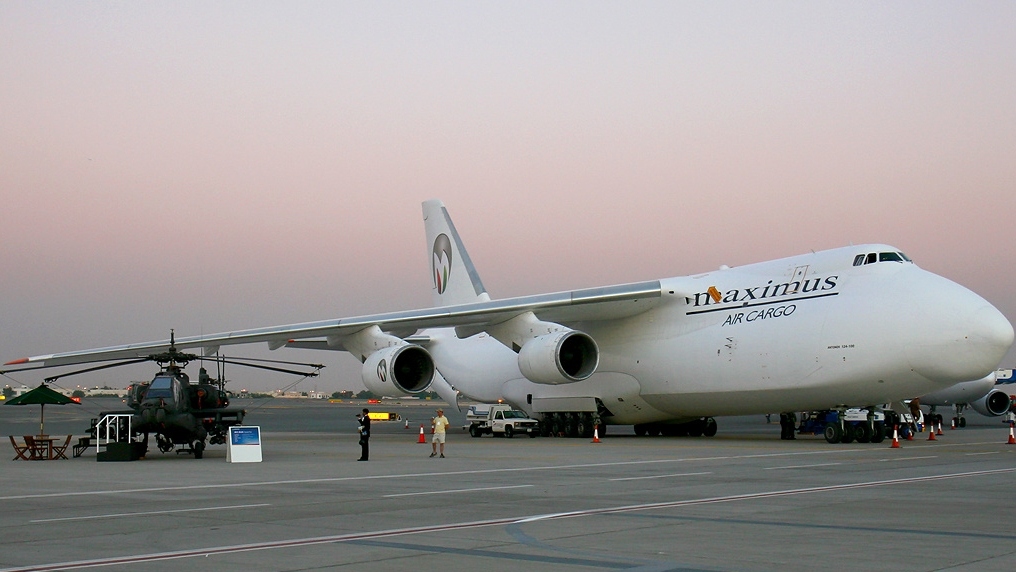
A cargo plane previously linked to the supply of weapons to UAE-backed fighters in Sudan and Libya has made a number of flights in recent days between military bases in Abu Dhabi, Israel, Bahrain and Ethiopia, Middle East Eye can reveal.
While the purpose and any connection between the flights is unclear, they have taken place against the backdrop of a spiralling power struggle between the UAE and Saudi Arabia across Yemen and the Horn of Africa that has upturned the geopolitics of the region and prompted concerns of a new escalation in the Sudan war.
The UAE has been thrown onto the back foot after Saudi Arabia launched military action to oust the Emirati-backed Southern Transitional Council (STC) from the Yemeni port city of Aden, and has been forced to withdraw from its key military base in Bosaso on the opposite Somali coastline.
Meanwhile, Israel’s recognition of Somaliland, where the UAE maintains another military base and controls the port of Berbera, has further destabilised the regional order and prompted speculation that Ethiopia, which is closely aligned with Abu Dhabi, could be poised to do the same in return for access to Berbera.
The war in Sudan between the Sudanese Armed Forces (SAF) and the paramilitary Rapid Support Forces (RSF), which began in April 2023 and has led to the largest humanitarian crisis in the world, is now firmly part of this struggle, with Saudi Arabia – alongside Egypt and Turkey – stepping up its military support for the SAF in an attempt to counteract the UAE’s longstanding patronage of the RSF.
New MEE newsletter: Jerusalem Dispatch
Sign up to get the latest insights and analysis on
Israel-Palestine, alongside Turkey Unpacked and other MEE newsletters
The uncertainty at the UAE’s bases in Berbera and Bosaso after the Somali government cancelled all its agreements with the UAE has seen Emirati personnel redeployed to Ethiopia, which, according to multiple sources, including a former Ethiopian government adviser, is now crucial to the UAE’s strategy in the region.
The adviser, who worked for the Addis Ababa government for over a decade, said that Prime Minister Abiy Ahmed Ali “certainly seems to see the future as Ethiopia aligning itself firmly with the UAE alliance rather than other options”.
“Some, in Ethiopia’s foreign ministry and elsewhere, believe the UAE has been calling the shots for Ethiopia in regard to the Sudan government, RSF and Eritrea over Assab for the last two years,” the source said, referring to the Eritrean port of Assab, which the adviser said Abiy “very nearly invaded last year at the behest of Abu Dhabi”.
‘Addis Ababa will stick with the UAE. The Emiratis are therefore focusing military operations on Ethiopian territory’
– Jalel Harchaoui, analyst
Jalel Harchaoui, an analyst focusing on North Africa and political economy, told MEE that since the onset of the war in Sudan, “the UAE has acted with greater speed, audacity and financial commitment than any other foreign interferer”.
But, he said, Saudi Arabia’s “victory over the UAE in Yemen late last year has strengthened Riyadh’s regional credibility”, and the Saudis are now “spending aggressively to alter the trajectory of the Sudan war”.
Pakistani officials recently told Reuters that negotiations are advanced on a defence package valued at about $1.5bn that would include JF-17 Block III fighters, K-8 attack aircraft, and more than 200 drones for the Sudanese Armed Forces.
“While several regional actors will adjust to Riyadh’s overtures, Ethiopia will not,” Harchaoui said. “Addis Ababa will stick with the UAE. The Emiratis are therefore focusing military operations on Ethiopian territory, preparing a major offensive as Saudi actions have disrupted other staging areas.”
UAE cargo planes
The flight-tracking data analysed by MEE in recent days revealed a pattern of repeat flights between Abu Dhabi and Harar Meda airport, the main base of the Ethiopian Air Force, by an Antonov An-124 cargo plane flown by Maximus Air with the tail number UR-ZYD.
The Antonov An-124 has been called the world’s largest military transport aircraft. Maximus Air’s website describes it as capable of carrying “21x Toyota Land Cruisers or 4 x Mi 17 MTV Helicopters without breaking a sweat”.
On 3 January, UR-ZYD flew from Abu Dhabi International Airport to Harar Meda, landing at 9.12am local time (6.12am GMT). It took off again at 10.45am local time (7.34am GMT) and returned to Abu Dhabi. On 12 January, UR-ZYD flew once more to Harar Meda, this time departing from Abu Dhabi’s Al Dhafrar military base. It landed at 10.50am, returning to Abu Dhabi at 1.34pm.
‘Evidence that an An-124 has been making repeated sorties between Abu Dhabi and this airfield seeing increased uptick in RSF presence and operations should be of global concern’
– Nathaniel Raymond, Yale HRL
It made the same journey a third time three days later on 15 January, landing in Ethiopia at 8.27 am and leaving at 10.45am.
On 17 January, it flew again to Harar Meda from Al Dhafrar, before flying onto Addis Ababa’s main Bole International Airport.
From there, on 18 January it flew to Marseille in France, then onto Taraz Airport in Kazakhstan on the same day, according to plane-tracking websites.
On Monday, it flew from Taraz to Ghangzhou Airport in China, and on Tuesday it was recorded flying from China to U-Tapao International Airport in Thailand.
Intriguingly, days prior to its first flight to Ethiopia on 3 January, UR-ZYD made three round trips between military airbases in Bahrain and Israel.
On both 28 and 29 December, it flew from Bahrain’s Sheikh Isa Air Base and appears to have landed at the Israeli Air Force’s Ovda base in the southern Negev desert, according to flight-tracking data. On 31 December, it flew again from Sheikh Isa to Ovda, this time returning to Abu Dhabi.
“Evidence that an An-124, given the significant cargo capacity of this particular airframe, has been making repeated sorties between Abu Dhabi and this airfield near an area seeing increased uptick in RSF presence and operations should be of global concern,” Nathaniel Raymond, executive director of Yale’s Humanitarian Research Lab (HRL), which monitors the war in Sudan, told MEE.

UK government co-owns Somaliland port at centre of Horn of Africa crisis
Read More »
“If it is proven that these flights are the result of the UAE supplying RSF, it is incumbent on Ethiopia to follow the lead of its neighbours and block the access of UAE and its proxies to Ethiopian airspace immediately.”
The Sudanese intelligence source also said that the RSF had recently purchased “a minimum of six fighter jets” – Sukhoi Su-24s and MiG-25s that usually come from Serbia, which has a well-developed relationship with International Golden Group, an Emirati defence contractor.
The source said that the jets – including their wings and engines – are dismantled and then taken on cargo planes from the UAE to Ethiopia or to al-Kufra, an airbase in eastern Libya under the control of General Khalifa Haftar’s Libyan Arab Armed Forces (LAAF).
Middle East Eye has contacted the UAE’s foreign ministry, the Ethiopian foreign ministry, the Rapid Support Forces and Maximus Air asking for comment. The UAE has denied supporting the RSF, which has been widely accused of genocide in Darfur, western Sudan.
The Haftar connection
Abu Dhabi-based Maximus Air describes itself as “the largest all-cargo airline in the UAE”. It is part of the Abu Dhabi Aviation (ADA) group of companies which is majority owned by an investment fund, ADQ, chaired by UAE national security advisor Sheikh Tahnoon bin Zayed Al Nahyan.
Maximus Air’s clients include “the GHQ Armed Forces, Crown Prince Court, Ministry of Foreign Affairs and several other government entities,” according to ADA’s most recent report.
But the airline’s operations have previously attracted the attention of a United Nations panel of experts investigating the UAE’s sanctions-busting supply of weapons to Haftar, whose forces have been fighting against the internationally recognised government in Tripoli for much of the past decade.
‘The Horn of Africa is now at the mercy of what happens in Riyadh and Abu Dhabi’
– Kholood Khair, Sudanese analyst
In a report from 2021, the panel accused Maximus Air of violating a UN resolution prohibiting the direct or indirect supply of weapons to parties fighting in Libya.
It identified 12 suspicious flights made by UR-ZYD between Assab in Eritrea and Mersa Matruh in Egypt, which it said were part of a covert Emirati “airbridge” operation to supply weapons to Haftar, whose forces have gone on to support the RSF in the war in Sudan.
Lana Nusseibeh, then the UAE’s ambassador to the United Nations, said in 2021 that the allegations outlined in the report were “false” and that the UAE’s government denied “them in their entirety”.
In June last year, militias allied to Haftar helped the RSF take control of the Sudanese portion of the triangle border region that runs through Sudan, Egypt and Libya, and MEE has tracked countless UAE-linked cargo flights going into Haftar’s al-Kufra airbase, which has been a key supply point for the RSF.
Now, Saddam Haftar, Khalifa’s son, is under pressure from Saudi Arabia to stop helping the UAE support the RSF. Egypt, which has stepped up its pre-existing support for the SAF in Sudan, has begun bombing RSF supply convoys running close to its territory.
On Monday, a “temporary closure” of al-Kufra airbase went into effect, with “runway repairs” due to last a month. This runway, though, was renovated as recently as February 2024, and the advertised closure is believed to be designed to buy the Haftar family time as they chose between the UAE and Saudi Arabia.
“The Horn of Africa is now at the mercy of what happens in Riyadh and Abu Dhabi,” Kholood Khair, a Sudanese analyst and policy expert, told MEE. “We are seeing the entrenchment of this Gulf imperium we’ve seen for the last five years… A lot of countries in the area are now making decisions based on which country in the Gulf they side with.”
Mohammed bin Zayed’s trips
The UN report from 2021 estimated that each flight made by UR-ZYD delivered a cargo of up to 18 military vehicles, and identified Mohammed bin Zayed, the current president of the UAE and then-crown prince of Abu Dhabi, as the beneficial owner of plane UR-ZYD.
“The Panel was unconvinced of the accuracy of the documentation provided by Maximus Airlines LLC,” the report said.
The same aircraft has also been linked by open-source plane-monitoring sleuths to the UAE’s supply of weapons via Chad to the Rapid Support Forces in Sudan.

How UAE bases arming Sudan’s RSF support US ‘grey ops’ in Somalia
Read More »
In September 2023, the now-inactive plane monitoring X account @Gerjon_ highlighted 16 flights made over a period of five months by UR-ZYD between Abu Dhabi and N’Djamena in Chad.
The same account had previously identified the same plane in connection with the supply of weapons by the UAE to Ethiopia during the war in Tigray in 2021.
Maximus Air did not respond to MEE’s requests for comment.
Annual reports by the Abu Dhabi Aviation group in 2022 and 2023 highlighted the airline’s “humanitarian mission” in support of “the UAE’s humanitarian efforts for refugees and displaced people”.
“Humanitarian and relief services have become a key component of operations at Maximus Air. The company works closely with the UAE Red Crescent Authority to provide end‐to‐end solutions to support affected countries around the world,” ADA said.
It cited the transportation of two MI-17 helicopters from China to Uganda in 2023 for deployment as part of a UN peacekeeping mission in the Abyei region between Sudan and South Sudan.
UR-ZYD’s links to Mohammed bin Zayed appear to extend beyond the UAE’s alleged involvement in arming its favoured protagonists in regional conflicts.
Last month, the aircraft was part of an entourage of cargo planes that accompanied the UAE president on an official visit to Pakistan.
Regional media reported that MBZ was also in the country to take part in the annual hunting season enjoyed primarily by members of Arab royal families for the houbara bustard, a highly prized bird whose meat is valued for its reputed aphrodisiacal powers.
