

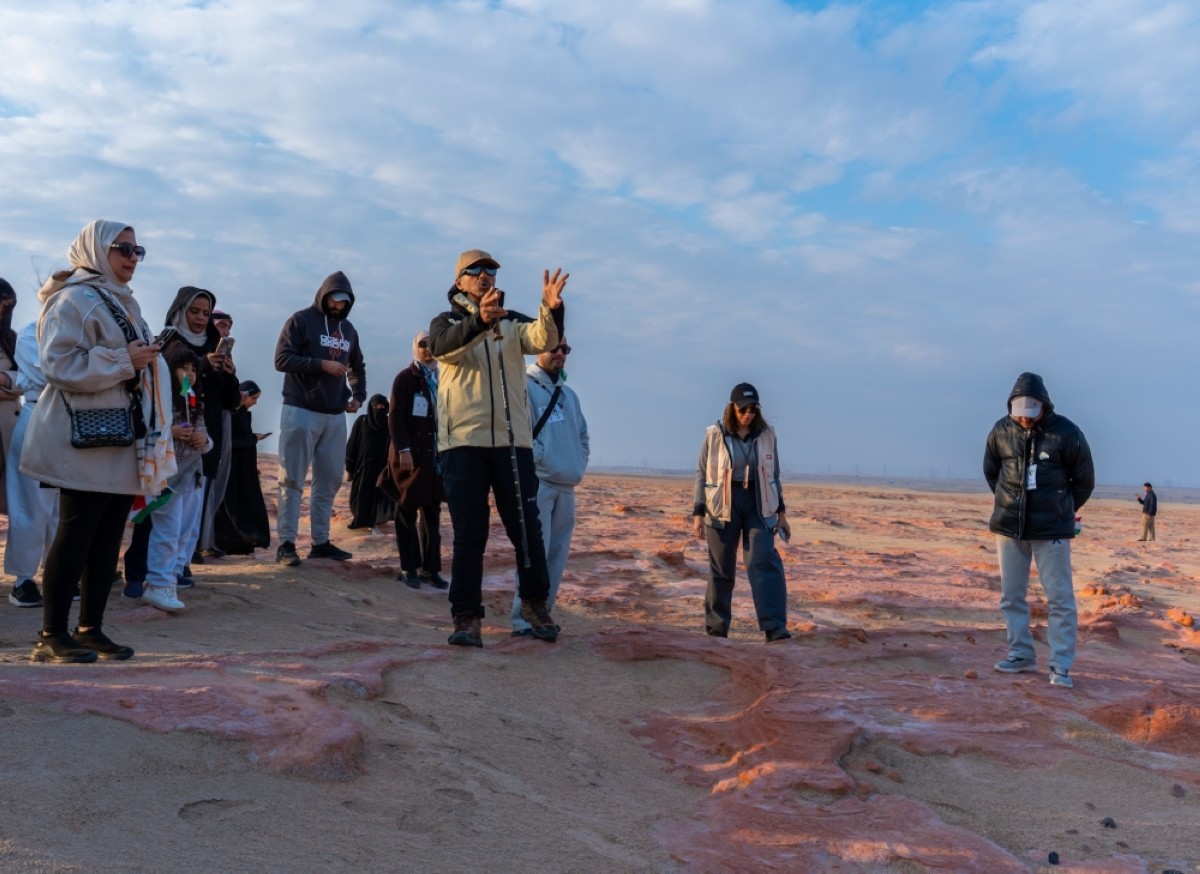
KUWAIT: The Kuwait Geological Society is calling on volunteers to join its newly launched guided geological tours at Kuwait Geopark. The initiative invites accredited volunteer teams and society members to explore the country’s unique geological formations, biodiversity and cultural heritage while contributing to knowledge-based environmental and educational outreach.
Dr Mubarak Al-Hajeri, president of the society, said the program provides an opportunity for participants to engage directly with Kuwait’s natural and cultural legacy. “The field trips include guided tours led by trained experts who present simplified scientific content, highlighting Kuwait’s distinctive geological features and deepening understanding of the interconnected relationship between land, people, and civilization,” he said.
Opened to the public earlier this month, Kuwait Geopark offers terrain that closely resembles the surface of Mars, making it an open-air laboratory for research in geology, archaeology, environmental science and even climate studies. Al-Hajeri described the park as “the richest location in Kuwait in terms of natural, scientific and cultural value, where rare geological formations meet traces of ancient human settlement and diverse ecosystems.”

Rocks displayed at Kuwait Geopark highlight the area’s geological features.

Kuwait Geopark
The park preserves biodiversity, including native plants, wildlife, and migratory birds, and highlights the history of Kuwait’s oil discovery and energy industry. According to Al-Hajeri, the site’s geological formations reflect climate shifts over millions of years, shaping both the land and patterns of human settlement.
The project began as a volunteer initiative led by geologists and earth science enthusiasts and evolved into a formal program under the Kuwait Geological Society. It now operates in partnership with the Ministry of Information, Kuwait Oil Company, and the National Council for Culture, Arts and Letters. Organizers hope that Geopark Kuwait will eventually gain recognition as a UNESCO Global Geopark, joining 229 such sites in 50 countries that use geological heritage to promote sustainable development and education.
Al-Hajeri called on accredited volunteer teams to join the program. “This initiative reflects the global trend of promoting knowledge-driven volunteerism,” he said. “It links volunteering with scientific research, heritage conservation, and sustainable development, creating benefits for society and the environment.” Al-Hajeri did not provide details on how volunteers can apply. In an earlier statement, he said that priority for participation in volunteer opportunities at the Geopark will be given to society members. — Agencies
