

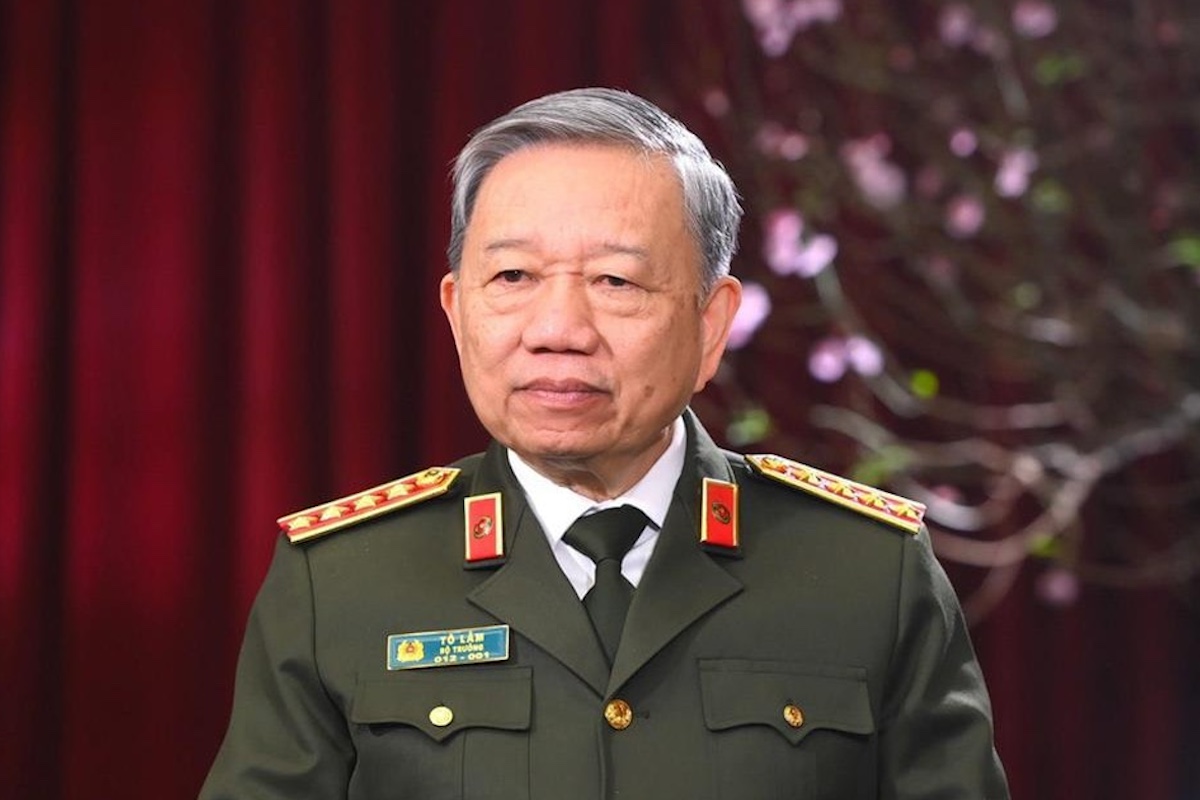
This week, Facebook notified me that my post analyzing General Secretary To Lam’s leadership style was restricted in Vietnam for the second time following a legal request from the Ministry of Culture, Sports and Tourism.
Simultaneously, netizens Hoang Thi Hong Thai and Le Minh Vu were charged under Articles 117 and 331, both anti-state provisions, for comments mentioning Lam and the Communist Party. This censorship validates the very point the state tried to hide: Lam is operating a sophisticated machinery bent on silencing all criticism of his rule.
However, while he acts like Chinese President Xi Jinping and Russian leader Vladimir Putin at home, he knows that his “police state” brand is toxic to the Western investors Vietnam desperately needs. To survive, he is assembling a contradictory power model, a “Political Frankenstein” that stitches together absolute control with crony capitalism.
Media war: “Force 47” defeated by international leaks
As the 14th Party Congress approaches, scheduled to run from January 19 to 25, the internal struggle between a public security faction loyal to Lam and the military faction initially appeared intense. For weeks, Vietnam’s social media was flooded with “seeding” campaigns by Force 47, the military’s cyber warfare unit, and AK47 groups.
The narrative the military faction pushed was pointed and specific: Defense Minister Phan Van Giang would replace Lam as General Secretary of the Communist Party at the upcoming congress.
Giang was promoted by opinion shapers using images of him rushing through storms in Central Vietnam, projecting the image of a leader devoted to the people and country, a familiar propaganda trope used by the Communist Party since the days of Ho Chi Minh.
However, Lam showed that he operates on a higher level. While his opponents played in the mud of domestic social media rumors, To Lam’s camp dictated the narrative through international heavyweights.
By strategically leaking to agencies like Bloomberg and Reuters his intention to permanently merge the titles of general secretary and president, copying Xi’s absolute power model in China, Lam effectively overrode the domestic rumor mill.
The result? The Military faction now appears winded and outmatched in the waning days before the five-yearly congress, where top leadership roles and key policies are decided. Their resistance has effectively hit a wall, unable to keep pace with the political momentum Lam has generated through state apparatus control and international signaling.
Diplomatic paradox: US signals and the “Comrade X” factor
At the same time, Lam faces a critical weakness: the economy is gasping for new foreign investment. A general secretary with a police background does not naturally inspire confidence among Western investors or capital markets.
This creates a peculiar reliance on the past. To secure FDI sources and access Western economies, Lam seemingly needs the “brand” of former Prime Minister Nguyen Tan Dung, widely known as “Comrade X.”
Dung, who served as prime minister from 2006 to 2016, was a darling among Western investors for his market-oriented reforms that paved the way for a surge of multinational investment. Lam’s emphasis on security, in comparison, has put many investors on edge.
This dynamic was subtly but powerfully highlighted this week by outgoing US Ambassador Marc Knapper. Before ending his term, Knapper paid farewell visits not just to incumbent leaders but also notably to Dung and former President Truong Tan Sang.
This was not merely a diplomatic courtesy; it was a clear signal. The US understands well Vietnam’s internal power map. By visiting “Comrade X,” Washington tacitly acknowledged that the pro-business faction of the past is still relevant in its view.
It suggests that if Lam wants to sustain and expand their Comprehensive Strategic Partnership and US market-fueled economic growth, he cannot rely solely on his security apparatus and must keep open channels to the old guard.
Trade-off: return of the prince
Any perceived Lam-Dung alliance, however, would come at a price. Vietnam’s politics are highly transactional, and the cost of Dung’s support would be at least the partial resurrection of his dynasty. Dung’s power and influence were diminished in his second five-year term amid corruption allegations rooted in his pro-business, pro-investment stance.
Many of Dung’s known colleagues and factional supporters were taken down on graft charges, initiating the first sparks of now-deceased General Secretary Nguyen Phu Trong’s often-politicized “Burning Furnace” anti-corruption campaign that convicted and jailed many Party cadres and their state enterprise-linked cronies.
The return of Dung’s son, Nguyen Thanh Nghi, to the Central Committee is key to any Lam-Dung pact. By allowing the “prince” to return to the center of power, Lam would secure the loyalty of Dung’s still-powerful patronage network. It is a calculated trade-off: the police state gains political power, while the old business faction gets a new seat at the table to help manage the economy.
If successful in assuming both the general secretary and president titles at the upcoming congress, Lam will have laid the foundation for an unprecedented power model in Vietnam.
Like Frankenstein, it would possess the head of Xi’s ideological control and absolute dual-title power, the body of Putin’s police state and suppression of dissent, and the market-friendly hands of Dung’s faction to wave at Western investors.
Lam has not just defeated his rivals in the military; he has co-opted a political force capable of saving the economy. The result will be a dictatorship that is stronger, sharper and more dangerous to the Vietnamese people’s aspirations for freedom, while at the same time hard-focused on reviving foreign investor confidence in the nation’s direction.
Nguyen Ngoc Nhu Quynh, widely known as Mother Mushroom, is a Vietnamese blogger, human rights advocate and former prisoner of conscience. She is the founder & executive director of WEHEAR, a 501(c)(3) public charity dedicated to empowering women, supporting exiled activists and advancing independent human rights reporting.
