

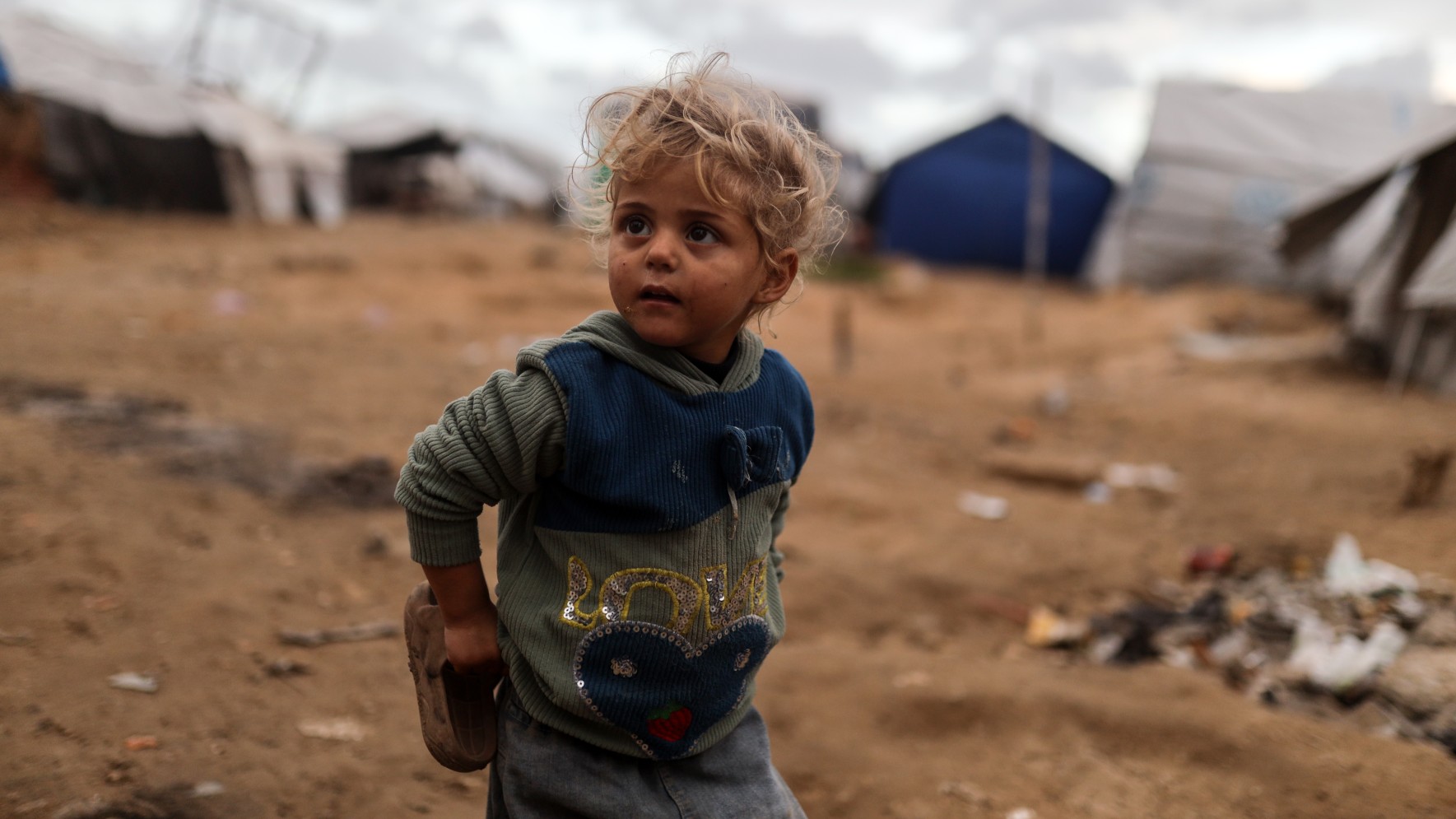
In Gaza today, tens of thousands of children wake up without a parent’s voice calling their name. This is not because of illness or accident, but because Israel’s war on the Palestinian enclave erased the people who made them feel safe.
As of last March, more than 39,000 children in Gaza were estimated to have lost one or both parents in Israel’s ongoing aggression, including 17,000 who were fully orphaned, according to the Palestinian Central Bureau of Statistics.
This is one of the largest orphan crises in modern history. And these figures are not just statistics; they represent a mass unravelling of childhood itself.
For a child, parents are not simply caregivers; they are the world’s first promise of safety. The steady presence of a mother or father represents a familiar voice, a predictable routine, a hand held in the dark. It is how a child learns that fear can pass, that hunger can be soothed, that danger has limits.
When that anchor is torn away violently, the child’s entire sense of reality shifts. The world becomes unstable. Trust becomes fragile. Safety becomes a memory.
New MEE newsletter: Jerusalem Dispatch
Sign up to get the latest insights and analysis on
Israel-Palestine, alongside Turkey Unpacked and other MEE newsletters
In Gaza, this rupture is happening at scale. The loss of caregivers is not only through death, but also through severe injury, detention, enforced disappearance, or separation in the chaos of repeated displacement.
Some children have been pulled from rubble, only to find no one left to call “mine”. Others have a living parent, but one so injured, traumatised, or absent that the child is left without real protection.
Switching off
Among younger children, the consequences are immediate and heartbreaking. Many become inconsolable. They cry for hours, cling to any adult nearby, and panic when a caregiver leaves their sight – even for a moment. Some lose words they once had, or start bedwetting again.
Some go quiet, as if switching off is the only way to survive what their minds cannot process. In crowded shelters, where adults are themselves exhausted and grieving, children often attach to whoever is available, because their need for safety is urgent and unmet.
For older children, especially those entering adolescence, the damage takes a different form: they become adults overnight. When a parent is killed, detained or severely injured, the child often inherits the role of provider, protector and decision-maker.
This role reversal does not build resilience. It steals development. It teaches emotional suppression as a survival skill
In Gaza, I have seen children, especially eldest daughters, carrying responsibilities that would break most adults: securing food, caring for siblings, managing a traumatised surviving parent, and keeping the family functioning under bombardment and hunger.
This role reversal does not build resilience. It steals development. It teaches emotional suppression as a survival skill, and turns fear into permanent background noise.
I think often of one 11-year-old girl living in a displacement shelter in central Gaza. Her father was killed in an air strike. With no gas, electricity or stable income, she and her mum began making small baked goods over a wood fire, using whatever materials were available.
Every day, the girl walked among overcrowded shelters, weaving through debris and insecurity, trying to sell what they made to help feed her widowed mother and younger siblings.
When we spoke, she said almost nothing about grief. She spoke about necessity, about “what must be done”. But what was most striking was what had disappeared: play, rest, childhood softness. Her face carried the exhaustion of someone far older.
Unbearable separation
I also worked with a seven-year-old boy whose father was killed in an air strike. Since then, that child has not let go of his mother. He insists on being held constantly. He refuses to play with other children.
If she steps out of the room, even briefly, he panics. At night, he wakes her to accompany him to the toilet. If she does not wake fast enough, he wets the bed.
When I spoke with him, he barely raised his eyes. He talked in a low voice, using only a few words – and always checking that his mother was still beside him. He did not describe the bombing, nor did he talk about fear or anger.

Why Israel is waging war on Palestinian children
Read More »
When asked what he wanted most, he answered simply: “I want my father back.”
For this child, the loss of his father did not just bring grief. It shattered his sense of safety so completely that separation itself became unbearable.
In another case, a 14-year-old girl became her family’s only survivor. She was referred for a mental health assessment in a field hospital because doctors said she was not cooperating with rehabilitation.
When we spoke, her resistance made sense. She talked about how everything had collapsed in a single moment; about how her father, the person she trusted to protect her, could not save her.
“If he couldn’t,” she asked quietly, “who else can?”
What terrified her most was not her injuries, but recovery. She was afraid that if her health improved, she would be discharged. And then what?
“Discharged where?” she asked. There was no family waiting for her. No home. No place that felt even remotely safe. The hospital, despite everything, had become her only shelter. Her refusal to cooperate was not defiance. It was fear of being released back into a world she had experienced as lethal and unprotected.
‘What choice do I have?’
Then there was the 12-year-old boy who had lost both parents and his older brother. His grandfather brought him to see me, worried because the child kept disappearing from their tent for hours at a time.
Eventually, the truth came out. The boy had been repeatedly visiting food distribution points run by the Gaza Humanitarian Foundation – sites that many international organisations and witnesses have described as chaotic and deadly.
The boy cried as he spoke. He cried about losing his parents, and about what he had seen at those distribution points: shootings, panic, people falling around him.
It is a generation learning, through lived experience, that love can vanish without warning; that homes and families can be erased
He said he was terrified every time he went there. When asked why he kept returning, he answered without hesitation: his younger brother and sister had not eaten for days. His grandfather could barely feed himself.
“I know it’s dangerous,” he said. “But what choice do I have?”
This is what orphanhood looks like in Gaza. It is not only the absence of parents. It is the collapse of the psychological scaffolding that children need to grow: stability, protection and the freedom to be young.
It is a generation learning, through lived experience, that love can vanish without warning; that homes and families can be erased, and that the world offers no guarantee of mercy.
The long-term mental health consequences do not end with a ceasefire. Children who lose caregivers in this way carry wounds that shape how they attach to others, how they trust, how they imagine the future, and how they understand their own worth.
In Gaza today, thousands of children are growing up not just without parents, but without the basic belief that the world can ever be safe again.
The views expressed in this article belong to the author and do not necessarily reflect the editorial policy of Middle East Eye.
