

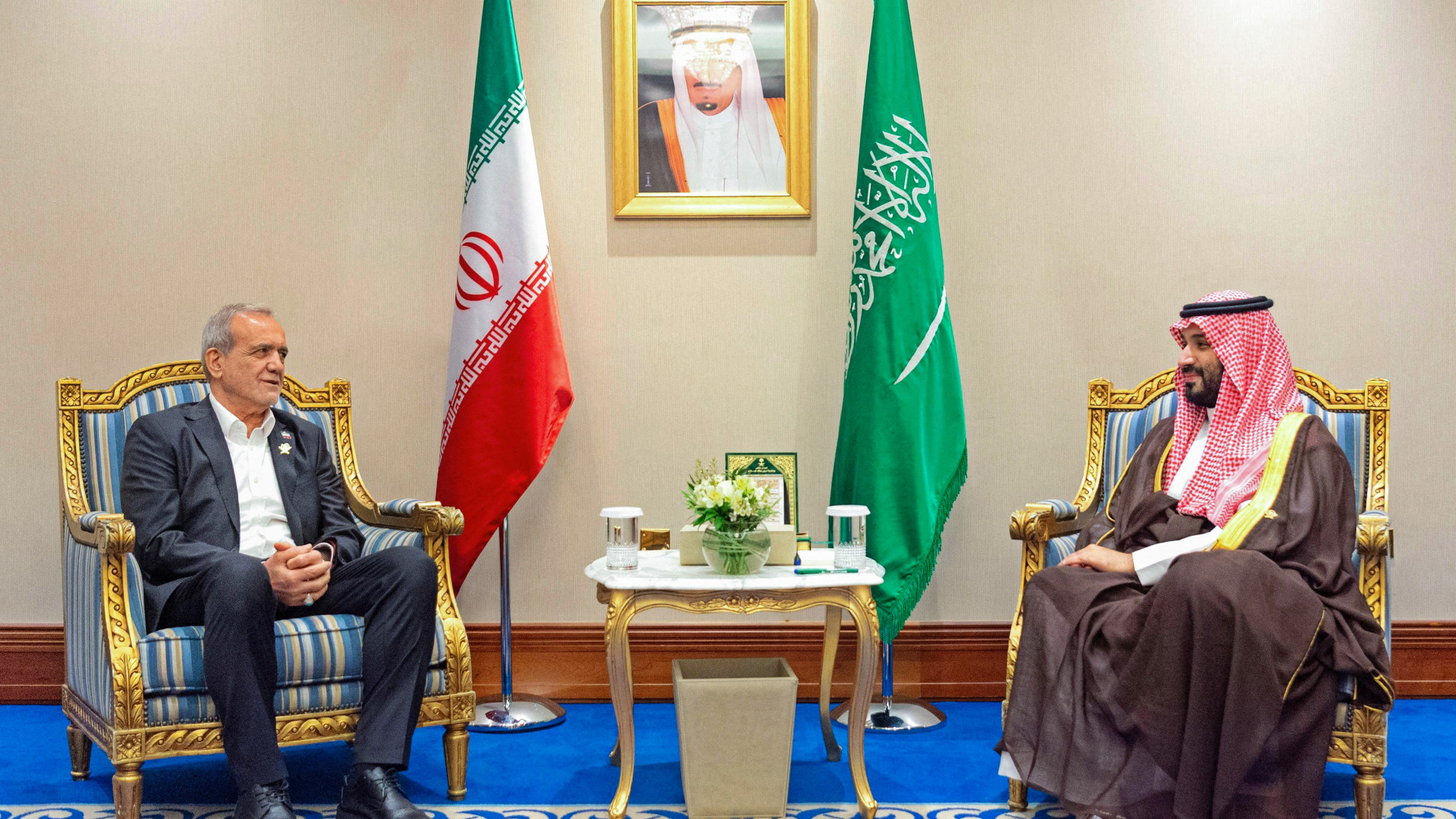
Only a few years ago, many Arab states, particularly in the Gulf, may have viewed a US regime change attack on Iran favourably.
For decades, they regarded Iran with deep suspicion, often treating it as the region’s primary threat. But now, as US President Donald Trump reportedly mulls exactly such an attack, Arab leaders, including Gulf rulers long at odds with Tehran, are lobbying the US administration not to strike Iran.
For 27 months, Arab leaders have watched Israel’s rampage throughout the region, in pursuit of its “Greater Israel” project, an expansionist biblical vision for territory spanning from the Euphrates River in Iraq to the Nile River in Egypt.
To this end, Israel has significantly expanded its illegal occupation of Arab lands. Not only has Israel carried out genocide in Gaza and indicated its plans to take the territory over, but it has also deepened its hold in the West Bank, Syria and Lebanon.
Perhaps most alarming for Arab leaders, after months of Netanyahu openly declaring his expansionist ambitions, was Israel’s unprecedented assault on Qatar, a US ally, in September 2025. That escalation had been preceded only a few months earlier, in June, by Israel convincing the US to bomb Iran in an assault aimed at destroying Iran’s nuclear programme and ensuring Israel remains the region’s sole nuclear power.
New MEE newsletter: Jerusalem Dispatch
Sign up to get the latest insights and analysis on
Israel-Palestine, alongside Turkey Unpacked and other MEE newsletters
In short, Israel’s aim of absolute regional hegemony has never been clearer, and a US strike on Iran would represent both an extension of Israeli aggression and an expansion of its regional power.
This is the structural shift at the heart of Arab opposition to a potential US-Israel attack on Iran.
Israeli expansionism
Although Israel has attempted to distance itself from a possible US strike on Iran, evidence suggests it is actively fuelling ongoing anti-regime protests that have helped precipitate the most recent American interference.
From the perspective of Arab governments, Iran’s decline has rendered further attack unnecessary and perhaps counterproductive
Earlier this month, both former US Secretary of State Mike Pompeo and current Israeli Heritage Minister Amichai Eliyahu suggested that Israeli agents are fuelling the protest movement from the front lines.
Meanwhile, Israel’s Channel 14 has insinuated that Israel has been supplying weapons to opposition protesters, who have reportedly killed dozens of Iranian security personnel.
These reports will almost certainly be read by Arab leaders in the context of Israel’s decades-long attempt to convince the US to carry out a regime change operation in Iran, as well as America’s history of covert regime change and chaos operations in the region.
But Israel’s push for regional hegemony is not the only calculation affecting how Arab states view conflict between Iran and the US-Israel axis, or the potential collapse of the Iranian regime.
Recent regional shifts also play an important role.
Since 2023, Iran has been severely weakened, with sanctions crippling the economy and direct attacks by the US and Israel compromising both the country’s military capabilities and nuclear programme.
Follow Middle East Eye’s live coverage of Israel’s genocide in Gaza
Iran’s proxy network has also been degraded. Syria’s Bashar al-Assad fell in December 2024, and Lebanon’s Hezbollah has suffered mightily in the face of constant Israeli bombardment.
From the perspective of Arab governments, Iran’s decline has rendered further attack unnecessary and perhaps counterproductive.
Indeed, while a weak Iran may be manageable and perhaps even desirable, the costs of a completely collapsed Iranian state greatly outweigh any potential benefits.
A shifting threat map
Gulf countries need stability to preserve regional security and further economic interests.
They worry in particular about what an attack on Iran, and a potential Iranian retaliation, could do to oil and natural gas prices.
An Iranian retaliation would likely threaten the Strait of Hormuz, which is essential to the transport of both natural gas and oil. Egypt fears that regime collapse in Iran could lead to further instability in the Red Sea and Suez Canal, both vital to the Egyptian economy.
It is also worth noting that Arab states have themselves moved diplomatically closer to Iran in recent years, in part because of Israeli aggression and expansionism. The Saudis and Iranians restored diplomatic relations in 2023 and moved closer after Israel’s September 2025 attack on Qatar.
Iran’s relationship with Egypt has also improved.

Gulf states must act to avoid Israel’s war on Iran spiralling into chaos
Read More »
Moreover, recent events, and in particular Israel’s unchecked aggression and territorial expansion, have forced a structural shift in how Arab states assess regional threats.
Gone, at least for now, are the days when Saudi Arabia viewed Iran as its foremost enemy, when Qatar saw Saudi Arabia as its principal threat, or when Egypt treated Qatar as the chief source of regional instability.
Increasingly, Arab regimes, with perhaps the exception of the UAE, now view Israel as the region’s most destabilising force.
Israeli expansionism, its willingness to strike across borders without regard for accepted international norms, and its open pursuit of regional hegemony have fundamentally altered how Arab leaders assess risk.
Arab leaders now fear that they may already be on the path of “Greater Israel”, or that they could be Israel’s next target.
Trump’s de-escalation rhetoric on Wednesday may have clarified what some analysts believe has been the US plan all along: squeeze the Iranian economy, support opposition protesters on the ground, and seek regime collapse without the costs of a direct military intervention.
Should the de-escalation trend continue, Arab leaders will be pleased, at least until the next Israeli effort to weaken, destabilise and fragment the region.
The irony is that Israeli belligerence – and American belligerence at the behest of Israel – carries the potential to unite a divided region, if not on the basis of common interests, then at least on the basis of a common threat.
The views expressed in this article belong to the author and do not necessarily reflect the editorial policy of Middle East Eye.
