

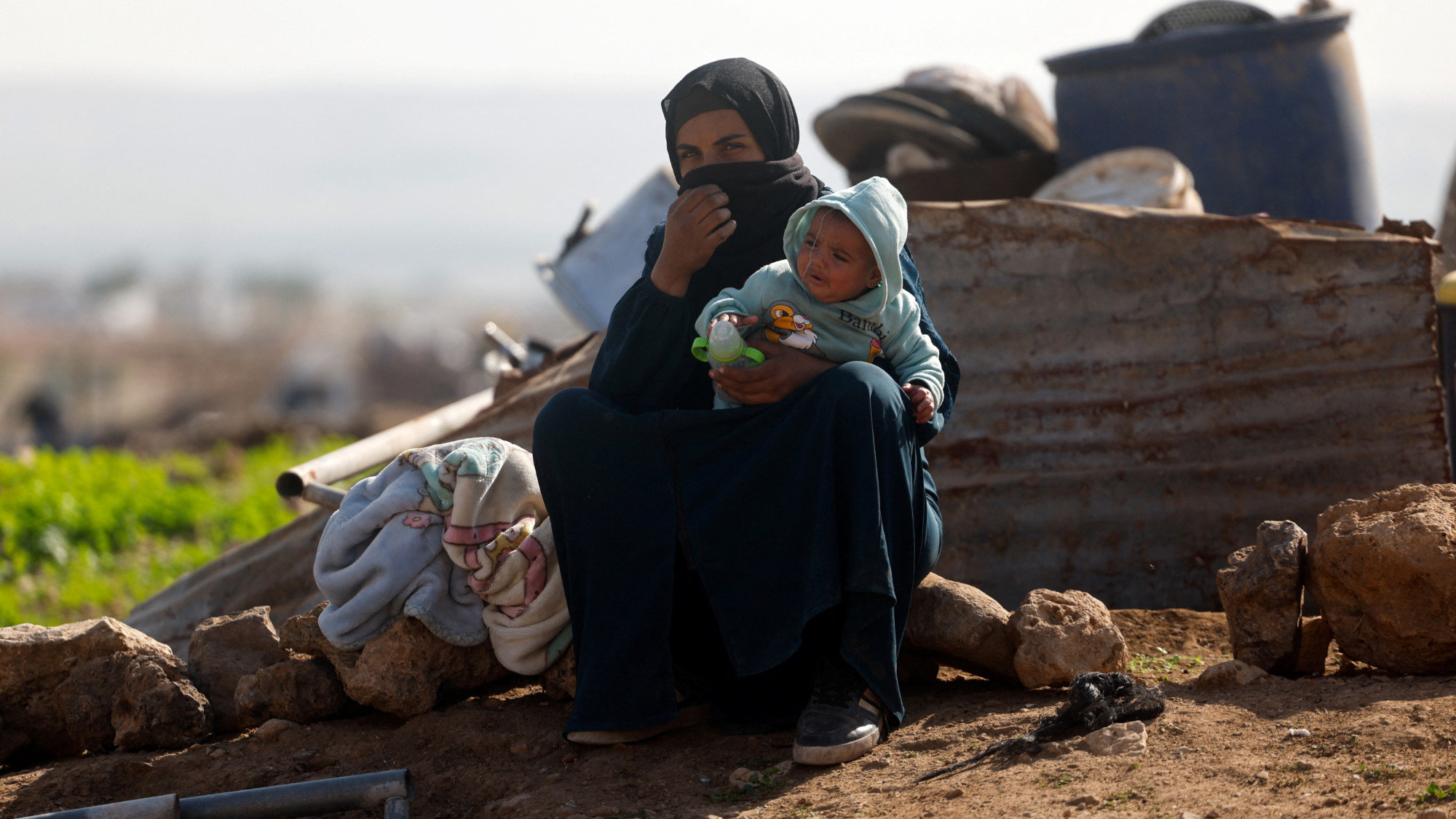
“Utensils in exchange for a bottle of olive oil and a kilo of za’atar so my children can take some to school.”
The post, shared by a Palestinian woman in Bethlehem in a private Facebook group for mothers, is no longer unusual.
Since the war on Gaza began – and Israeli restrictions across the occupied West Bank intensified – women have increasingly offered furniture, toys, kitchenware and even their children’s clothes in return for basic food.
Long the barest staples of Palestinian life, olive oil and za’atar (a herb blend) have become shorthand for poverty itself, captured in the saying: “He lives on oil and za’atar.”
Before the war, these Facebook groups dealt in surplus. They offered goodwill exchanges of outgrown clothes and spare toys.
New MEE newsletter: Jerusalem Dispatch
Sign up to get the latest insights and analysis on
Israel-Palestine, alongside Turkey Unpacked and other MEE newsletters
But with time, they have turned into urgent pleas for milk, cooking oil, medicine and other essentials.
Today, they map the depth of a cost-of-living crisis tightening its grip across the West Bank.
The territory is sliding into a hunger crisis, says economy researcher Dr Haitham Oweida.
Hunger, by international definitions, does not mean total deprivation. It means the inability to secure enough nutritious food consistently – a condition now visibly taking hold across the West Bank, according to Oweida.
The crisis, though less stark than in Gaza, is felt daily, as economic conditions across the West Bank rapidly deteriorate.
Economic collapse
Since October 2023, Israeli restrictions on livelihoods and resources across the West Bank have pushed an already fragile economy towards collapse, turning everyday survival into a struggle.
Poverty rates have risen to around 28 percent of the population. There has been an unprecedented decline in the ability of social protection programmes to meet growing needs.
Before the war, the Palestinian economy rested on three main pillars.
The first was Palestinian labour in Israel. Between 250,000 and 300,000 workers, with and without permits, injected around $460m a month – more than $5.5bn a year – into the economy.

It’s time to decolonise the Palestinian economic system
Read More »
Most workers have been banned from entering Israel since the war broke out in October 2023.
The second was domestic tourism by Palestinian citizens of Israel, which sustained trade and services across the West Bank and generated a similar $460m per month.
The third was clearance revenues – taxes collected by Israel on behalf of the Palestinian Authority (PA) – which brought in between $260m and $310m monthly.
After the war began, most of these flows dried up. International aid to the PA also declined and became increasingly unstable, falling in 2025 to an estimated $710m-$770m a year.
The affect has been immediate. The PA has struggled to pay full salaries to public-sector employees, even as security conditions deteriorated.
Meanwhile, Israeli closures have intensified. Military checkpoints have increased to around 898, alongside some 300 military gates, according to the UN Office for the Coordination of Humanitarian Affairs (OCHA). This has left trade and internal movement largely paralysed.
Unlike previous economic crises, the fallout has not been confined to the poorest. It has cut across all layers of society.
“What is happening in the West Bank is voluntary economic displacement,” Dr Oweida told Middle East Eye.
‘We have reached a stage where Palestinians – whether traders, public employees or labourers – can no longer continue’
– Dr Haitham Oweida, economy researcher
“We have reached a stage where Palestinians – whether traders, public employees or labourers – can no longer continue.”
According to the 2025 report by the Palestinian Central Bureau of Statistics and the Palestinian Monetary Authority, unemployment in the West Bank has reached around 28 percent.
GDP has fallen by 13 percent compared with 2023. Consumption has dropped by 12 percent, reflecting a sharp fall in living standards.
Oweida believes the true figures for poverty and unemployment may be higher. Around 50 percent of private-sector institutions have been affected, he says.
He argues that the absence of effective government policies and interventions has deepened the crisis.
No other choice
This economic deadlock has driven many Palestinians to risk their lives trying to reach workplaces inside Israel.
Hardly a day passes without reports of a Palestinian worker injured or killed after being shot by Israeli soldiers while attempting to cross the separation wall, particularly in the Ramallah area north of occupied East Jerusalem.
One recent case was Jihad Qazmar, 58, from the village of Izzbet Suleiman near Qalqilya in the northern West Bank.
Qazmar had worked in Israel for years. After the war began, his income vanished overnight. A father of nine, he faced mounting expenses. He first spent his savings, then sold part of his property, before turning to small loans.
Even family support ran out. Some of his brothers are PA employees now receiving only partial salaries. Others lost their jobs in Israel. Returning to farming was impossible after the separation wall cut off most of the family’s land.
His brother, Zaid Qazmar, told MEE he tried to dissuade him days before his death. Jihad replied that he had no choice left but “to beg for my family’s food outside mosques”.
He left home and never returned.
After crossing the wall, he collapsed on the other side and died instantly.


According to the Palestinian General Federation of Trade Unions, 38 Palestinian workers were killed from October 2023 to September 2025 while attempting to reach their workplaces in Israel.
More than 1,500 have been injured since October 2023. The real figure is probably much higher, as many avoid reporting injuries for fear of persecution.
Saeed Imran of the federation said: “Many workers have sold everything they own, even their household furniture, simply to survive.”
Before the war, around 240,000 Palestinians worked in Israel, earning monthly wages of more than $410m – exceeding the combined salaries of the public and private sectors in the West Bank. Their losses during the war are estimated at around $9bn.
Today, only about 40,000 workers manage to reach jobs in Israel. Around 30,000 do so without permits, taking daily routes fraught with danger.
‘We could no longer provide meals or meet our children’s needs’
– Hiba, Palestinian mother
Among them was Salim Rajab al-Far, a father of seven. His youngest child, Abdullah, is six.
After he lost his job, the family burned through its savings. His wife, Hiba, sold her jewellery. As debts mounted, he began risking the crossing.
“We reached a stage where we could no longer provide meals or meet our children’s needs,” Hiba told MEE.
More than once, he managed to reach his workplace. Each time meant hours of walking over rough terrain, climbing the separation wall and crawling through sewage and water channels.
The last attempt ended differently.
Last October, he left home for work, crossed the wall and reached a culvert, where Israeli soldiers on the other side detained the group. Minutes later, he asked one of the soldiers for water. He was beaten until he died.
Despite her grief, Hiba says he had no other choice.
“I lost my husband on the wall. I cannot ask others to stop their sons,” she said.
“My sister fears for her sons, who have been forced to do the same. No one takes this road unless they have to.”
