

The United States inaugurated the new year by hard launching its “Donroe Doctrine”, President Donald Trump’s reimagining of the 1823 imperialist Monroe Doctrine.
The benighted neologism gained currency in the wake of the US bombing of Venezuela and the abduction of its president, Nicolas Maduro, and his wife on 3 January. While the doctrine asserts an American arrogation of a sphere of influence in the Western Hemisphere, in reality it is a global takeover project, not unlike standard US imperial policy that has prevailed since World War Two.
In the past month alone, the US has waged an onslaught against oil-producing countries across three continents, extending far beyond the Western Hemisphere.
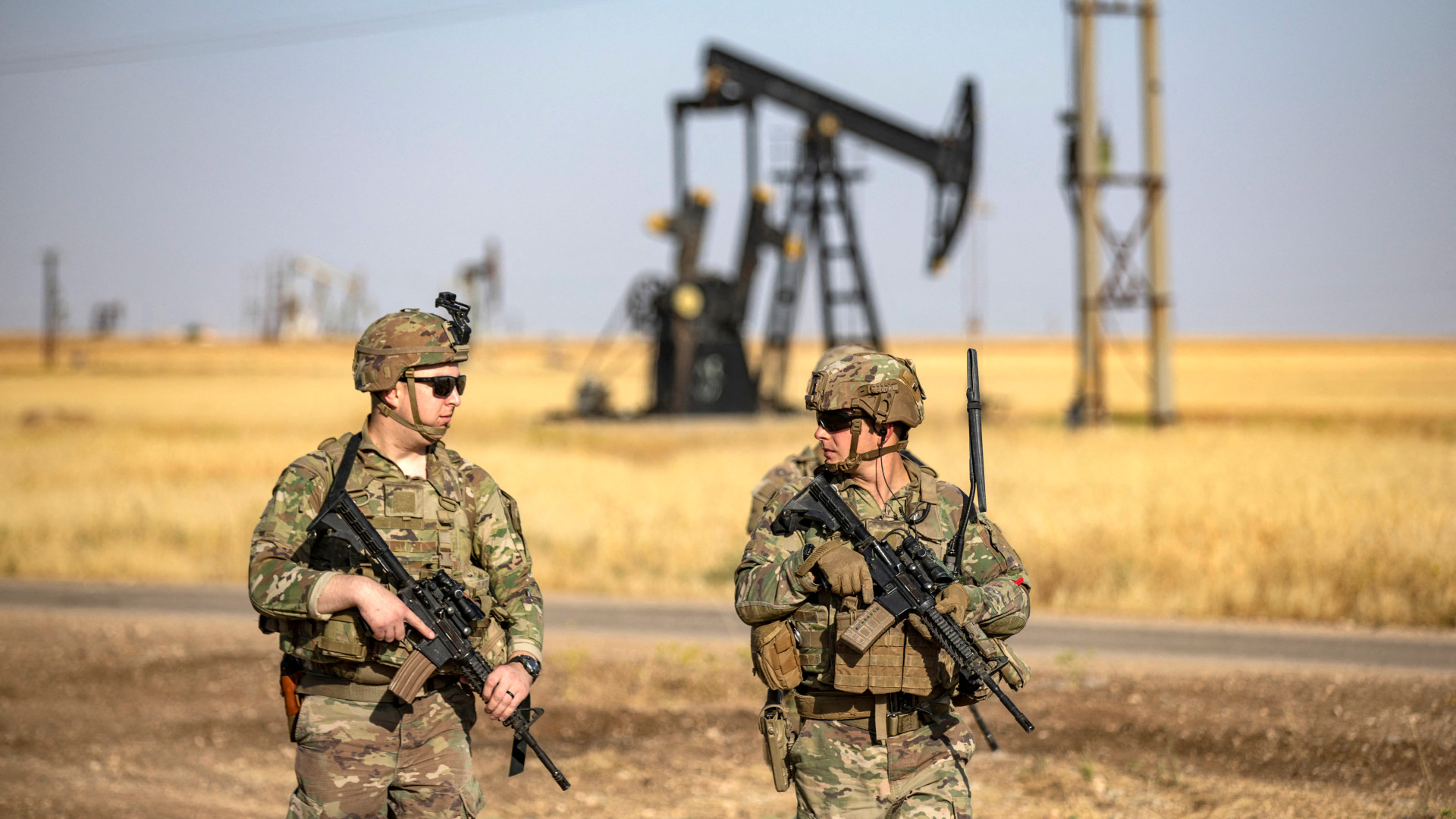
On 19 December, and again on 10 January, the US bombed Syria, ostensibly targeting Islamic State operatives who had killed two US soldiers and their interpreter on 13 December. The soldiers were part of more than 2,000 American troops occupying Syria’s oil-producing regions, where they have extracted and sold Syrian oil and pocketed the proceeds since 2014.
Meanwhile, after several threatening Trump pronouncements that Nigeria’s Christians are allegedly being killed in the tens of thousands by jihadist groups, on 25 December he delivered a bombing raid on Africa’s largest oil-producing nation as a “Christmas present”, killing scores of alleged “jihadists” for the purpose of “saving” the Christians.
New MEE newsletter: Jerusalem Dispatch
Sign up to get the latest insights and analysis on
Israel-Palestine, alongside Turkey Unpacked and other MEE newsletters
He has since warned that he will strike Nigeria again if “Christians continue to be killed.”
Trump has transported his interventionist zeal into Asia, where he is now urging Iranians to “keep protesting” and declaring that “help is on the way”, after mass anti-government protests and riots erupted on 28 December amid a deepening economic crisis.
Some estimates put the death toll as high as 2,000 – protesters shot by police and security personnel killed by rioters, who have also set fire to cars and buildings.
While the doctrine asserts an American arrogation of a sphere of influence in the Western Hemisphere, in reality it is a global takeover project
Israeli officials have confirmed that Mossad agents are operating in Iran, implying involvement in the protests, a claim reinforced by former US Secretary of State Mike Pompeo, who greeted “Iranians and Mossad agents beside them” in a post on X.
On Tuesday, Trump escalated his threats against Iran, cancelling all talks with Tehran, announcing 25 percent tariffs on countries that do business with it and threatening “very strong” military action on the pretext of Iran’s treatment of protesters.
In South America, Trump’s illegal attack on Venezuela, which killed more than 100 people, and his subsequent assertions that the US will now “run” the country that happens to have the largest proven oil reserves on the planet, have underscored the centrality of oil to Washington’s current imperial doctrine.
Trump has now set his sights on Greenland, a semi-autonomous Danish territory with vast oil potential that has long attracted US interest, threatening Denmark with force and making military plans to invade the island “whether they like it or not”. Incidentally, Republican Congressman Randy Fine, an enthusiastic supporter of Israeli land theft and genocide, introduced a House bill on Monday backing US annexation of Greenland.
The US insistence on controlling the world’s oil has two dimensions: maintaining its grip on oil prices and ensuring that the dollar remains the sole currency for energy trade, and controlling oil exports and access in ways that constrain its major economic rival, China.
These are not new concerns for America’s imperial elites, but hark back to the post-World War Two era, when Washington instituted a policy of regime change to help itself to the oil of sovereign countries worldwide.
Oil conquests
The first post-World War Two CIA-sponsored coup was carried out in March 1949 in Syria, which overthrew the country’s democratically elected president, Shukri al-Quwwatli, and installed Colonel Husni al-Zaim, who collaborated with the US and Israel to replace him.
Unsurprisingly, the motive was oil.
Al-Quwwatli’s refusal to allow the Americans to build the Trans Arabian Pipeline, “Tapline”, to carry Saudi oil – then owned by American corporations – through Syria to the Mediterranean, in order to bypass costly shipping through the Suez Canal, brought the wrath of empire upon him.

How Israel and the US are exploiting Iranian protests
Read More »
Al-Zaim immediately approved the Tapline plan and began to negotiate with Israel on schemes to expel the Palestinian people to Iraq. After the coup, the Tapline was built through the Golan Heights, ending in Sidon in Lebanon.
After the Israeli conquest and occupation of the Golan, the Saudis, Syrians, Lebanese and Jordanians acquiesced in the Israeli control of 50km of the pipeline.
The Popular Front for the Liberation of Palestine blew up the Tapline on 30 June 1969, spilling between 6,000 and 9,000 tonnes of oil into Lake Tiberias and causing major revenue losses for the Saudis and the American oil companies. The Tapline continued to pump oil through Israeli-occupied territory until 1976, when tanker transport became cheaper.
The US takeover of Syria’s oil fields since 2014 continues the same imperial tradition, especially as it aided the fall of the Assad regime a year ago and has subjugated the new al-Qaeda regime in Damascus to its diktats.
The second US-sponsored coup of the post-war era was the August 1953 overthrow of the Iranian government of Prime Minister Mohammad Mossadegh, who had nationalised Iranian oil then being pillaged by British oil companies.
Operation Ajax, as it was called, was a joint CIA-MI6 effort: the CIA hired thugs to stage pro-Shah demonstrations, bussed hundreds to Tehran to take part in fake anti-government protests and to harass pro-Mossadegh marchers.
Follow Middle East Eye’s live coverage of Israel’s genocide in Gaza
The coup restored to power the much-hated Shah, who promptly facilitated his country’s continued pillage by western oil companies.
The recent US intervention in Iran, from subversion to open threats of invasion, is yet another repetition of Washington’s actions in the country since World War Two.
Imperial pretexts
As for Venezuela, its petroleum remained in the hands of US oil companies until the government finally nationalised the industry in 1976, as many oil-producing states did in that period.
Further nationalisations followed under President Hugo Chavez in 2008. US sanctions escalated steadily and by 2014, under the no less imperialist Barack Obama administration, reached unprecedented levels.
With Maduro’s abduction, the ‘rules-based world order’ is officially dead
Marco Carnelos
Read More »
It was the same year that Obama took over Syria’s oil fields. More sanctions followed under the first Trump administration and later under Biden, and US subversion aimed at regime change in Venezuela never abated.
The cacophony of cliched imperial pretexts for overthrowing these governments ranges from accusations of terrorism (as with Syria, and Libya before it), to drug-trafficking (Venezuela and Colombia) and repression of democracy (Iran), not to mention the laughable accusations of possession of weapons of mass destruction, which it deployed against Iraq to justify its imperial invasion and occupation since 2003.
In the case of Greenland, Trump has added a novel argument with no precedent in international law: that the territory is “vital to US national security”.
The abduction of Maduro is hardly a new crime. The US has kidnapped a number of presidents before and removed them from power: Panama’s Manuel Noriega, a former US client and henchman, in 1990; and, with French collaboration, the democratically elected Haitian president Jean-Bertrand Aristide in 2004, after he demanded reparations from France, which had robbed the country of billions of dollars.
US-backed coups
As for regime change and CIA-backed coups, the list since World War Two runs into the dozens, especially in Latin America, and is driven by the oil and minerals the US covets.
In his 1970 classic Open Veins of Latin America, Latin America’s foremost journalist and historian, Eduardo Galeano, listed some of the US-sponsored coups during the decade of the 1960s:
The wealth of iron beneath Brazil’s Paraopeba valley overthrew two presidents – Janio Quadros and Joao Goulart – before Marshal Castelo Branco, who made himself dictator in 1964, graciously handed it over to the [American] Hanna Mining Company…In Peru in 1968, page 11 of the agreement which President Fernando Belaúnde Terry had signed with a Standard Oil affiliate was mysteriously lost; General Juan Velasco Alvarado overthrew Belaúnde, took the reins, and nationalized the firm’s wells and refinery…Argentina’s frequent coups d’etat erupt before or after each offer of oil concessions. Copper was a far from minor factor in the Pentagon’s disproportionate military aid to Chile before the electoral victory of Salvador Allende’s left coalition… In 1964, Che Guevara showed me, in his office in Havana, that Batista’s Cuba was not merely sugar: the Imperium’s blind fury against the revolution was better explained, he thought, by Cuba’s big deposits of nickel and manganese. The United States’ nickel reserves subsequently fell by two-thirds when Nicaro Nickel was nationalized and President Johnson threatened an embargo on French metal exports if the French bought nickel from Cuba…Minerals had much to do with the fall of Cheddi Jagan’s socialist government, which at the end of 1964 had again won a majority of votes in what was then British Guiana. The country now called Guyana is the world’s fourth producer of bauxite and Latin America’s third producer of manganese. The CIA played a decisive role in Jagan’s defeat. Arnold Zander, leader of the strike that served as a provocation and pretext to deny electoral victory to Jagan, afterward admitted publicly that his union had dollars rained upon it from one of the CIA foundations.
None of what has transpired in the last month is new. Washington may well fear that any US attack on Iran could spur the country to bomb oil wells across the Gulf, disrupting the oil market. Iran has already threatened to strike US bases in the region, scattered across the Arab oil-producing countries, and Jordan.
The US is already moving to control the oil of Libya, after sponsoring the 2011 overthrow of Muammar Qadhafi with its European allies, as well as Syria’s oil fields, and now Venezuela’s – with Greenland and Nigeria in its sights. This is arguably the back-up plan for controlling the flow of oil in the world except for Russia’s, in case of an Iranian strike on Gulf oil wells. This would better enable the US to disrupt the Chinese economy more effectively.
This may very well be the central aim of the “Donroe Doctrine”: a project targeting not merely the Western Hemisphere but the entire globe. Indeed, developments in the coming days and weeks will likely reveal just how far this agenda extends.
The views expressed in this article belong to the author and do not necessarily reflect the editorial policy of Middle East Eye.
