

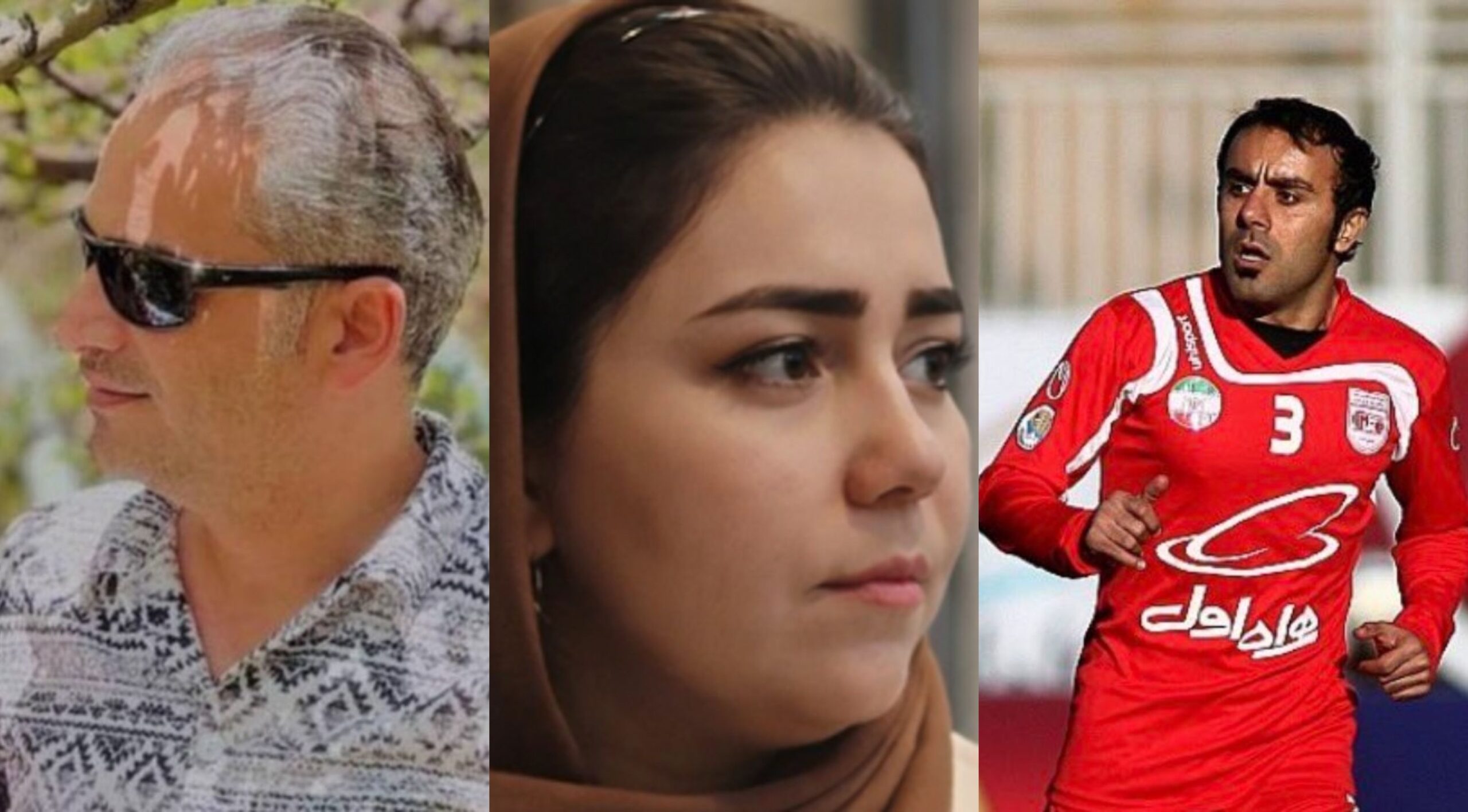
The death toll has continued to mount in Iran since protests began in late December.
According to Reuters, more than 2,600 people may have been killed so far, mostly protesters, but also some security officials and bystanders.
Those killed have come from all over the country and across Iranian society, from a range of different professions, ages, ethnic and religious backgrounds.
The deaths have provoked outrage from the international community, while the US has increasingly been threatening to intervene militarily, using the killing of protesters as a rationale.
Using information collected by Iran-focused rights groups, which has not been independently verified by Middle East Eye, we take a look at just a small number of the protesters killed in recent weeks.
New MEE newsletter: Jerusalem Dispatch
Sign up to get the latest insights and analysis on
Israel-Palestine, alongside Turkey Unpacked and other MEE newsletters
Ejmin Masihi, 17


Ejmin Masihi, a member of the Armenian community, was killed on Saturday.
According to Hengaw, a Norway-based human rights group, Masihi lived in Tehran’s Majidiyeh district and was shot dead by the security services during a protest in Narmak, in the capital.
Armenians in Iran make up the country’s largest Christian community, and the reports of deaths and casualties have already provoked an intervention from the Republic of Armenia.
Armenian Diaspora Affairs High Commissioner Zareh Sinanyan was quoted last week by local media as saying Yerevan has lost communication with the Armenian community in Iran, a situation he described as deeply concerning.
“Since Friday, when the protests escalated, we have had no information from Iran. Even now, we are unable to contact our compatriots there, which is very worrying for us,” Sinanyan told Armenpress.
Mojtaba Torshiz, 47

Mojtaba Torshiz, a former footballer, was killed on 8 January during protests in Tehran.
A former player for Nassaji Mazandaran, Tractor Sazi, Esteghlal Ahvaz, Fajr Sepasi and Mes Kerman, Torshiz was shot by security forces alongside Ahmad Khosravani and Mehdi Lavasani, a former basketball player and a football player-coach respectively.
According to Hengaw, Lavasani was shot in the back and died at the scene.
Football is immensely popular in Iran and has been a major unifying factor across the country.
Star players have voiced support for previous anti-government protests, risking their careers and liberty in the process.
Akram Pirgazi, 40

Akram Pirgazi was the first woman reported to have been killed in the protests.
Hengaw said Pirgazi was shot in the head by government forces on 7 January.
She was transferred to a hospital in Neyshapur, where she later died.
Mostafa Safian
Mostafa Safian was killed by security forces on Friday in the central city of Shahreza.
He is one of at least four members of the minority Lur community who are suspected to have been killed since the protests began.
Hengaw cited a source close to the family saying that his body has not been handed over and that his burial would be carried out by authorities.
Other Lur Iranians killed in recent days are Reza Ahmadi, Amin Ghobadi and Dariush Ansari Bakhtiariwand.
Ahmadi and Ghobadi, residents of Fuladshahr, were killed by government forces on 8 January. Bakhtiariwand, also of Fuladshahr, was killed on 31 December.
Lurs make up around six percent of Iran’s population and have a distinct language and cultural traditions.
Mansoureh Heidari and Behrouz Mansouri

Mansoureh Heidari and her husband Behrouz Mansouri were shot dead on the evening of 8 January, on Ashouri Street in the city of Bushehr.
According to Hengaw, they were killed with live ammunition while standing in front of the Qoran Mosque.
Eyewitnesses said they were fired on from within the mosque.
Amir Mohammad Koohkan, 26

Amir Mohammad Koohkan was killed with live ammunition on 3 January, during protests in the town of Neyriz, according to a friend speaking to BBC Persian.
The 26-year-old’s body was then taken by Islamic Revolutionary Guard Corps forces. Repeated attempts to recover it for burial have been unsuccessful, according to Hengaw.
Kookhan was a referee for futsal, a scaled-down variant of football that involves five players on each side and a smaller pitch.
A range of futsal players have been killed and arrested in recent months across Iran.
Reza Haji Moradian
Reza Haji Moradian was killed in the city of Karaj during protests on 8 January.
A young Kurdish man originally from the city of Qasr-e Shirin, Moradian was buried in his hometown on 12 January, according to Hengaw.
Despite initial reluctance, increasing numbers of Kurds have become involved in the latest protests, and several have been killed as a result.
Many Kurds have been deterred by the death toll from the Mahsa Amini protests, which were inspired and mostly led by Kurds.
Rubina Aminian, 23

Rubina Aminian, a 23-year-old student, was shot from behind during a protest in Tehran on 8 January, according to the Human Rights Activist News Agency and the Iran Human Rights (IHR) organisation.
Aminian, originally from Kermanshah, was studying textile and fashion at Shariati Technical and Vocational College in the capital.
IHR said her family had to search through hundreds of bodies of young people killed in the protests at a location close to her college.
“It wasn’t just my daughter; I saw hundreds of bodies with my own eyes,” Aminian’s mother said, according to IHR.
