

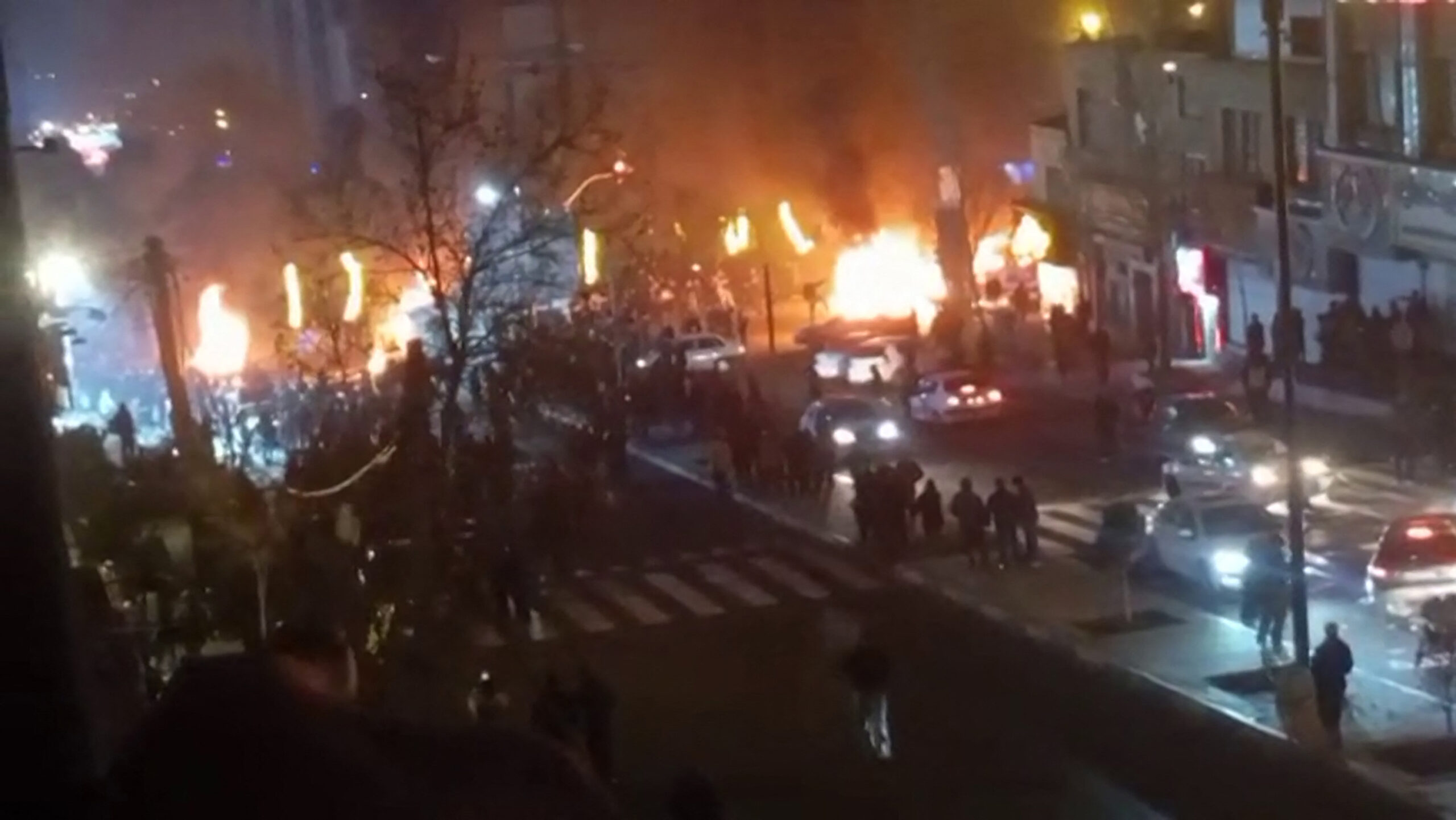
It has been 18 days since the first demonstrations began in Tehran, sparked by economic woes that have gravely impacted Iranians’ ability to afford the very basic necessities.
The protests soon spread to other cities, and what began as economic demands shifted into chants calling for the fall of the establishment.
A media battle has also intensified alongside the unrest. Both the government and Persian-language media linked to monarchists, backed by Israel and the United States, are circulating fake and inaccurate news, as well as photos and videos created by AI.
The nationwide internet shutdown that began on 8 January has made it more difficult to verify videos and reports from either side.
Still, Middle East Eye is attempting to provide the clearest account possible of the protests and the deadly crackdown, especially since the blackout.
New MEE newsletter: Jerusalem Dispatch
Sign up to get the latest insights and analysis on
Israel-Palestine, alongside Turkey Unpacked and other MEE newsletters
This report draws on interviews with eyewitnesses inside Iran, an Iranian national who has recently left the country, open-source analysts from exiled Persian media, and human rights experts.
The blackout begins
When the blackout began on 8 January, many Iranians feared a repeat of what had happened in past protests: once the internet goes down, the military steps in and the killing starts. This pattern was seen in 2017, 2019 and 2022.
A source who joined a protest in the capital’s Tehranpars district on 8 January told MEE that at first there were “strangely, no signs of many riot police or other forces”.
But once crowds gathered and began chanting against the establishment, gunfire suddenly broke out and continued until midnight.
The next day, as the weekend began, clashes broke out again at nightfall, with protesters returning to the streets.
Another source in Tehran told MEE that even though he stayed inside, he could hear gunfire well past midnight.


Human rights groups say the use of live ammunition marked a major shift in the establishment’s response.
Iran’s protests broke out on 28 December. Initially, security forces tried to control crowds with shotgun pellets in major cities, including Tehran, Isfahan and Mashhad.
Until then, live ammunition had mostly been used in smaller cities where protesters had raided government buildings.
According to Mahmood Amiry-Moghaddam, director of the Norway-based Iran Human Rights (IHRNGO) organisation, after the internet shutdown some protesters were first wounded by pellets and then killed by live ammunition.
The protesters and the forces of repression
Eyewitnesses and videos verified by MEE indicate that the protests include Iranians from all walks of life.
Young people make up most of the crowds, but older people and children have also joined in. IHRNGO says most of those killed were under 30.
In recent days, police have been deployed first, followed by large numbers of riot police and a smaller amount of Basij forces.
The Basij, a branch of the Islamic Revolutionary Guard Corps (IRGC), is called in when unrest spreads.
Basij members often wear plain clothes, receive military training, and have previously been deployed to Lebanon and Syria.

In Tehran, IRGC special units also moved in. Most live gunfire came from these forces.
The IRGC has several military and intelligence branches, and in major cities it has units dedicated to protest suppression.
In Tehran, this role is handled by the Mohammad Rasulullah Corps.
Photos and videos from recent days show IRGC forces widely involved in the killing of protesters.
How many killed, injured and arrested?
The total number of deaths in the recent protests is still unclear.
On Tuesday, IHRNGO reported that at least 734 protesters have been killed, including 12 children, thousands wounded, and more than 10,000 arrested.
IHRNGO’s Amiry-Moghaddam told MEE that his organisation’s figures reflect only what they could verify amid the internet shutdown, and said the real toll is likely higher.
Eyewitness accounts indicate that many bodies have been piled in hospital morgues.
An anonymous Iranian official told Reuters that around 2,000 people had been killed.

A relative of Rubina Aminian, a 23-year-old student killed in Tehran on 8 January, said Rubina’s parents were confronted with hundreds of bodies when they went to identify her. Most were aged 18 to 22 and had been shot in the neck at close range.
A video from funeral centres in Kahrizak, near Tehran, shows the faces of the dead covered in blood or marked by gunshot. The video also shows dozens of bodies on the street inside black bags.
State media has also confirmed a large number of deaths, though it describes the victims as casualties of terrorist attacks.
The Islamic Republic of Iran Broadcasting (IRIB), the country’s main state television network, recently shared a report on social media showing rows of bodies in black bags at Tehran’s forensic centre.
What will happen next?
The official narrative that the establishment is using to respond to the protests is that a group of people associated with the US and Israel have turned peaceful demonstrations into riots.
Officials have thus defined the unrest as a continuation of the 12-day war in June, during which Israel and the United States attacked Iran with fighter jets and missiles, killing around 1,000 people.
To back this narrative, the government has repeatedly pointed to a post on X by former US Secretary of State Mike Pompeo on 2 January, when he wrote: “Happy New Year to every Iranian in the streets. Also to every Mossad agent walking beside them…”
On 11 January, the government declared three days of national mourning for “martyrs” killed in the unrest, such as members of the security forces.

Iran protests: What is driving the unrest?
Read More »
The next day, it mobilised loyalist groups to take to the streets in several cities in support of the establishment.
The government has used this tactic in past waves of unrest, though such rallies have not always sent protesters home.
In 2009, for example, protests in Tehran contesting the election result carried on for eight months despite several pro-government marches.
It is still unclear how the recent repression has affected protesters. But state media’s widespread use of videos showing those killed suggests an effort to wage psychological pressure and frighten people off the streets.
Iranian media expert Nazli Kamouri wrote on X: “The Islamic Republic’s media deliberately displays the bodies of protest victims; not as a result of information leaks, but as a message. All the branches of power are openly declaring: We will kill, we will execute.”
Human rights groups say this has raised serious fears about fast-track executions of people detained in recent days.
Iran has used this tactic in previous rounds of unrest, including in 2022 and during the 12-day war in June.
On Wednesday, Gholamhossein Mohseni Ejei, head of the judiciary, said during a visit to a prison holding protesters that public fast-track trials will soon begin.
