

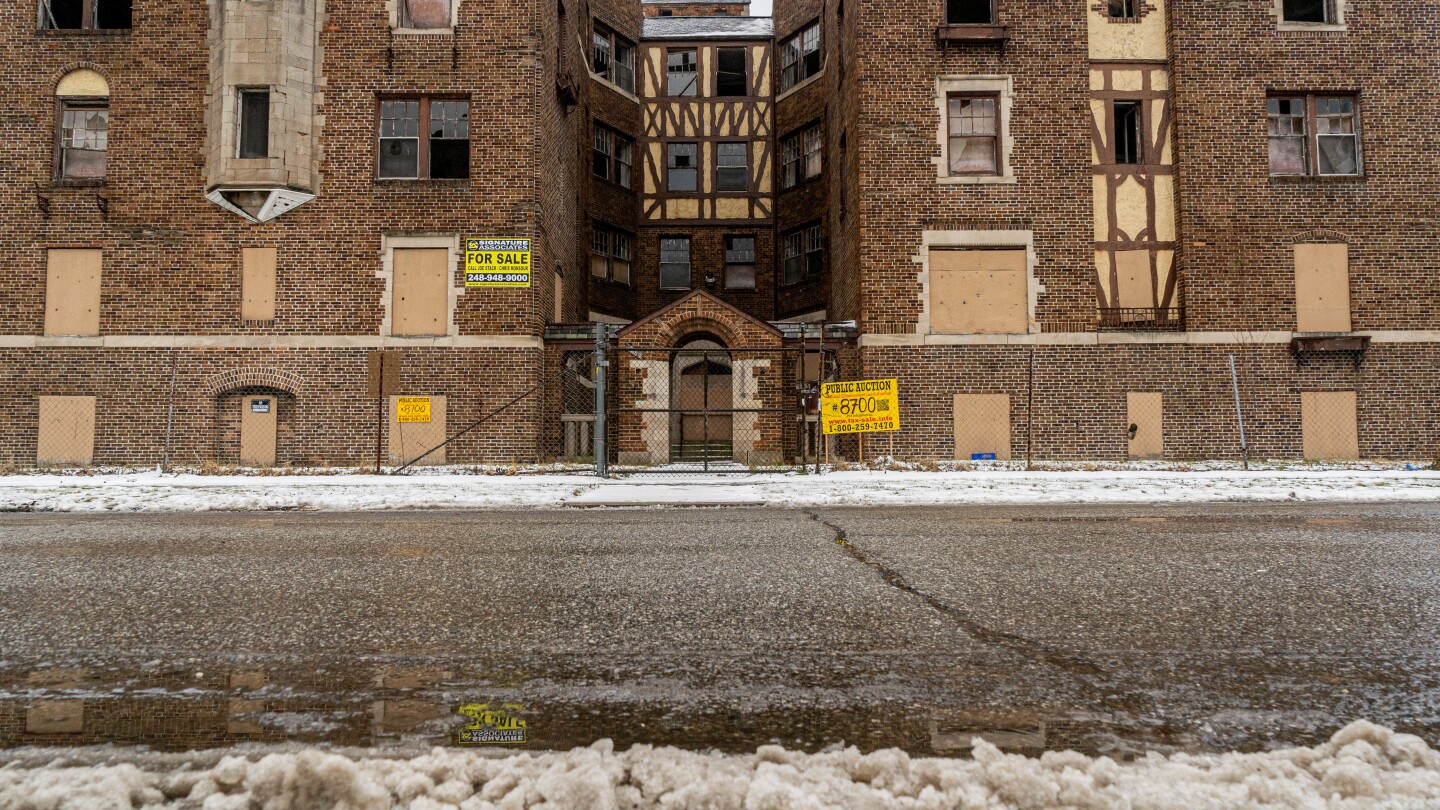
A real estate gamble gone sideways has hollowed out more than a third of the apartment buildings in Palmer Park. Close to two dozen buildings in the neighborhood are practically abandoned, putting the viability of the neighborhood and its historic buildings at risk.
Phoenix-based Urban Communities began buying multifamily buildings in the neighborhood near Detroit’s northern border in 2020. Today, all 21 buildings are either in receivership, foreclosed or highly distressed.
Many are in dire physical condition.
Wayne County tried to market five of the buildings the treasurer seized for unpaid taxes in a special auction earlier this year.
Listing photos and descriptions of the properties paint a grim picture. According to an inspection report of 361 Merton Road, the electrical wiring and much of the plumbing was stolen, several units sustained fire damage, the stairs weren’t secure, and paint and plaster were coming off the walls throughout the building.
“Getting this building back to an occupiable condition will be a significant undertaking,” the report said.
Not one of the properties elicited a single bid.
Frank Simon, a court-appointed receiver tasked with marketing 14 of the buildings for sale, said he inherited a rough situation.
Stay up to date with the news and the best of AP by following our WhatsApp channel.
Follow on

“(The portfolio) definitely was not in good shape at all,” he said. “It was not managed well and had much deferred maintenance.”
Edward Lennon is the attorney for Urban Communities and its CEO Maximiliano Palacio. In an emailed statement to Outlier Media, Lennon blamed several factors for the company’s downfall, including increased construction costs, nearby crime and the 36th District Court’s “refusal to enforce evictions for non-payment.”
Other multifamily landlords have spoken about the challenges of Detroit’s rental market. Urban Communities also had trouble getting renovations approved by the city’s Historic District Commission.
But the company’s rapid collapse suggests that its move into Detroit real estate was mismanaged from the start. It had persistently high vacancy rates, mounting repair issues and a trail of unpaid bills. The company stopped making payments on a mortgage just a few months after taking it out.
Dayton Martindale rented an Urban Communities apartment for about seven months starting in June 2022. He experienced poor property management right from the start.
Upon moving in, he discovered that his stove and oven were broken, and immediately put in a work order. Despite visits to the front office and follow-up emails requesting service, which Martindale shared with Outlier, the repairs took more than a month.
When he withheld a month’s rent because he couldn’t cook, the company filed for eviction. He paid the rent and continued living in the apartment.
Then, months later, he came home one day to find that someone had broken in and stolen his bike and other belongings. He said he called management right away to report the break-in and request that his door be repaired.
“They said they would send ‘emergency maintenance’ — that was their phrase — to fix the doorknob. It was never fixed,” Martindale said. “I moved out about a month later, and I did not have a working doorknob that whole time.”
Today, Urban Communities barely exists. Its website is offline, and emails sent to its general address bounce back.
‘One-of-a-kind’
Palmer Park is distinct in Detroit.
The vast majority of the city’s residential building stock is single-family homes. But the Palmer Park Historic District is almost exclusively apartment buildings — 57 of them, according to a report for Detroit’s Historic District Commission.
The neighborhood includes a wide variety of architectural styles — Moorish, Art Deco, Tudor-Revival, Modern — spanning decades and built by some of Detroit’s great architects, including Albert Kahn.
“The density, the diversity and the beauty” of Palmer Park’s buildings are what make them “a really one-of-a-kind collection that you don’t see anywhere else in the city,” said Detroit historian Amy Elliot Bragg.
Bragg said it’s important to protect this unique collection of buildings and worries how long-term abandonment affects the neighborhood.
“Each individual apartment building is historically, architecturally significant in its own way,” she said. “But the district as a whole also benefits from the density and the continuity of the neighborhood.”
The rise and fall of Urban Communities
Outlier pieced together the events that led to Urban Communities’ downfall largely through court records and filings at the Wayne County Register of Deeds.
The company went on a buying spree starting late 2020, scooping up all the properties in its portfolio in about a year. It didn’t list purchase prices on the deeds it filed, so it’s unclear how much it paid in total, but it took out several mortgages.
The company struggled from the outset to maintain its properties and pay the bills.
Emma Greschak lived in her Urban Communities apartment for most of 2022. She said the building’s back door wouldn’t lock, numerous windows were broken, and both the heat and hot water went out for a week.
“You would see people with stuff crammed into their window, like pillows — just any attempt to cover it,” Greschak said. “They didn’t care about the tenants at all and didn’t update the building.”
Urban Communities seemed to stop paying its bills in early 2023. Multiple contractors filed liens against the company for hundreds of thousands of dollars of unpaid work, including Genesee County-based Cardinal Roofing. Co-owner Suzanne Pierce said her company did around 10 roofing jobs for Urban Communities under a $214,000 contract. When the company stopped paying in May 2023, Pierce said it still owed roughly half that amount.
“We’re a smaller company,” Pierce said. “My husband and I own it, and we have four salesmen and a crew for commercial work. So it was a huge hit for us.”
Then came the defaults. Urban Communities took out a $25 million loan on 15 properties in June 2022. It missed its first payment just nine months later.
Court filings in Michigan’s 3rd Circuit Court detail the missed mortgage payments and other issues in a lawsuit between Urban Communities, its lender and several trusts that transferred properties to the company in exchange for an ownership stake.
A complaint for the plaintiffs, John Secco Trust, et al., alleges that Urban Communities never maintained adequate insurance on the 15 properties, which had less than 50% occupancy, more than $2 million in unpaid bills and nearly $700,000 in unpaid taxes.
By 2025, the tax debt for the entire portfolio ballooned to more than $4.1 million.
Raechel Badalamenti, an attorney representing the trusts, said her clients settled with the lender. She declined to comment further, saying the agreement was confidential. Attorneys for the lender, CoreVest, did not respond to requests for comment.
“Urban Communities and its investors were wiped out of their equity investment, rendering a loss in excess of $17 million,” said Lennon, Urban Communities’ attorney.
What’s next?
Urban Communities sold one property with a more than $122,000 tax delinquency in February. A property the company lost to tax foreclosure was sold to a bidder based in Naples, Florida at auction in September for $35,000.
Adam Abusalah, a spokesperson for the treasurer’s office, said it would hold another auction at a later date for the five properties that didn’t sell.
People still live in some of the buildings involved in the lawsuit, according to Simon, the court-appointed receiver. He said the lender has put a “substantial” amount of money into renovations, though he declined to say how much. He added that several companies have put in offers for the portfolio.
Former tenants Martindale and Greschak each took Urban Communities to small claims court to try and retrieve their security deposits. By then, Urban Communities had mostly ghosted on its obligations. No representative for the company showed up to the hearings, and the tenants both won default judgments.
But neither got their money back, and they’re on a long list of people Urban Communities owes money to.
“I had to pay money, do some digging and go to court to be told I was owed my security deposit, then I never got it back,” Martindale said. “One can only assume this happened to every single person who lived there.”
___
This story was originally published by Outlier Media and distributed through a partnership with The Associated Press.
