

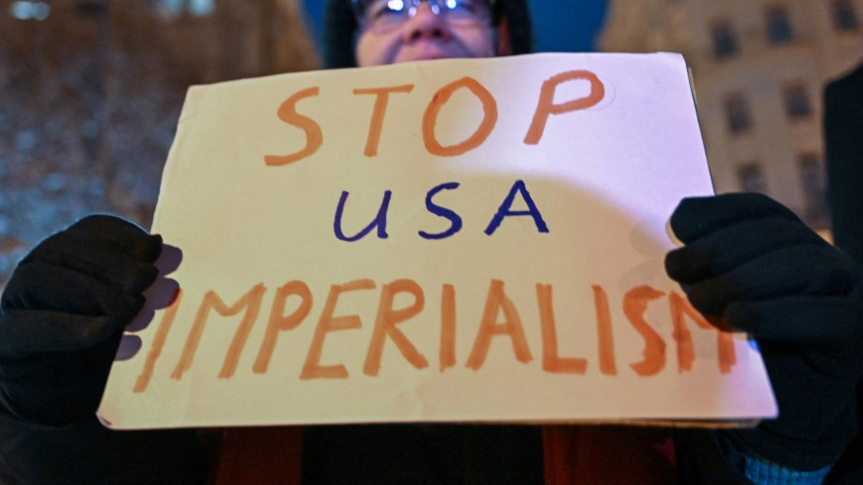
As the new year dawned, the “rules-based world order” took its last breath.
Following a long illness, its death came with the US intervention in Venezuela and the kidnapping of President Nicolas Maduro, and with the non-reaction of European countries “allied” with Washington. With few notable exceptions, they scrambled unsuccessfully to justify this blatant violation of international law.
The so-called rules-based world order was a convenient concept invented by western political circles to replace the more pressing and binding “respect for international law”. Rule is generally a weaker term than law.
The concept’s main feature is that its rules – which in any case, are very loosely defined – are binding for every country in the world except western democracies, and above all, the US.
The last decade of the 20th century, and the first two decades of the 21st, have offered plenty of evidence of these double standards.
New MEE newsletter: Jerusalem Dispatch
Sign up to get the latest insights and analysis on
Israel-Palestine, alongside Turkey Unpacked and other MEE newsletters
Their most evident application has been in how differently Russia and Israel have been treated in recent years. As to the Venezuelan case, be assured that we will not hear mainstream western politicians and media uttering the never-ending mantra distinguishing between attacker and attacked, as in the case of Ukraine.
Indeed, the 21st century has just passed its first troublesome quarter, marked by an increasing and widespread global disorder. The international system is returning to the one that characterised the 19th and early 20th centuries, where foreign policy was essentially imperial and colonial, mainly focused on the European scramble for natural resources in Africa and Asia.
Today, the US is eyeing Venezuela’s natural resources; tomorrow, it will turn to Canada’s, Mexico’s and Denmark’s, the latter by way of Greenland.
The Donroe Doctrine
The 19th and early 20th centuries marked a historical period described as the era of “gunboat diplomacy”, referencing the preferred tool to settle international disputes. At the time, each major power was mobilised in creating its own sphere of influence.
To put it another way, today’s international relations are going backwards by two centuries.
The US has even codified this new normal in international politics through its latest National Security Strategy, which reaffirms its exclusive hegemony in the western hemisphere. What was once called the Monroe Doctrine, issued in 1823 by the country’s fifth president, has now been renamed the Donroe Doctrine, a tribute to the current leader.
The 21st century is thus witnessing the most transformative moment in the international system in almost 100 years
In line with this doctrine, Venezuela was not only attacked and its president abducted, but the Trump administration now openly claims that the country’s interim authorities should follow US instructions, allowing the massive oil reserves under its soil to be exclusively controlled and managed by American companies.
Considering the official justification invoked for attacking Venezuela – drug smuggling into the US, which the Americans have defined as an existential threat – logically, the next in line should be Colombia and Mexico, from where far larger amounts of drugs are shipped into the US. Mexico is also a major source of immigration flows.
Of course, neither this US administration, nor the previous ones, have ever focused on the real existential question looming over the country: why have millions of Americans turned to drugs in the first place?
Cuba is also on the “threat” list, and the US will always find good reasons to crush this tiny country. In the medium-to-long-term, Brazil should be on the list as well – at least as long as it is ruled by President Lula da Silva or like-minded leftists and anti-imperialist forces.
Argentina, on the other hand, has been normalised, placed on a tight US financial leash with President Javier Milei’s blessing.
Nato under threat
As to the north, the situation seems even more complicated, with far more serious potential consequences. The Trump administration’s rapacious appetite extends to Canada and Greenland, the latter of which is under the sovereignty of another Nato ally, Denmark.
Canada is the major heavy oil supplier to the US, while Greenland has suddenly turned into a crucial security interest, with President Donald Trump baselessly claiming that the island is surrounded by Chinese and Russian ships. Amid similar groundless claim about Venezuelan drug smuggling, he may soon insist that the white substance covering Greenland is not snow, but cocaine.
Any US action against allies like Canada and Denmark – as absurd as such a move might sound – would spell the practical end of Nato.
And while the US feels entitled to claim its own sphere of influence in the western hemisphere, it is not keen to recognise the same right for other great powers, such as China in East Asia or Russia in Eastern Europe. Once again, this is double standards on steroids.
The coming weeks and months should hopefully clarify whether Russia will see its own sphere of influence in Eastern Europe recognised – that is, in Ukraine, through negotiations that Washington is carrying out with Moscow and Kyiv, while other European states sit on the sidelines.
Whether China will get something similar, as far as Taiwan is concerned, remains uncertain. For the time being, the Trump administration has lowered its anti-China rhetoric, even conceding in its National Security Strategy that Beijing holds an almost-peer status in economic terms.
Alarm bells ringing
Smaller, but not less significant, spheres of influence are emerging in other regions. Israel is the most compelling case, as it uses force against Syria and Lebanon, and leverages ties in the Gulf and Red Sea under the guise of expanding the Abraham Accords. Tel Aviv has also found itself in a growing marriage of convenience with the UAE, while extending its outreach to Azerbaijan, mainly to keep Iran under close watch.
Turkey could soon become Israel’s main competitor, through close coordination with Qatar and the latter’s financial support. Ankara is already quite active in Libya, Syria and Iraq, and it is not concealing its ambitions to play a role in Gaza and Lebanon, the latter of which would be logical, considering its strong influence in Syria.
All of this might set off alarm bells in the Saudi royal court – which has recently flexed its muscles by taking decisive action in Yemen against Gulf rival the United Arab Emirates. Riyadh has also made public its increasing coordination with the third western Asian nuclear power, besides India and Israel: Pakistan.

Venezuela extends the lesson of Gaza into the western hemisphere
Read More »
As for Iran, which is once again facing internal turmoil, it will be lucky if it can maintain some residual pillars of its once fearsome “axis of resistance”, spanning Iraq, Yemen and a degraded Hezbollah; Syria, for now, is lost.
And once again, the Europeans will be marginalised in this new global Great Game centred on natural resources. France is continually losing influence in Africa, while the post-Brexit “Global Britain”, so far, has been a total failure.
The 21st century is thus witnessing the most transformative moment in the international system in almost 100 years. We are entering uncharted waters, where the concept of spheres of influence, a relic of the Cold War, is being refreshed.
A new global scramble for natural resources is unfolding under the guise of new or reasserted spheres of influence. Unfortunately, this is not the ideal setting for a stable international system; rather, it risks igniting fresh tensions and bringing widespread global disorder.
If this is the new normal, a modern global Yalta Conference may soon become highly urgent. The real challenge for the main actors will be who sits at the table, and who is on the menu.
Considering the old continent’s current leaderships, there are unfortunately few doubts that Europe will be on the table, and not sitting around it.
The views expressed in this article belong to the author and do not necessarily reflect the editorial policy of Middle East Eye.
