

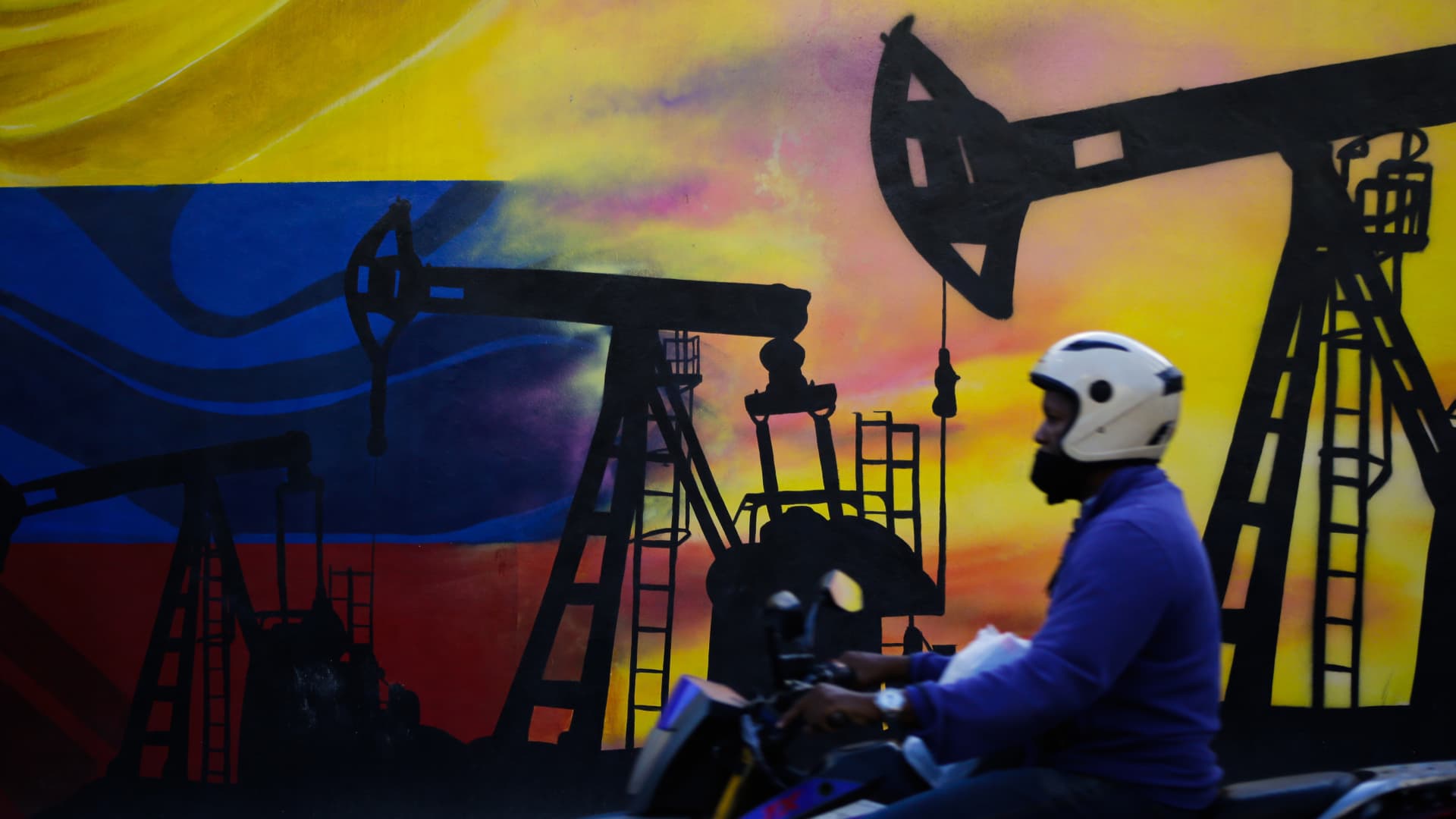
A motorcycle passes in front of an oil-themed mural in Caracas, Venezuela on May 9, 2022.
Nurphoto | Nurphoto | Getty Images
Crude oil prices edged lower Sunday, as the overthrow of President Nicolas Maduro by the Trump administration has cast deep uncertainty over oil-rich Venezuela.
U.S. crude oil fell 31 cents, or 0.54%, to $57.01 per barrel. Global benchmark Brent fell 22 cents, or 0.36%, to $60.53 per barrel.
President Donald Trump made it clear Saturday that U.S. investment in Venezuela’s oil sector is a key objective of the regime change operation that ousted Maduro.
“We’re going to have our very large United States oil companies — the biggest anywhere in the world — go in, spend billions of dollars, fix the badly broken infrastructure, the oil infrastructure,” Trump said in a press conference from his Mar-a-Lago residence in Palm Beach, Florida.
The president said Saturday that the U.S. embargo of Venezuelan oil remains in place.
Venezuela, a founding member of OPEC, sits on the largest proven crude oil reserves in the world at 303 billion barrels or about 17% of the global total, according to the U.S. Energy Information Administration.
Caracas produced about 3.5 million barrels per day at its peak in the late 1990s, but output has declined significantly since then, according to energy consulting firm Kpler. The South American nation is currently producing about 800,000 bpd, Kpler data shows.
Chevron is the only U.S. oil major operating in Venezuela. It was exporting about 140,000 bpd at the end of the fourth quarter of 2025, according to Kpler.
The impact of Maduro’s overthrow on oil prices is ambiguous in the short run, said Daan Struyven, head of oil research at Goldman Sachs. Production could edge higher if a U.S.-supported government is installed and the Trump administration lifts sanctions against Venezuela, Struveyn told clients in a Sunday note.
But Maduro’s ouster could also lead to supply disruptions in the short term, the analyst said. Long term, U.S. investment that boosts Venezuelan production would put downward pressure on oil prices, Struvyven said. A recovery of production, however, will likely be gradual and partial, he said.
Oil executives operating in Venezuela say it will cost $10 billion annually to turn production around and a stable security environment is essential to grow production back to historic levels, said Helima Croft, head of global commodity strategy at RBC Capital Markets.
Full sanctions relief could bring several hundred thousand barrels of production back over a 12-month period if there is an orderly transition of power, Croft told clients in a Saturday note.
“However, all bets are off in a chaotic change of power scenario like what occurred in Libya or Iraq,” she said.
