

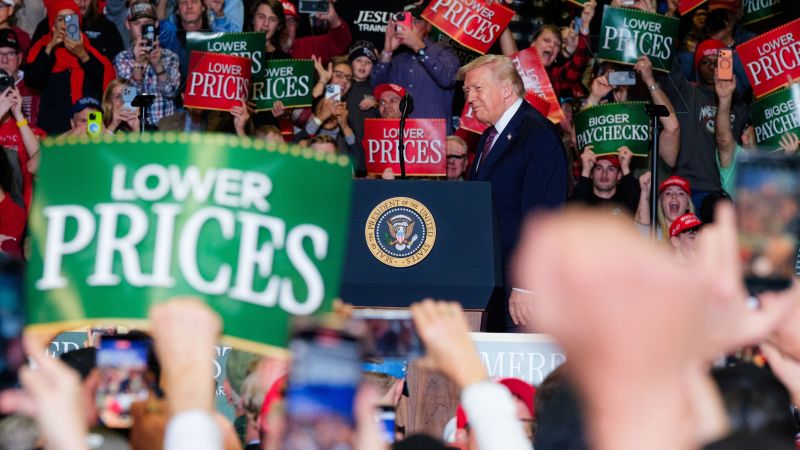
President Donald Trump says he expects to nominate a new Federal Reserve chair this month. When that happens, Trump will have run out of excuses: This will officially become his economy, for better or worse.
Throughout the first year of his second term, Trump has mostly blamed America’s affordability problems on two men: Former President Joe Biden and Fed Chair Jerome Powell, whom he accuses of mismanaging the economy and allowing prices to rise out of control.
But those excuses are already falling flat.
Excuse No. 1) Biden. Trump continues to disparage Biden for high inflation, but Biden hasn’t been in office for 12 months, and polls show Americans are no longer giving Trump the benefit of the doubt.
For example, in CNN’s most recent poll on the economy, 61% of Americans said Trump’s policies have “worsened economic conditions in this country.” That’s a higher percentage than those who blamed Biden for the direction the economy had taken.
Excuse No. 2) Powell. Trump started criticizing his 2017 pick for Fed chair almost immediately after taking office again, slamming Powell for keeping interest rates higher than Trump wants.
Powell has acknowledged the Fed responded too late to rising inflation in 2021 and 2022, earning him the “too late” nickname Trump uses to blast Powell on social media. But Trump says Powell is once again too late, arguing that reduced interest rates would help bring down mortgage rates and unlock the frozen housing market.
Even though Powell was Trump’s own choice to lead the Fed, Trump has said his nomination was a mistake and that the next Fed chair will lower rates quickly.
When that chair is appointed, likely in May when Powell’s term as chair expires, Trump will have claimed the economy for himself. That could be a politically precarious proposition for the president.
Among the many dangers of Trump’s economic blame game is that the president has almost certainly overpromised on what the new Fed chair will be able to accomplish.
Although the Fed chair wields outsize influence over the voting members of the rate-setting Federal Open Market Committee, ultimately they are just one of 12 votes and cannot unilaterally set interest rates. Trump has a number of Fed appointments to make this year, and installing like-minded voters could help to usher in an era of lower rates – but it’s by no means guaranteed.

Even if the next Fed chair gets rates down significantly in 2026, it’s not clear that would dramatically improve America’s affordability problems. It might actually make them worse.
Lower interest rates can reduce businesses’ borrowing costs, unlocking capital for hiring and other expenses. Over time, that can help boost the job market, but it can also lift prices. More jobs can mean bigger paychecks, which can lead to more consumer demand.
Changes in interest rates can take many months to work their way through the economy, and the Fed already lowered rates in three straight meetings to close out 2025. Lowering rates further risks a longer-term reignition of inflation.
Lower interest rates could, however, help bring mortgage rates down. The two aren’t directly linked – home loan rates are more closely tied to long-term US Treasury yields. But those tend to move in tandem over time with the Fed’s short-term rate changes.
High rates have hurt the housing market, for sure, and reduced mortgage costs could crack open the market for some first-time buyers. A dip of even a single percentage point could shave hundreds of dollars off the monthly cost of owning a home – and hundreds of thousands of dollars off long-term interest payments.
But lower mortgage rates would not solve high housing prices, driven in large part by a massive supply shortage. America needs to build 4 million more homes to keep pace with population growth, according to Goldman Sachs. That has contributed to entrenched affordability problems in major metropolitan areas – especially New York and San Francisco.
It’s also possible lower mortgage rates would, instead, exacerbate America’s growing wealth divide, enabling current homeowners to refinance their mortgages and unlock their home equity – while doing little to add much-needed supply to the market.
Ultimately, the president really can’t do much to control the direction of the US economy – a $30 trillion behemoth that federal legislation and executive orders just don’t have all that much sway over.
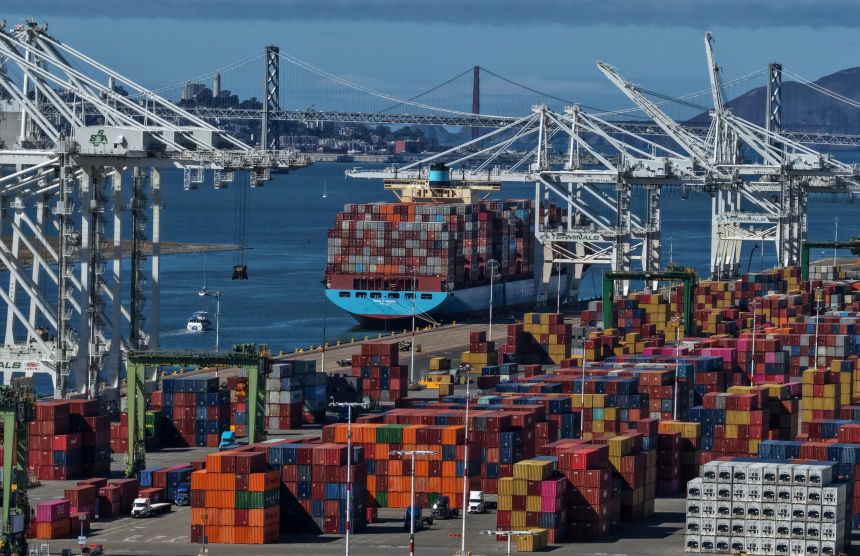
Trump has already enacted policies that affect Americans’ affordability – for better and worse. For example, tariffs have raised the average American household’s expenses by $1,100 in 2025, according to the conservative-leaning Tax Foundation. Trump’s spending and tax bill will give millions of Americans a larger tax return in 2026, but it also is expected to remove millions of Americans from Medicaid coverage. He has also gotten many drug companies to lower prices for Medicare patients and pitched $2,000 tariff rebate checks to be delivered ahead of this year’s midterms.
Those policies, though significant for many Americans’ wallets, will do little to solve the big, underlying problems that this economy faces. Hiring has stagnated, unemployment is on the rise, wage growth is falling, inflation remains stubbornly high, and lower-income Americans are living paycheck to paycheck.
That’s why Trump’s economic message – that the economy is booming and deserves an “A+++++” grade – has fallen so flat with Americans, many of whom are struggling to make ends meet or who feel like the American Dream has never been further out of reach.
Trump’s blame game, already falling on deaf ears, is about to be out of convenient targets.
That means Trump will own this economy, politically at least, at perhaps the worst possible time – when the job market and affordability appear to be on a sinking ship. The midterms are coming up and Americans are once again voting with their wallets.
