

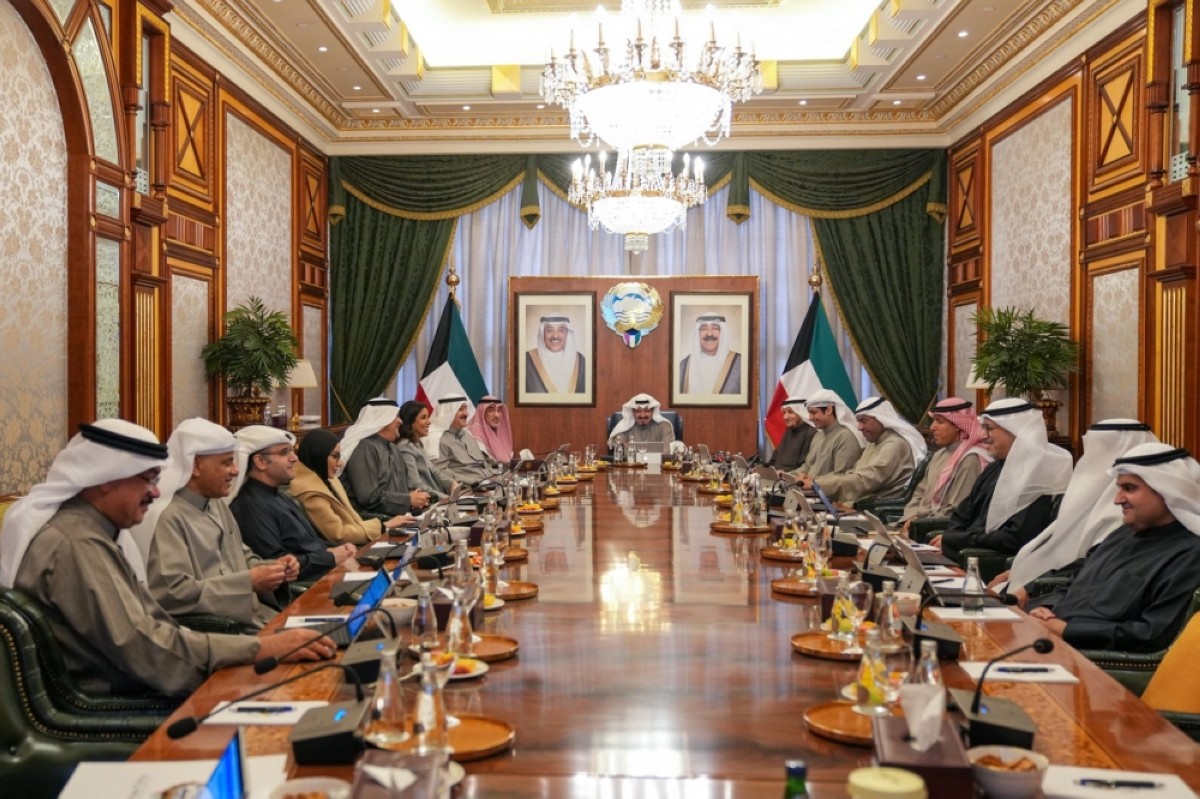
Cabinet reviews addiction rehabilitation project, accessibility code
KUWAIT: The Council of Ministers, during its weekly meeting held on Tuesday at Bayan Palace and chaired by HH the Prime Minister Sheikh Ahmad Al-Abdullah Al-Ahmad Al-Sabah, approved a draft decree-law on Kuwait’s accession to the Second Protocol to the 1954 Hague Convention for the Protection of Cultural Property in the Event of Armed Conflict.
Following the meeting, Deputy Prime Minister and Minister of State for Cabinet Affairs Shareeda Al-Maousherji said the Cabinet reviewed the minutes of the ministerial committee for legal affairs, which included the draft decree-law approving accession to the protocol. The decree-law comes in implementation of Kuwait’s policy to strengthen the application of international humanitarian law, harmonize national legislation with international obligations, integrate protection rules at the domestic level and enhance institutional frameworks supporting prevention and legal accountability.
Accession to the protocol is of particular importance, as it provides an advanced legal framework for the protection of cultural property during armed conflicts, establishes enhanced protection for designated cultural assets, restricts the targeting of cultural and religious sites and affirms cultural heritage as a shared legacy of humanity. The Cabinet approved the draft decree-law and decided to submit it to HH the Amir.
In a related statement to KUNA, Minister of Justice Nasser Al-Sumait said Kuwait’s accession to the Second Protocol strengthens the protection of historic, cultural and religious heritage in the event of armed conflict. Al-Sumait, who also serves as Chairperson of the Permanent National Committee for International Humanitarian Law, said the move affirms Kuwait’s commitment to the humanitarian value of heritage as a common human legacy and aligns with state policy supporting international humanitarian law.
He expressed appreciation to the government for the decision and praised cooperation with Minister of Information and Culture and Minister of State for Youth Affairs and Chairperson of the National Council for Culture, Arts and Letters Abdulrahman Al-Mutairi, Minister of Foreign Affairs Abdullah Al-Yahya and the Permanent National Committee.
At the outset of the session, the Cabinet reviewed messages received from the Amiri Diwan addressed to HH the Amir Sheikh Meshal Al-Ahmad Al-Jaber Al-Sabah. The messages were sent by leaders of several countries and addressed ways to enhance bilateral relations and expand cooperation across political, economic and developmental fields.
The Cabinet also reviewed a visual presentation by Minister of Health Dr Ahmad Al-Awadhi on the addiction rehabilitation center project in Sulaibiya, implemented pursuant to law no. 59 of 2025 on combating narcotics and psychotropic substances and regulating their use and trafficking. Dr Al-Awadhi explained that the project will serve as an integrated addiction treatment center providing comprehensive medical and rehabilitation services in accordance with the highest professional standards. It targets individuals subject to judicial rulings and addiction-related complaints, enabling completion of treatment without compromising the prescribed duration. He noted that the project represents a pioneering national model reflecting integration between government efforts and community support, highlighting the role of the ministries of health and interior, in cooperation with Zakat House, in treating and rehabilitating addiction patients.
In another development, the Cabinet listened to an explanation by Minister of Social Affairs, Family and Childhood Affairs and Chairperson of the Public Authority for Disability Affairs Dr Amthal Al-Huwailah regarding ministerial decision no. 696 of 2024. She said the decision amends provisions of ministerial decision no. 206 of 2009 regulating construction works and provides for the issuance of the Kuwait accessibility code for persons with disabilities based on universal design principles.
She explained that the code applies to all buildings and facilities according to their designated use and functional nature, and includes updated construction, design and implementation requirements to meet public safety, sustainability and comprehensive accessibility standards. Dr Al-Huwailah stressed that the decision enhances social inclusion for persons with disabilities and aligns with international conventions, foremost the Convention on the Rights of Persons with Disabilities, as well as Kuwait’s orientation toward sustainable urban development and inclusive quality of life.
The Cabinet instructed all ministries, government agencies, public authorities and institutions to fully comply with applying the building code and the Kuwait accessibility code for persons with disabilities as mandatory references for all current and future state projects. It also directed entities to circulate the decision and upload all related codes and requirements on their official websites to ensure full implementation.
The Cabinet further approved the minutes of the Supreme Committee for the Investigation of Kuwaiti Nationality, which included cases of loss and withdrawal of Kuwaiti nationality in accordance with decree-law no. 15 of 1959 and its amendments. Finally, the Council of Ministers reviewed additional agenda items, approving some and referring others to the relevant ministerial committees for further study and completion of the required procedures. — KUNA
