

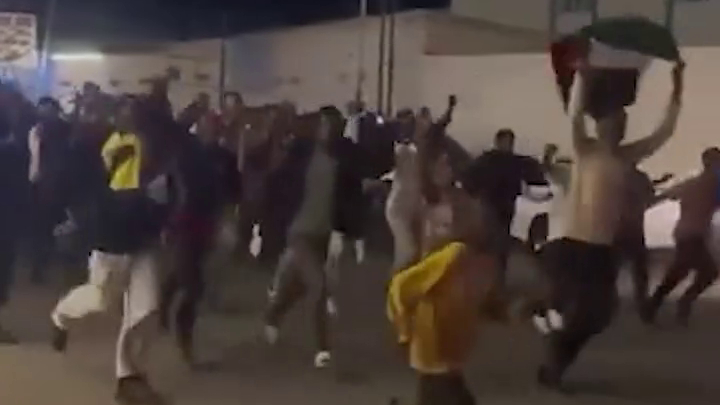
Protests erupted in the breakaway Somali region of Somaliland on Sunday following Israel’s announcement that it would formally recognise the territory as an independent state.
Videos posted on social media showed protesters taking to the streets of Boroma, a town about 50km west of Somaliland’s regional capital Hargeisa, where they chanted slogans against Israel and waved Palestinian flags.
“Free, Free Palestine,” the large group of protesters could be heard chanting as onlookers cheered them on.
“We don’t want separatists,” others chanted.
Israel on Friday became the first country to formally recognise the self-declared republic as sovereign state, with Israeli Prime Minister Benjamin Netanyahu saying Israel would seek immediate cooperation with Somaliland in the fields of agriculture, health, technology and the economy.
New MEE newsletter: Jerusalem Dispatch
Sign up to get the latest insights and analysis on
Israel-Palestine, alongside Turkey Unpacked and other MEE newsletters
It was not immediately clear why Israel made the declaration or whether it was expecting something in return.
Earlier this year, news reports had said that Israel and the US had approached Somaliland, among others, about accepting Palestinians from Gaza as part of US President Donald Trump’s plan at the time to forcibly resettle the territory’s population.
Neither Somaliland nor Israel addressed the idea in their respective statements on Friday.
Somaliland President Abdirahman Mohamed Abdullahi, also known as Abdirahman Cirro, welcomed Israel’s recognition as a “historic moment” and said the move “marks the beginning of a strategic partnership that advances mutual interests, strengthens regional peace and security, and delivers shared benefits to all stakeholders”.
Somaliland declared independence from Somalia in 1991 following the collapse of the central government and has pushed for international recognition for decades.
It has never been recognised by the United Nations or any UN member state but Abdullahi has begun making recognition a top priority since taking office last year.
Somalia operates a federal system granting significant autonomy to its states. Two other key states, Puntland and Jubaland, have withdrawn from the system amid constitutional and electoral disputes.
In a post on X, Puntland’s interior minister said patience pays off, suggesting that he viewed the development favourably.
“Puntland needs to calculate strategically,” Juha Farah said.
Dangerous precedent
Somalia reacted angrily to Friday’s announcement and rejected Israel’s recognition as a violation of international law.
Somali President Hassan Sheikh Mohamud reaffirmed that the northern region remained an integral part of Somalia’s sovereign territory and urged the international community to reject what he said was a dangerous precedent.
Demonstration also erupted in the Somali capital Mogadishu with large crowds expressing support for national unity and condemning the recognition.
Within hours of Friday’s announcement, the armed Somalia-based group al-Shabab vowed to fight any Israeli presence or interests in Somaliland, framing the recognition as further justification for attacks.
While al-Shabab has limited influence inside Somaliland, analysts have warned the group could use the issue to mobilise support elsewhere.
Meanwhile, in Hargeisa, prominent Islamic scholars have been publicly silent on the issue, a stance that many observers described as deeply concerning.
Adding to the tensions, Yemen’s Houthi movement said it would consider Somaliland a legitimate target if Israel established a presence there.
The Houthis, who have already attacked Israeli-linked shipping in the Red Sea, said Israel’s move threatened regional security and maritime routes.
Several countries, including Saudi Arabia, Turkey and Pakistan, said Israel’s decision undermined international norms and risked destabilising the Horn of Africa.
The foreign ministry of Egypt, a major mediator in Israel’s genocidal war on Gaza, said on social media that it rejected Israel’s recognition of Somaliland and stressed full support for Somalia’s sovereignty, unity and territorial integrity.
Meanwhile, the East African governing body IGAD said that Somalia’s sovereignty was recognised under international law.
“Any unilateral recognition runs contrary to the charter of the United Nations, the constitutive act of the African Union, and the agreement establishing IGAD,” it said in a statement.
