

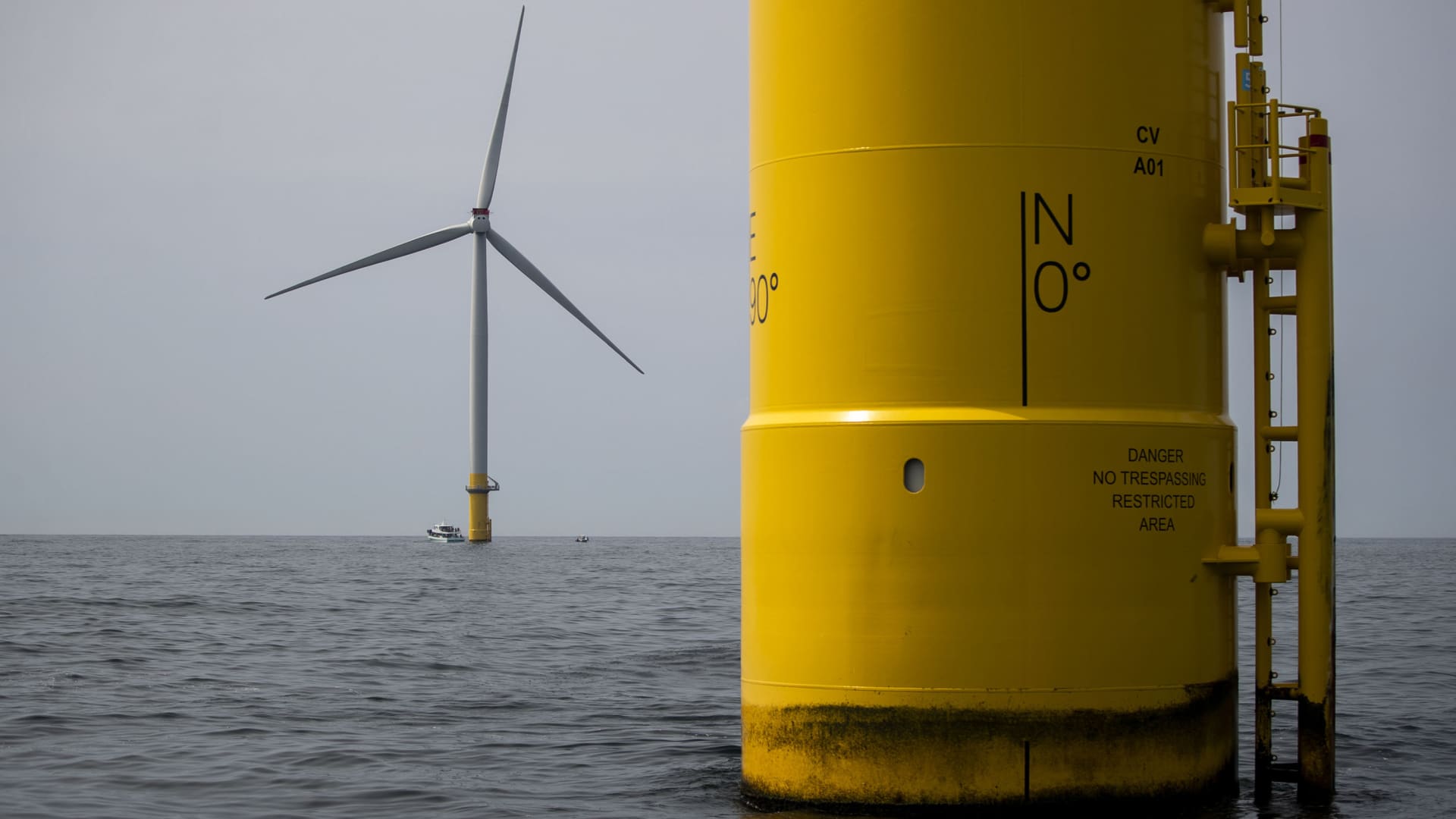
Dominion Energy’s wind turbines located 27 miles off of Virginia Beach in the Atlantic Ocean on July 17, 2023.
Kendall Warner | Virginian Pilot | Getty Images
The Trump administration on Monday halted Coastal Virginia Offshore Wind, the largest project of its kind in the U.S., as well as four other projects under construction off the East Coast in a devastating blow to the wind industry.
Shares of Dominion Energy, the utility developing the project, dropped more than 5% on the news.
The administration also paused leases for Vineyard Wind 1 off Massachusetts, Revolution Wind off Rhode Island, Sunrise Wind off Long Island and New England, and Empire Wind 1 south of Long Island.
Interior Secretary Doug Burgum said the administration paused leases for the projects due to national security concerns identified by the Pentagon.
Shares of Denmark’s Orsted, the developer of the Revolution and Sunrise projects, tumbled 11%. Norway’s Equinor, the developer of Empire Wind 1, was down less than 1%.
Coastal Virginia Offshore Wind is a 176 turbine project project that would provide enough power for more than 600,000 homes, according to Dominion. The project was expected to be complete next year.
Dominion said the massive project is essential for U.S. national security and Virginia’s dramatically growing energy needs. Northern Virginia is the largest hub for data centers in the world. Growing demand from artificial intelligence is contributing to higher electricity prices in the state.
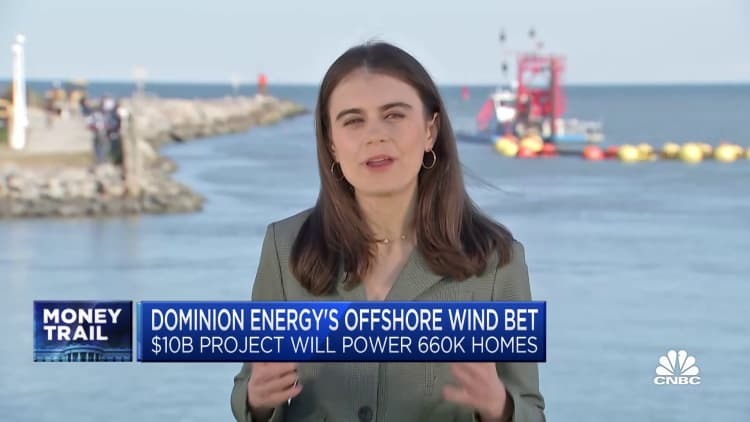
“Stopping CVOW for any length of time will threaten grid reliability for some of the nation’s most important war fighting, AI, and civilian assets,” Dominion said in a statement.
“It will also lead to energy inflation and threaten thousands of jobs,” the utility said.
Virginia Gov. Glenn Youngkin, a Republican, supports the project. Incoming Gov. Abigail Spanberger, a Democrat, won the gubernatorial election in November on a promise to address rising electricity costs in part by expanding renewable energy.
The Interior Department said in a statement that the pause will give the federal government time to “work with leaseholders and state partners to assess the possibility of mitigating the national security risks posed by these projects.”
Interior said the U.S. government found that turbine blades and “highly reflective towers” create radar interference risk.
“The clutter caused by offshore wind projects obscures legitimate moving targets and generates false targets in the vicinity of the wind projects,” Interior said.

President Donald Trump has targeted the U.S. wind industry since his first day in office. Trump on Jan. 20 ordered a halt to all new leases and permits for onshore and offshore wind pending federal review.
Sen. Chuck Schumer, D-N.Y., condemned Trump’s campaign against wind projects as “irrational.” The senate minority leader said Interior’s decision would spike energy bills.
“Trump’s obsession with killing offshore wind projects is unhinged, irrational, and unjustified,” Schumer said in a statement Monday. “At a time of soaring energy costs, this latest decision from DOI is a backwards step that will drive energy bills even higher.”
Trump’s campaign against the wind industry has run afoul of the courts. Judge Patti Saris of the U.S. District Court for the District of Massachusetts ruled on Dec. 8 that Trump’s order was “arbitrary and capricious and contrary to law.”
